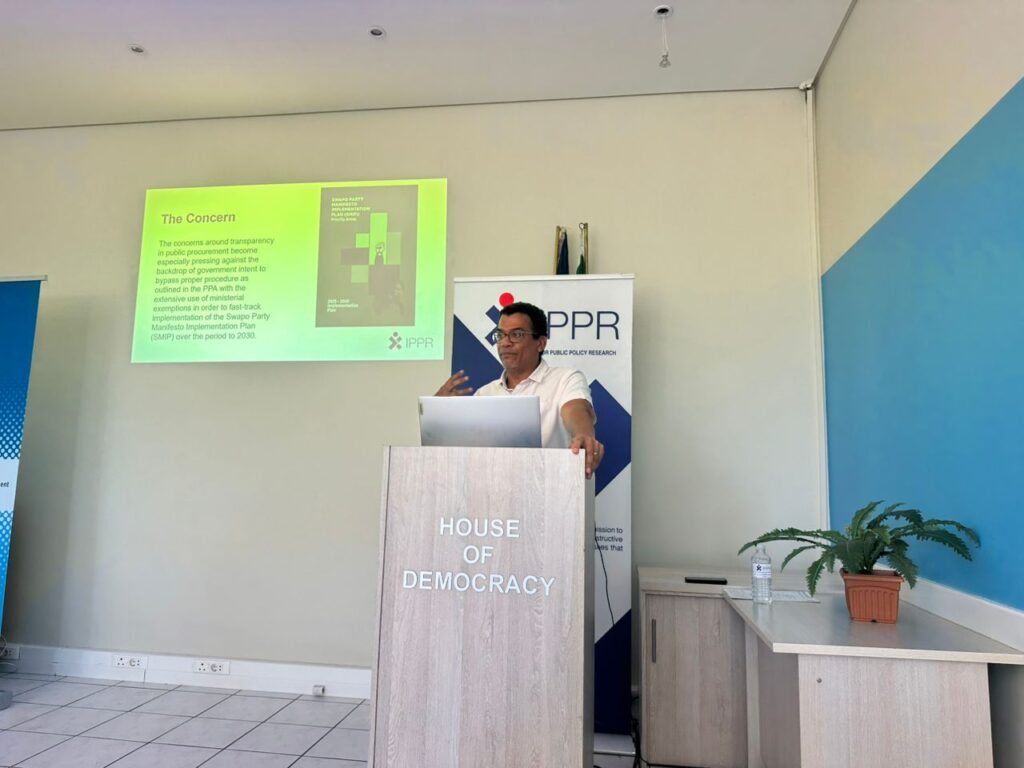
Only about 30% of public entities submitted their annual procurement plans on time for the 2026/27 financial year, according to the latest Procurement Tracker data compiled by the Institute for Public Policy Research (IPPR).
According to IPPR Associate Researcher Frederico Links, by 10 June 2026, only 53 of the 176 public entities required to submit procurement plans had made them available on the e-Procurement Portal.
Even more concerning, he said, only eight plans, representing about 5% of the total, were submitted within the legally required deadline of 31 December 2025, as stipulated under Section 25(4)(a) of the Public Procurement Amendment Act of 2022.
The law requires public entities to submit procurement plans at least three months before the start of the financial year. However, data shows compliance with this requirement remains consistently weak, even a decade after the Public Procurement Act framework came into force during the 2017/18 financial year.
“As such, all procurement plans should have been accessible by 1 April 2026. However, compliance remains low, with only a 30% submission rate recorded at this stage. Nearly three months into the financial year, after the close of the first quarter, the majority of entities had still not complied with the requirement,” he said.
Links said the persistent failure reflects a broader and long-running breakdown in procurement governance across the public sector. Similar concerns have repeatedly surfaced in high-risk sectors, particularly healthcare, where procurement irregularities, delays and corruption allegations have been reported for years.
He further argued that the recurring nature of procurement scandals points to a cycle of investigation without resolution. Reports produced by the Procurement Policy Unit (PPU) in previous years identified potential irregularities and recommended further investigations, but enforcement action has remained limited.
His latest analysis contends that fragmented investigations risk becoming a distraction if they focus broadly on institutions rather than targeting specific decision-makers and accountability structures.
Calls are growing for deeper and more focused investigations into procurement practices within key ministries, alongside stronger transparency and enforcement mechanisms. Although the current procurement framework contains transparency provisions, compliance remains inconsistent.
“The PPU’s report, which was available on its website and which we have archived, clearly pointed out evidence of alleged corruption. It explicitly stated that these matters should be investigated and identified the specific individuals who should be held accountable. Yet nothing happened. The Ministry of Finance’s own unit conducted an investigation and produced findings, but the report simply sat there. None of this is new, nothing is being fixed, and no one is being held accountable,” he said.
Links also called on government to strengthen oversight institutions and accelerate reforms proposed in the Public Procurement Amendment Bill of 2025, which includes the establishment of a more robust procurement regulatory authority with enforcement powers.
At present, the Procurement Policy Unit functions primarily as an advisory body without law enforcement authority, limiting its ability to ensure compliance.
“We need full transparency around public procurement. We are not asking for anything radical; we are simply asking for compliance with the law. The current procurement framework already contains built-in transparency mechanisms that are being ignored,” Links said.
Beyond enforcement, he said there is a need for the full implementation of existing laws, including access-to-information and beneficial ownership disclosure frameworks, many of which remain only partially operational despite having been enacted.
There are also renewed calls to fast-track the rollout of e-procurement systems, particularly in high-risk sectors such as healthcare, where procurement failures have direct consequences for public service delivery.
“We need to begin implementing e-procurement, and the health sector makes the strongest case for a pilot programme. Procurement failures in the Ministry of Health directly affect the most vulnerable citizens of this country, the majority of whom rely entirely on the state healthcare system,” he said.