Sunday, November 15, 2026
Subscribe
The Brief | Namibia's Leading Business & Financial News
  • Home
  • Companies
    • Finance
    • Agriculture
    • Technology
    • Property
    • Trade
    • Tourism
  • Business & Economy
  • E-PAPERreader
  • Mining & Energy
  • Opinions
    • Analysis
    • Columnists
  • Africa
No Result
View All Result
The Brief | Namibia's Leading Business & Financial News
Subscribe
No Result
View All Result
Home Latest

Only 84 of 260 public entities submit procurement plans on time

by reporter
October 5, 2026
in Latest
8
A A

Only 84 of Namibia’s approximately 260 public procuring entities had submitted annual procurement plans for the 2026/27 financial year by the end of September, translating to a compliance rate of about 32%, according to the Institute for Public Policy Research (IPPR).

The IPPR’s Procurement Tracker, presented by Research Associate Frederico Links, shows that compliance with statutory submission deadlines was even lower, with only eight entities submitting their procurement plans before the end of December 2025 deadline.

This means fewer than 5% of all procuring entities submitted their plans on time, despite the requirement under Section 25(4)(a) of the Public Procurement Amendment Act of 2022 that procurement plans be submitted at least three months before the start of the financial year.

“By end-September 2026, halfway through the 2026/2027 government financial year, only 84 annual procurement plans for 2026/2027 were viewable via the e-Procurement Portal of the Procurement Policy Unit (PPU),” Links said.

“Of the 84 procurement plans viewable via the e-Procurement Portal only eight were submitted to the PPU before the end of December 2025, which would mean that less than 5% of all plans were submitted on time.”

The findings come as the number of listed public procuring entities has increased from about 176 in recent years to approximately 260, widening the number of state institutions subject to procurement requirements.

Links also raised concerns about accountability under recently amended public procurement regulations, which significantly increased the value of contracts that public entities can handle before the Central Procurement Board of Namibia (CPBN) becomes involved.

Under the new thresholds, Category 1 entities can procure goods valued at up to N$45 million and works worth up to N$60 million before CPBN involvement. The previous thresholds were N$25 million for goods and N$35 million for works.

The changes were gazetted by the Ministry of Finance on 4 August 2026 and also introduced the categorisation and re-categorisation of public entities, including a new category of high-value public entities.

The IPPR warned that greater procurement autonomy could increase integrity and accountability risks where public entities have weak internal controls, limited procurement capacity and inadequate oversight.

The Procurement Tracker also questioned provisions allowing the Procurement Policy Unit to conduct compliance and contract audits, arguing that the regulations give the unit discretion rather than making such audits mandatory.

“Some commentators have pointed to the fact that the new regulations provision that the ‘Policy Unit may conduct compliance and contract audits’ as evidence for ‘strong checks’. However, it should be noted that may audit is not the same as must audit,” Links said.

He said the provision gives the PPU discretion without requiring it to justify a decision not to conduct an audit.

“Importantly this power to audit only applies when ‘High Value Public Entities’, of which there are seven, engage in a procurement matter that exceeds a Category 1 threshold,” he said.

The findings highlight persistent compliance gaps in public procurement planning at a time when government entities are being given greater authority to manage higher-value procurement contracts without direct CPBN involvement.

author avatar
reporter
See Full Bio
Previous Post

Capricorn Foundation supports skills development for 2,400 youths

Next Post

High Court overturns minister’s approval of Ohorongo cement merger

Must Read

A man in a dark suit and red tie wearing glasses speaks into a handheld microphone, gesturing with his left hand during a panel discussion.
Latest

Gawaxab identifies power costs, regulatory uncertainty as barriers to Namibia’s mineral beneficiation

November 13, 2026
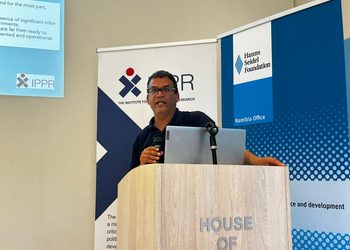
Man in glasses speaks at a wooden podium with a laptop and handheld mic, flanked by banners for IPPR and Hanns Seidel Foundation Namibia Office
Latest

Namibia only partially ready to govern oil and gas industry, IPPR finds

November 13, 2026
Portrait of a chef in a white uniform and glasses, standing with arms crossed in a bright kitchen environment.
Latest

Curt Burns: Championing Culinary Excellence and Developing Namibia’s Next Generation of Chefs

November 13, 2026
Tall modern hotel building illuminated in purple at night, AVANI signage visible on the facade.
Latest

Our People, Our Purpose: Developing Talent at Avani Windhoek Hotel & Casino

November 13, 2026
African man in a gray plaid suit and red tie speaks at a podium with dual microphones in front of a blue backdrop.
Latest

Amutse appoints new NIDA, NEAB boards

November 12, 2026
BIPA to deregister 1,000 companies every month
Latest

New BIPA and NaCC boards appointed

November 12, 2026
Load More

Related News

Smiling Black woman wearing a navy blazer and white blouse, in a bright indoor setting with greenery outside the window.

Beyond the 97% Gap and how Namibia’s institutional banking models are de risking the vision of the female entrepreneur

April 16, 2026
Windhoek approves 186 building plans worth N$486.5m in October

Windhoek approves building plans worth N$2.29 billion in 2025

January 15, 2026
Windhoek faces 3,000-stall shortage for small businesses

Windhoek faces 3,000-stall shortage for small businesses

March 13, 2025

Browse by Category

  • Africa
  • Agriculture
  • Analysis
  • Business & Economy
  • Columnists
  • Companies
  • e-edition
  • Finance
  • Finance
  • Fisheries
  • Green Hydrogen
  • Health
  • Investing
  • Latest
  • Market
  • Mining & Energy
  • namibia
  • Namibia
  • News
  • Opinions
  • Property
  • Retail
  • Technology
  • Tourism
  • Trade
The Brief | Namibia's Leading Business & Financial News

The Brief is Namibia's leading daily business, finance and economic news publication.

CATEGORIES

  • Business & Economy
  • Companies
    • Agriculture
    • Finance
    • Fisheries
    • Health
    • Property
    • Retail
    • Technology
    • Tourism
    • Trade
  • e-edition
  • Finance
  • Green Hydrogen
  • Investing
  • Latest
  • Market
  • Mining & Energy
  • namibia
  • News
    • Africa
    • Namibia
  • Opinions
    • Analysis
    • Columnists

CONTACT US

Cell: +264814612969

Email: newsdesk@thebrief.com.na

© 2026 The Brief | All Rights Reserved. Namibian Business News, Current Affairs, Analysis and Commentary

Welcome Back!

Login to your account below

Forgotten Password?

Retrieve your password

Please enter your username or email address to reset your password.

Log In
No Result
View All Result
  • Home
  • Companies
  • Mining & Energy
  • Business & Economy
  • Opinions
    • Analysis
    • Columnists
  • Africa

© 2026 The Brief | All Rights Reserved. Namibian Business News, Current Affairs, Analysis and Commentary

This website uses cookies. By continuing to use this website you are giving consent to cookies being used. Visit our Privacy and Cookie Policy.