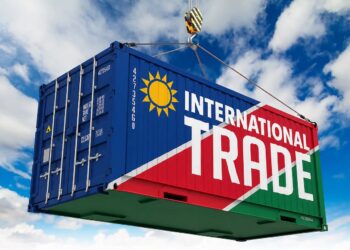
Namibia imported goods worth N$138.8 billion during the first nine months of 2026, an increase of N$29.6 billion or 27.1% from the N$109.2 billion recorded during the corresponding period in 2025, according to the Namibia Statistics Agency (NSA).
The latest International Merchandise Trade Statistics Bulletin shows that cumulative export earnings reached N$103.5 billion over the same period, up N$11.7 billion year-on-year, leaving the country with a cumulative trade deficit of N$35.3 billion.
The figures indicate that Namibia’s import bill grew faster than export earnings during the nine-month period, widening the gap between the value of goods purchased from international markets and those sold abroad.
“By September 2026, Namibia’s cumulative export earnings had reached N$103.5 billion, which was N$11.7 billion higher than the value recorded during the same period of the previous year. On the import side, the cumulative value for the month under review amounted to N$138.8 billion, which is an increase from N$109.2 billion recorded over the same period in 2025,” the NSA said.
In September alone, Namibia imported goods worth N$16.9 billion, representing an increase of 2.1% from August and 55.5% compared with September 2025.
Export earnings, however, declined by 3.4% month-on-month to N$12.2 billion, resulting in a monthly trade deficit of N$4.7 billion.
This marked a deterioration from the N$3.9 billion deficit recorded in August 2026 and the N$3.5 billion deficit registered in September 2025.
“In September 2026, Namibia’s trade balance, measured as the difference between exports and imports, recorded a deficit of N$4.7 billion, a deterioration from the N$3.9 billion deficit and the N$3.5 billion deficit registered in August 2026 and September 2025, respectively,” the report states.
The NSA attributed the monthly increase in imports to higher purchases of several commodities, including sulphur and unroasted iron pyrites, which increased by N$734 million, ships and boats by N$470 million, and fertilisers by N$148 million.
Petroleum oils remained Namibia’s largest imported commodity in September, accounting for N$2.2 billion or 12.8% of the country’s total import bill.
Sulphur and unroasted iron pyrites followed at N$1.6 billion, while nickel ores and concentrates accounted for N$747 million.
Manufactured products dominated Namibia’s imports, with purchases valued at N$13.1 billion during September, representing an increase of 13.6% compared with August.
South Africa remained Namibia’s largest source of imports, accounting for 30.7% of the country’s total import bill.
China was the second-largest source at 12.2%, followed by Canada at 6.5%, the United States at 5.9% and Zambia at 4.7%.
“Analysis of Namibia’s major trading partners shows that China emerged as the country’s largest export destination, while South Africa continued to be the leading source of imports,” the NSA said.
The figures show that Namibia’s merchandise trade deficit continued to widen in September, with the increase in import expenditure outpacing growth in export earnings during the first nine months of 2026.