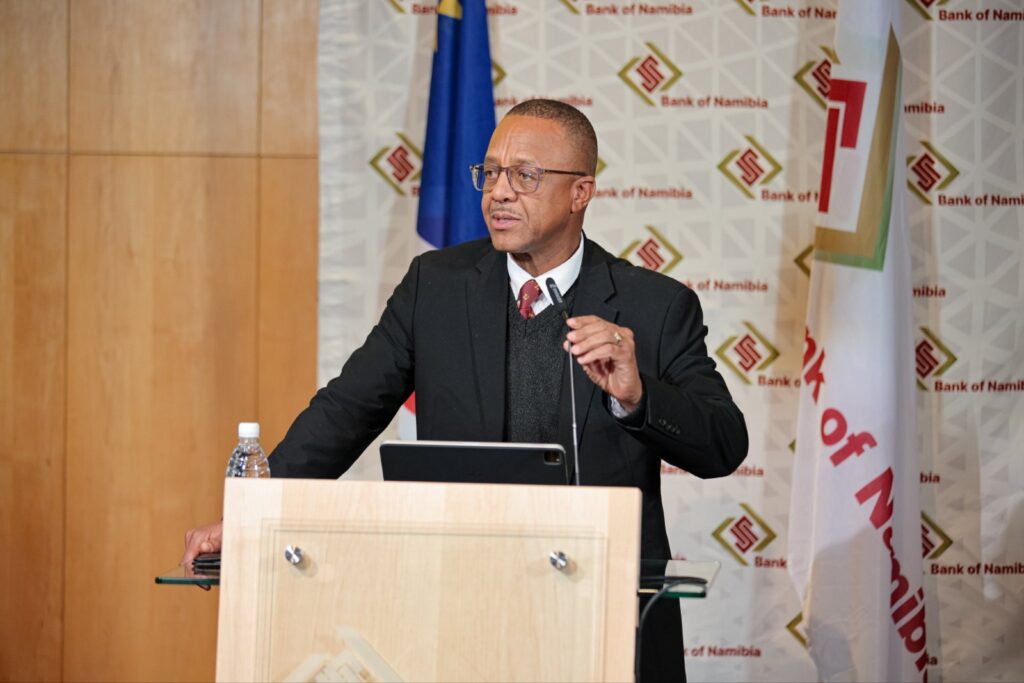
Capital outflows from Namibia fell by about N$8 billion year-on-year to approximately N$10 billion so far in 2026, as the interest rate gap with South Africa narrowed, Bank of Namibia Governor Ebson Uanguta has said.
The outflows are down from about N$18 billion recorded over the corresponding period last year, representing a decline of roughly 44%.
Uanguta attributed the improvement partly to the narrowing of the policy rate differential between Namibia and South Africa to 25 basis points.
Speaking during a recent monetary policy dialogue, Uanguta said the central bank closely monitors the interest rate differential because a wider gap can encourage investors to shift funds from Namibia into South Africa in search of higher returns.
“The Bank of Namibia monitors the interest rate differential between Namibia and South Africa closely to manage capital outflows. When the gap between the two countries’ repo rates exceeds approximately 75 to 100 basis points, it tends to trigger significant capital outflows from Namibia to South Africa,” Uanguta said.
He said the reduction in capital leaving Namibia this year shows the impact of keeping domestic interest rates closer to those in South Africa.
“Regarding current trends, the outflow of capital year-to-date is approximately N$10 billion, which is a marked improvement compared to the N$18 billion observed during the same period last year. This reduction is attributed to the narrowing of the policy rate differential to 25 basis points,” he said.
The Bank of Namibia maintained the repo rate at 6.75% at its August monetary policy meeting, while South Africa’s policy rate stands at 7.00%. Namibia’s prime lending rate remains at 10.25%.
Uanguta said controlling excessive capital outflows is critical to protecting Namibia’s foreign exchange reserves and maintaining the Namibia Dollar’s one-to-one peg with the South African Rand.
“The Bank emphasises that maintaining the one-to-one peg between the Namibian Dollar and the South African Rand is a primary objective. Allowing capital to flow out excessively would effectively mean exporting the nation’s reserves,” he said.
Namibia’s preliminary international reserves increased to N$57.1 billion at the end of July from N$55.4 billion at the end of May, supported by Southern African Customs Union receipts and customer foreign currency placements.
The reserves provide an estimated 3.5 months of import cover, which the central bank considers sufficient to support the currency peg and meet Namibia’s international financial obligations.
Uanguta said the Monetary Policy Committee considered the need to limit capital outflows and close the interest rate gap with South Africa when deciding to keep rates unchanged in August.
“In determining the appropriate monetary policy stance, the MPC considered the need to close the interest rate gap between Namibia and the anchor country to stem capital outflows, alongside elevated inflationary pressures,” he said.
However, the central bank opted against raising rates, citing subdued domestic economic activity, a relatively benign inflation outlook and adequate foreign exchange reserves.
The Bank of Namibia currently expects the economy to grow by 2.1% in 2026, while annual inflation is projected to average 4.0%.