Friday, August 14, 2026
SUBSCRIBE
The Brief | Namibia's Leading Business & Financial News
  • Home
  • Companies
    • Finance
    • Agriculture
    • Technology
    • Property
    • Trade
    • Tourism
  • Business & Economy
  • E-PAPERreader
  • Mining & Energy
  • Opinions
    • Analysis
    • Columnists
  • Africa
No Result
View All Result
The Brief | Namibia's Leading Business & Financial News
  • Home
  • Companies
    • Finance
    • Agriculture
    • Technology
    • Property
    • Trade
    • Tourism
  • Business & Economy
  • E-PAPERreader
  • Mining & Energy
  • Opinions
    • Analysis
    • Columnists
  • Africa
No Result
View All Result
The Brief | Namibia's Leading Business & Financial News
Subscribe
No Result
View All Result
DSTV WC26 Campaign
Home Companies Finance

Namibia’s capital outflows drop N$8bn as interest rate gap narrows

by reporter
August 14, 2026
in Finance
6
A A
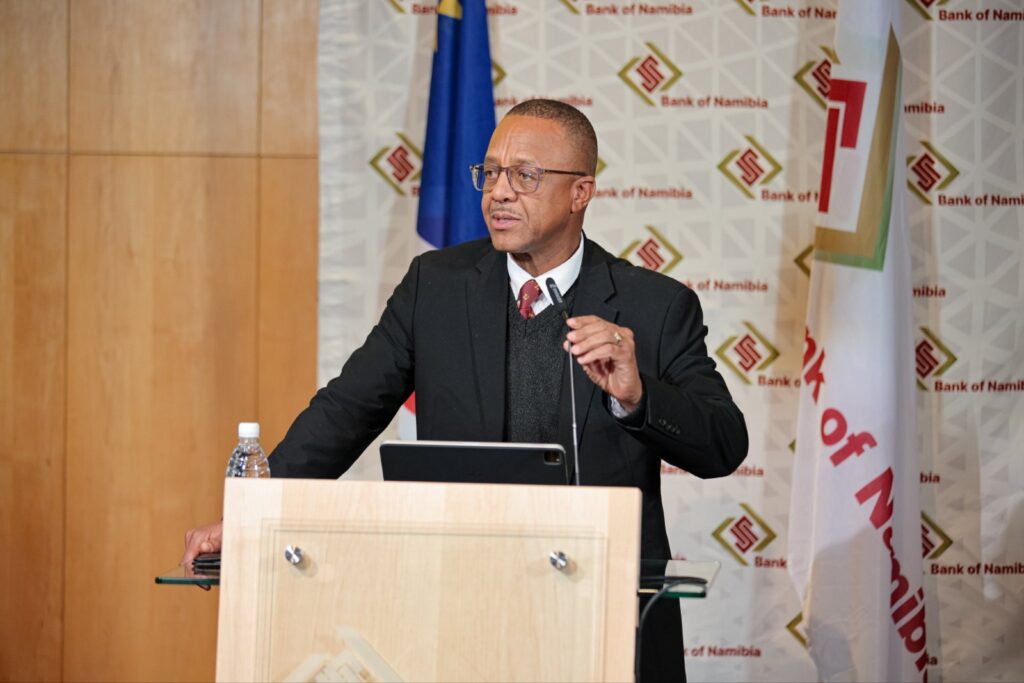
Man in a dark suit and glasses gives a speech at a wooden podium with a microphone and tablet in front, Bank of Namibia backdrop behind him.

Capital outflows from Namibia fell by about N$8 billion year-on-year to approximately N$10 billion so far in 2026, as the interest rate gap with South Africa narrowed, Bank of Namibia Governor Ebson Uanguta has said.

The outflows are down from about N$18 billion recorded over the corresponding period last year, representing a decline of roughly 44%.

Uanguta attributed the improvement partly to the narrowing of the policy rate differential between Namibia and South Africa to 25 basis points.

Speaking during a recent monetary policy dialogue, Uanguta said the central bank closely monitors the interest rate differential because a wider gap can encourage investors to shift funds from Namibia into South Africa in search of higher returns.

“The Bank of Namibia monitors the interest rate differential between Namibia and South Africa closely to manage capital outflows. When the gap between the two countries’ repo rates exceeds approximately 75 to 100 basis points, it tends to trigger significant capital outflows from Namibia to South Africa,” Uanguta said.

He said the reduction in capital leaving Namibia this year shows the impact of keeping domestic interest rates closer to those in South Africa.

“Regarding current trends, the outflow of capital year-to-date is approximately N$10 billion, which is a marked improvement compared to the N$18 billion observed during the same period last year. This reduction is attributed to the narrowing of the policy rate differential to 25 basis points,” he said.

The Bank of Namibia maintained the repo rate at 6.75% at its August monetary policy meeting, while South Africa’s policy rate stands at 7.00%. Namibia’s prime lending rate remains at 10.25%.

Uanguta said controlling excessive capital outflows is critical to protecting Namibia’s foreign exchange reserves and maintaining the Namibia Dollar’s one-to-one peg with the South African Rand.

“The Bank emphasises that maintaining the one-to-one peg between the Namibian Dollar and the South African Rand is a primary objective. Allowing capital to flow out excessively would effectively mean exporting the nation’s reserves,” he said.

Namibia’s preliminary international reserves increased to N$57.1 billion at the end of July from N$55.4 billion at the end of May, supported by Southern African Customs Union receipts and customer foreign currency placements.

The reserves provide an estimated 3.5 months of import cover, which the central bank considers sufficient to support the currency peg and meet Namibia’s international financial obligations.

Uanguta said the Monetary Policy Committee considered the need to limit capital outflows and close the interest rate gap with South Africa when deciding to keep rates unchanged in August.

“In determining the appropriate monetary policy stance, the MPC considered the need to close the interest rate gap between Namibia and the anchor country to stem capital outflows, alongside elevated inflationary pressures,” he said.

However, the central bank opted against raising rates, citing subdued domestic economic activity, a relatively benign inflation outlook and adequate foreign exchange reserves.

The Bank of Namibia currently expects the economy to grow by 2.1% in 2026, while annual inflation is projected to average 4.0%.

author avatar
reporter
See Full Bio
Previous Post

Namibia airport passenger traffic drops 8.9% to 90,834 in June

Next Post

Safland’s Lüderitz mall targets October 2027 opening with Shoprite as anchor tenant

Must Read

Standard Bank posts N$556.9m six-month profit, up 10%
Finance

SBN Holdings profit rises 4.1% to N$580m in six months

August 14, 2026
Indoor Standard Bank lobby with a blue-lit ATM on the left and a service desk visible in the background.
Finance

Standard Bank ATMs to show foreign visitors cost of Namibia dollar withdrawals in home currency

August 14, 2026
Close-up of a shopper holding a grocery receipt over a red cart filled with bananas, greens, and other groceries.
Finance

Households turn to overdrafts as cost-of-living pressures mount

August 14, 2026
Portrait of a smiling woman with curly dark hair wearing a red blouse, standing between potted plants in an office-like setting.
Finance

Capricorn Private Wealth appoints Elize Smith as new Head

May 6, 2026
Momentum Metropolitan Namibia appoints Evangelina Nailenge Executive:Retail Distribution
Companies

Momentum Metropolitan Namibia appoints Evangelina Nailenge Executive:Retail Distribution

April 6, 2026
SBN Oryx
Finance

Standard Bank Namibia provides N$178m financing for Goreangab Mall

September 18, 2025
Load More

Related News

GIPF commits N$900 million to pension-backed housing loan scheme

GIPF: A vehicle for economic and social transformation

August 22, 2025
Understanding layer hens

Understanding layer hens

August 14, 2025
Why Humility Is the New Competitive Advantage in Leadership

Why Humility Is the New Competitive Advantage in Leadership

June 13, 2025

Browse by Category

  • Africa
  • Agriculture
  • Analysis
  • Business & Economy
  • Columnists
  • Companies
  • Finance
  • Finance
  • Fisheries
  • Green Hydrogen
  • Health
  • Investing
  • Latest
  • Market
  • Mining & Energy
  • Namibia
  • namibia
  • News
  • Opinions
  • Property
  • Retail
  • Technology
  • Tourism
  • Trade
The Brief | Namibia's Leading Business & Financial News

The Brief is Namibia's leading daily business, finance and economic news publication.

CATEGORIES

  • Business & Economy
  • Companies
    • Agriculture
    • Finance
    • Fisheries
    • Health
    • Property
    • Retail
    • Technology
    • Tourism
    • Trade
  • Finance
  • Green Hydrogen
  • Investing
  • Latest
  • Market
  • Mining & Energy
  • namibia
  • News
    • Africa
    • Namibia
  • Opinions
    • Analysis
    • Columnists

CONTACT US

Cell: +264814612969

Email: newsdesk@thebrief.com.na

© 2026 The Brief | All Rights Reserved. Namibian Business News, Current Affairs, Analysis and Commentary

Welcome Back!

Login to your account below

Forgotten Password?

Retrieve your password

Please enter your username or email address to reset your password.

Log In
No Result
View All Result
  • Home
  • Companies
  • Mining & Energy
  • Business & Economy
  • Opinions
    • Analysis
    • Columnists
  • Africa

© 2026 The Brief | All Rights Reserved. Namibian Business News, Current Affairs, Analysis and Commentary

This website uses cookies. By continuing to use this website you are giving consent to cookies being used. Visit our Privacy and Cookie Policy.