Thursday, November 19, 2026
Subscribe
The Brief | Namibia's Leading Business & Financial News
  • Home
  • Companies
    • Finance
    • Agriculture
    • Technology
    • Property
    • Trade
    • Tourism
  • Business & Economy
  • E-PAPERreader
  • Mining & Energy
  • Opinions
    • Analysis
    • Columnists
  • Africa
No Result
View All Result
The Brief | Namibia's Leading Business & Financial News
Subscribe
No Result
View All Result
Home Latest

Ngurare warns against favouritism in public and private sector recruitment

by reporter
October 15, 2026
in Latest
7
A A
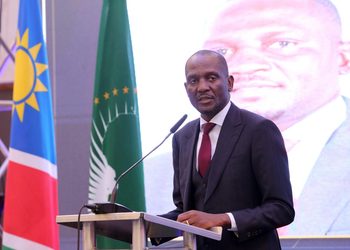
Smiling man in a gray suit gives a conference talk, gesturing with his hands beside a tablet on a clear podium.

Prime Minister Elijah Ngurare has urged public and private sector employers to end favouritism and discrimination in recruitment, warning that appointments based on personal relationships, ethnicity or community ties undermine equal employment opportunities and institutional performance.

Speaking at the 16th Institute of People Management (IPM) Namibia Annual Conference, Ngurare said recruitment decisions should be based strictly on qualifications, competence and performance rather than personal connections or backgrounds.

“Do not appoint someone simply because they are your friend or come from your village. If another candidate is better qualified and performs well, give that person the opportunity, regardless of their race, language, ethnicity or background,” Ngurare said.

He raised concerns about recruitment practices in the public service, including allegations that some candidates were disadvantaged because of their backgrounds, and called on human resource practitioners to eliminate discriminatory practices.

Ngurare also warned against situations in which government departments or divisions become dominated by employees from particular communities, saying recruitment processes should promote fairness and reflect the country’s diversity.

“The public service and private sector must both reflect the diversity of Namibia,” he said.

He said building a professional and effective public service required integrity, accountability and transparent recruitment processes, while human resource practitioners had a responsibility to ensure that employees were recruited, developed, managed and retained on merit.

Ngurare further stressed that Namibia’s economic transformation and investment ambitions depended on developing a skilled workforce capable of meeting the demands of emerging industries.

He called for stronger links between education, vocational training, entrepreneurship and employment to improve opportunities for young people and address skills shortages.

The Prime Minister also urged employers to create inclusive and productive working environments, warning that toxic workplace cultures could undermine employee well-being and organisational performance.

Turning to technology, Ngurare called for greater investment in locally developed artificial intelligence (AI) and digital solutions, saying Namibia should reduce its dependence on imported technologies and build systems that respond to domestic challenges.

“Artificial intelligence should not mean adopting everything developed in Silicon Valley and simply placing it in our communities. We must also be at the forefront of developing and programming solutions that address our own needs,” he said.

He said universities, students and local technology innovators had the potential to develop software that could improve government administration, reduce paperwork and make public services more accessible.

Ngurare cited the digitisation of government application processes as an example of how locally developed technology could reduce administrative costs and eliminate the need for citizens to travel long distances to submit documents.

He revealed that the public service had already begun work on digitisation and AI policies, stressing that technology adoption should strengthen national capacity, improve service delivery and safeguard national interests and security.

He urged human resource professionals to prepare employees for technological changes through training and skills development, ensuring that the introduction of digital systems translated into measurable improvements in productivity and service delivery.

“Technology should be used to address challenges such as unemployment rather than simply to communicate with one another,” he said.


author avatar
reporter
See Full Bio
Previous Post

Lack of credit histories shuts individuals, small businesses out of financing

Next Post

Govt rejects privatisation of electricity transmission and distribution

Must Read

Seven professionals pose for a photo at a formal event, with banners and a blue projection screen behind them in a conference room.
Latest

Namibia’s SDG reporting capacity rises to 71% as 2030 deadline approaches

November 18, 2026
Man in a dark suit and red tie speaking at a podium with a microphone, flags in the background.
Latest

Namibia targets upgrades to four regional trade corridors to cut logistics costs

November 18, 2026
Speaker in a white blazer presenting at a wooden podium in front of a geometric wall, addressing seated attendees in a classroom.
Latest

Standard Bank trains 30 NAMPOL investigators to tackle financial crime

November 18, 2026
Group of Standard Bank staff posing for a photo in a training room, many waving hands, projector screen displaying the Standard Bank logo in the background.
Latest

Standard Bank employees support communities through nationwide outreach programme

November 17, 2026
Farm worker in blue coveralls and a hat stands among a herd of cattle in a muddy pen under a cloudy sky, tending the animals.
Agriculture

Communal farmers yet to benefit from N$100m Equalisation Fund

November 17, 2026
Group of security guards in neon yellow vests standing on a grassy field under a clear blue sky, facing away from the camera.
Latest

Security guards’ minimum wage to increase to N$18 per hour in January 2027

November 17, 2026
Load More

Related News

NWR to break even in 2024

NWR to break even in 2024

April 18, 2023
NAC targets passenger growth and new routes through AviaDev Africa

NAC targets passenger growth and new routes through AviaDev Africa

June 12, 2025
Expo 2020 Dubai Namibia Pavilion officially opened

Expo 2020 Dubai Namibia Pavilion officially opened

October 7, 2021

Browse by Category

  • Africa
  • Agriculture
  • Analysis
  • Business & Economy
  • Columnists
  • Companies
  • e-edition
  • Finance
  • Finance
  • Fisheries
  • Green Hydrogen
  • Health
  • Investing
  • Latest
  • Market
  • Mining & Energy
  • namibia
  • Namibia
  • News
  • Opinions
  • Property
  • Retail
  • Technology
  • Tourism
  • Trade
The Brief | Namibia's Leading Business & Financial News

The Brief is Namibia's leading daily business, finance and economic news publication.

CATEGORIES

  • Business & Economy
  • Companies
    • Agriculture
    • Finance
    • Fisheries
    • Health
    • Property
    • Retail
    • Technology
    • Tourism
    • Trade
  • e-edition
  • Finance
  • Green Hydrogen
  • Investing
  • Latest
  • Market
  • Mining & Energy
  • namibia
  • News
    • Africa
    • Namibia
  • Opinions
    • Analysis
    • Columnists

CONTACT US

Cell: +264814612969

Email: newsdesk@thebrief.com.na

© 2026 The Brief | All Rights Reserved. Namibian Business News, Current Affairs, Analysis and Commentary

Welcome Back!

Login to your account below

Forgotten Password?

Retrieve your password

Please enter your username or email address to reset your password.

Log In
No Result
View All Result
  • Home
  • Companies
  • Mining & Energy
  • Business & Economy
  • Opinions
    • Analysis
    • Columnists
  • Africa

© 2026 The Brief | All Rights Reserved. Namibian Business News, Current Affairs, Analysis and Commentary

This website uses cookies. By continuing to use this website you are giving consent to cookies being used. Visit our Privacy and Cookie Policy.