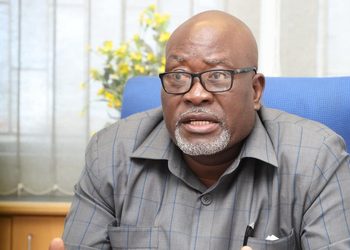
Monasa Advisory & Associates has called for an overhaul of Namibia’s natonal development planning system, warning that fragmented policies, poor coordination and weak implementation continue to undermine the country’s economic development objectives.
Monasa Chairman and Managing Partner Jason Kasuto said Namibia needed a core coordinated approach to development planning, proposing a framework comprising 10 sector visions and 30 key performance indicators (KPIs) to measure progress and strengthen accountability.
Speaking at the ICAN National Accounting Summit, Kasuto said Namibia had produced more than 45 policy documents over the years, but continued to struggle with translating development plans into measurable economic outcomes.
He cited reported achievement rates of 58% for targets under the Fifth National Development Plan (NDP5) and 54% for the National Planning Commission’s strategic plan, arguing that the figures highlighted weaknesses in implementation.
“There’s no one sheet balanced scorecard that can measure all of these sectors in one,” Kasuto said.
He proposed establishing a national development framework built around three overarching missions, supported by sector-specific targets covering agriculture, mining, oil and gas, tourism and fisheries.
The framework would also include enabling sectors such as health, education, energy, water and digital services.
Under the proposal, progress against the 30 KPIs would be reported annually, while sector visions would be reviewed every three to five years to respond to changing economic conditions and development priorities.
Kasuto said the existing planning system was further weakened by gaps of three to five years between the expiry of certain policy frameworks and the introduction of their successors.
He warned that such delays disrupted continuity and made it difficult to maintain momentum in implementing national development priorities.
The proposed framework would bring together government institutions, private-sector organisations and civil society to develop common sector objectives and share responsibility for achieving them.
“It allows for sectoral ownership because addressing the issue of silos, you can’t do it without that broad ownership by private sector, by public sector as a convener and civil society also as a participant,” Kasuto said.
He identified agriculture and mining as major economic sectors that lacked dedicated sector visions, despite their importance to Namibia’s economy.
Kasuto argued that sector-specific planning would allow Namibia to respond more effectively to challenges such as drought, foot-and-mouth disease outbreaks and fluctuations in commodity demand without disrupting the broader national development framework.
He also called for stronger independent oversight of development performance, proposing that chartered accountants, auditors and the Auditor-General play a greater role in verifying progress against national targets.
According to Kasuto, annual performance reporting supported by independent assurance would improve the credibility of development outcomes and strengthen accountability.
Beyond planning failures, Kasuto warned that Namibia’s fiscal position was restricting the government’s ability to finance development programmes and respond to economic shocks.
He cited public debt of approximately 68% of gross domestic product (GDP), revised upwards from 65%, a budget deficit of 5.5% of GDP and import cover of 3.6 months.
Kasuto proposed reducing public debt to 60% of GDP and the budget deficit to 3.3% by the 2028/29 financial year to strengthen fiscal sustainability.
He also called for clear rules governing the management of future oil revenues, including deposits into and withdrawals from Namibia’s sovereign wealth fund.
Kasuto said regulatory certainty was critical as Namibia prepared for potential large-scale petroleum investments, warning that unresolved policy issues could affect investor confidence and delay final investment decisions.
On infrastructure development, he urged the government to prioritise spending on social programmes, essential services and public goods, while mobilising private and blended financing for commercially viable projects.
He noted that Namibia had not executed a project under its Public-Private Partnership Act since the legislation was introduced in 2017, according to his presentation.
Kasuto proposed concentrating public-private partnership efforts on a limited number of flagship infrastructure projects, supported by local capital-raising expertise and development finance institutions.
He said such an approach would help attract private investment, improve project implementation and reduce the financial burden on the government.
Kasuto maintained that Namibia needed to move beyond producing development policies towards establishing clear implementation responsibilities, measurable targets and credible systems for monitoring results.
He argued that a coordinated national framework would help the country address institutional fragmentation, improve the use of public resources and ensure that development commitments translated into measurable economic outcomes.