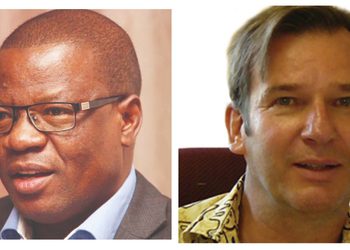
By Clerence Kameeta
The world is entering one of the most significant economic transformations since the Industrial Revolution.
Artificial intelligence is rapidly reshaping how businesses operate. Tasks that once required teams of employees can now be completed in minutes. Automation is becoming more affordable, cloud technology has removed geographical barriers, and businesses increasingly serve customers across global markets that never close.
For many, this progress raises an uncomfortable question.
If technology continues to become more capable, what happens to the people whose work it replaces?
Around the world, governments are investing billions in education, entrepreneurship, industrialisation, infrastructure, and skills development. Yet despite these efforts, unemployment and underemployment remain persistent challenges in both developed and developing economies.
The conversation about the future of work is often framed around one question:
“How do we protect jobs from artificial intelligence?”
Perhaps that is the wrong question.
A better question may be:
“How do we ensure that the productivity created by artificial intelligence results in more opportunities for people, rather than fewer?”
This is the idea behind what I call The Employment Expansion Model (EEM).
The World Doesn’t Need Less Innovation. It Needs More
Participation.
Throughout history, every major technological revolution has changed the labour market.
Mechanised farming reduced the need for agricultural workers while creating new industries in manufacturing and transportation.
The internet transformed retail while creating entirely new professions in software development, digital marketing, cybersecurity, and e-commerce.
Artificial intelligence will undoubtedly do the same.
Some jobs will disappear.
Others will evolve.
Entirely new occupations will emerge.
The challenge, therefore, is not to stop technological progress.
It is to ensure that economic progress expands human participation instead of concentrating its benefits among fewer businesses and fewer workers.
Innovation should not be measured only by how much labour it replaces.
It should also be measured by how many new opportunities it creates.
The Employment Model Was Built for Yesterday’s Economy
Much of today’s employment structure still reflects an economy built more than a century ago.
The traditional eight-hour workday was designed for factories, fixed production schedules,and manual labour.
Businesses operated during daylight hours.
Customers visited physical locations.
Most work required people to be physically present.
Today’s economy looks very different.
Businesses sell products online twenty-four hours a day.
Customers expect greater convenience.
Digital tools allow work to happen almost anywhere.
Artificial intelligence enables organisations to accomplish more with fewer routine tasks.
Yet many businesses still organise work around operating models that have changed remarkably little since the early twentieth century.
Technology has evolved.
Consumer behaviour has evolved.
Business has evolved.
Perhaps our employment model should evolve as well.
Introducing the Employment Expansion Model
The Employment Expansion Model begins with a different way of thinking.
Instead of asking:
“How many employees do we need to operate this business?”
Businesses could instead ask:
“How much larger could this business become if we used technology to serve more customers, operate longer where demand exists, and create more opportunities for people?”
This distinction is important.
The Employment Expansion Model is not about protecting outdated jobs.
It is not about asking businesses to employ more people while earning the same revenue.
Nor is it about dividing one full-time position into two smaller jobs.
It is about using productivity—including productivity created by artificial intelligence—to expand businesses, reach more customers, and create sustainable new employment where commercial demand exists.
In this model, technology becomes an enabler of employment rather than simply a substitute for it.
The Three Pillars of the Employment Expansion Model
Pillar One: Business Expansion
Businesses should explore opportunities to expand where demand exists.
This may include extending operating hours, entering new markets, introducing additional
services, or improving customer accessibility.
The objective is growth.
Growth creates additional revenue.
Additional revenue creates capacity for investment.
Pillar Two: Employment Expansion
As businesses grow, work can be organised through flexible or staggered shifts where economically viable.
This allows businesses to increase customer coverage without overburdening employees while creating opportunities for additional workers to participate in the economy.
Importantly, the goal is not to maximise the number of employees.
The goal is to maximise meaningful employment through sustainable business growth.
Pillar Three: Policy Enablement
The government also has a role.
Smart public policy can encourage employment by reducing the cost of creating new opportunities.
Rather than directing businesses whom to hire, governments can create conditions that make employment growth more attractive through targeted incentives, skills development, labour market reforms, and streamlined regulation.
Employment expansion should therefore be viewed as a shared responsibility between business, government, and workers.
Namibia Has Already Demonstrated This Principle
This approach is not entirely theoretical.
Namibia has already shown that public policy can influence employment decisions.
Through the Youth Internship Allowance contained in Section 17E of the Income Tax Act, qualifying employers may claim an additional tax deduction when they enter into certified internship agreements that satisfy the requirements of the legislation.
The objective is straightforward.
Reduce part of the employer’s cost.
Encourage businesses to create opportunities for young people.
This demonstrates an important principle.
Businesses respond to incentives.
If the government recognises that tax policy can encourage internship opportunities, perhaps similar thinking could be explored to encourage sustainable employment growth.
Future policies could consider incentives for businesses that expand operating hours where customer demand exists, create additional shift-based positions, employ first-time job seekers, or demonstrate measurable employment growth through business expansion.
Such policies should not replace market forces.
They should strengthen them by encouraging businesses already positioned to grow.
AI Should Expand the Economy—Not Just Productivity
Much of the discussion surrounding artificial intelligence focuses on efficiency.
Businesses naturally seek to reduce costs and increase output.
There is nothing inherently wrong with that.
However, history suggests that productivity alone does not guarantee widespread prosperity.
The real opportunity lies in how those productivity gains are used.
A business made more efficient by artificial intelligence could simply reduce its workforce and maintain its existing operations.
Or it could use those same productivity gains to extend customer service hours, enter new markets, develop new products, improve customer experience, open additional branches, and create entirely new roles that require human creativity, judgment, empathy, and
relationship-building.
The Employment Expansion Model encourages the second path.
Its central question is not:
“How do we stop AI from replacing people?”
It is:
“How do we use AI to create even more opportunities for people?”
Measuring Success Differently
Economic success has traditionally been measured through GDP growth, productivity,
exports, investment, and profitability.
These indicators remain essential.
But perhaps another measure deserves equal attention.
How many citizens are meaningfully participating in economic activity?
An economy cannot reach its full potential if technological progress benefits only a small portion of society.
The strongest economies of the future may not simply be those with the most advanced technology.
They may be those that use technology to create the broadest participation in prosperity.
Namibia Has an Opportunity to Lead
Namibia’s unemployment challenge is often viewed as a weakness.
It could become one of its greatest opportunities.
Countries that face significant challenges are often the ones that develop bold new ideas.
If Namibia becomes one of the first nations to seriously explore employment-centred business expansion—supported by technology, evidence-based policy, business innovation, and targeted government incentives—it could contribute a new perspective to one of the defining economic debates of our time.
Rather than importing every solution, Namibia has an opportunity to export one.
An Invitation to Rethink the Future of Work
The Employment Expansion Model is not presented as a finished answer.
It is a framework for discussion, research, pilot programmes, and continuous refinement.
Not every business should extend its operating hours.
Not every industry will require additional shifts.
Not every workplace will benefit from the same approach.
But every business, every government, and every economy should ask a common question.
How can technological progress create more opportunities for people instead of fewer?
The future of work should not be defined solely by automation.
Nor solely by efficiency.
It should also be defined by participation.
Innovation should not simply reduce the amount of human work required.
It should expand the number of people who share in the benefits of economic progress.
Perhaps the question is no longer:
“Where are the jobs?”
Perhaps the better question is:
“How should we redesign work, business, and public policy so that the age of
artificial intelligence becomes the age of greater human opportunity?”
If we are willing to rethink how businesses grow, how governments encourage employment, and how technological progress is shared, unemployment need not become the inevitable consequence of innovation.
Instead, it may become the catalyst for designing a more inclusive economy. And perhaps that conversation can begin in Namibia.