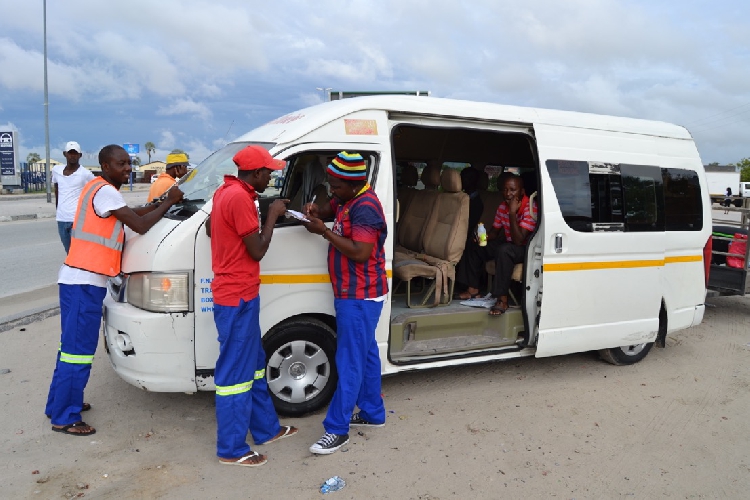
More than 70% of Namibians rely on public transport every day, with transport operators and road safety researchers warning that rising accidents involving buses and taxis require stronger enforcement, better use of crash data and coordinated action to reduce fatalities.
Presenting before the National Council Standing Committee on Transport, Infrastructure and Housing on Tuesday, Namibia Bus and Taxi Association (NABTA) Secretary General Pendapala Nakathingo said public transport remains the backbone of the country’s mobility system but continues to face growing safety risks.
“Public transport moves over 70% of Namibians daily. Taxis and buses are the backbone of mobility. But with this responsibility comes risk. The rising road accidents involving public transport threaten lives, livelihoods and public trust,” Nakathingo said.
He identified driver fatigue, speeding, reckless driving, substance abuse, vehicle overloading, poor maintenance, informal operations and inadequate taxi and bus rank infrastructure as the main contributors to road crashes involving public transport.
To improve accountability, NABTA proposed the introduction of the Smart NABTA System (SNS), a digital platform that would verify drivers and vehicles, monitor trips, register passengers and share transport data with relevant authorities.
The association said operators have already introduced measures including driver training, vehicle inspections, codes of conduct, passenger registration books and awareness campaigns, but argued that self-regulation alone is insufficient to improve road safety.
NABTA also called for stronger enforcement against overloading and unroadworthy vehicles, improved taxi and bus rank infrastructure, incentives for operators investing in safety technologies and the construction of rest facilities for long-distance drivers.
Meanwhile, representatives from the International University of Management (IUM), Sioni Iikela and Roswitha Vincentius, told the committee that Namibia recorded 1,333 road crashes, 2,273 injuries and 229 fatalities between January and June 2026, according to Motor Vehicle Accident (MVA) Fund data.
The university said human factors accounted for 72% of crashes, with speeding, driver fatigue, overloading and distracted driving identified as the leading causes.
IUM also pointed to infrastructure-related risks, including animals on roads and inadequate wildlife management, while calling for improved analysis of existing crash data.
“Raw data exists but it is not fully analysed. Causes of serious crashes are not sufficiently researched. Findings are not shared with stakeholders,” IUM said.
The institution said it is strengthening research partnerships with the MVA Fund and the National Road Safety Council to analyse crash patterns, identify accident hotspots and develop evidence-based interventions.
The University of Namibia’s Robert Ambunda and Monika Shapua also urged authorities to adopt a Safe System approach, arguing that road deaths cannot be reduced through awareness campaigns alone.
UNAM’s analysis of more than 30,000 crash records from the National Road Safety Council between 2012 and 2025 found that severe crashes were strongly linked to dangerous manoeuvres, unsafe overtaking, alcohol-impaired driving, speeding, fatigue and distracted driving.
The university warned that Namibia’s well-developed road network has not translated into better safety outcomes.
“Quality of asphalt is not the same as safety of the system. Our road fatality rate exceeds regional averages despite Namibia being rated among the best road networks in Africa,” UNAM said.
Among its recommendations, UNAM called for a national crash evidence platform, data-driven traffic enforcement, independent road safety audits and phased upgrades of high-risk road corridors. It also proposed short-term interventions such as rumble strips, speed-over-distance enforcement and livestock fencing before the construction of dual carriageways.
The recommendations come as policymakers seek new strategies to reduce road deaths and improve safety for passengers, motorists and other road users.