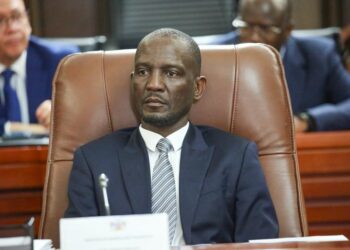
The Namibian government recovered about N$15.09 million through the Criminal Assets Recovery Fund during the financial year ended 31 March 2025, according to a report tabled in the National Assembly by Auditor-General Junias Kandjeke.
The recovered funds originate from assets confiscated in cases linked to criminal activities such as fraud, corruption, drug trafficking and organised crime. However, the amount was slightly lower than the N$15.35 million recorded in the previous financial year.
The report shows that the fund received an unqualified audit opinion, indicating that its financial statements fairly represent its financial position in all material respects.
“In my opinion, the financial statements of the Criminal Assets Recovery Fund as at 31 March 2025 are prepared, in all material respects, in accordance with the Prevention of Organised Crime Act, 2004 (Act 29 of 2004); the State Finance Act, 1991 (Act 31 of 1991); the Public Procurement Act, 2015 (Act 15 of 2015); Treasury approval (18 June 2012); and relevant legislation,” the report stated.
The report further notes that the decline was largely influenced by a sharp reduction in operating expenses, which fell from more than N$1.91 million in the 2023/24 financial year to just N$92,000 in the current period.
Spending patterns also shifted during the year. Legal costs and photocopying expenses, which previously amounted to N$600,000 and N$700,000 respectively, were eliminated.
At the same time, the fund recorded new operational costs, including N$58,000 for insurance, N$20,000 for property valuations and N$8,000 for rates and taxes.
“My objectives are to obtain reasonable assurance about whether the financial statements as a whole are free from material misstatement, whether due to fraud or error, and to issue an auditor’s report that includes my opinion. Reasonable assurance is a high level of assurance but is not a guarantee that an audit conducted in accordance with the International Standards for Supreme Audit Institutions (ISSAIs) will always detect a material misstatement when it exists,” the report said.