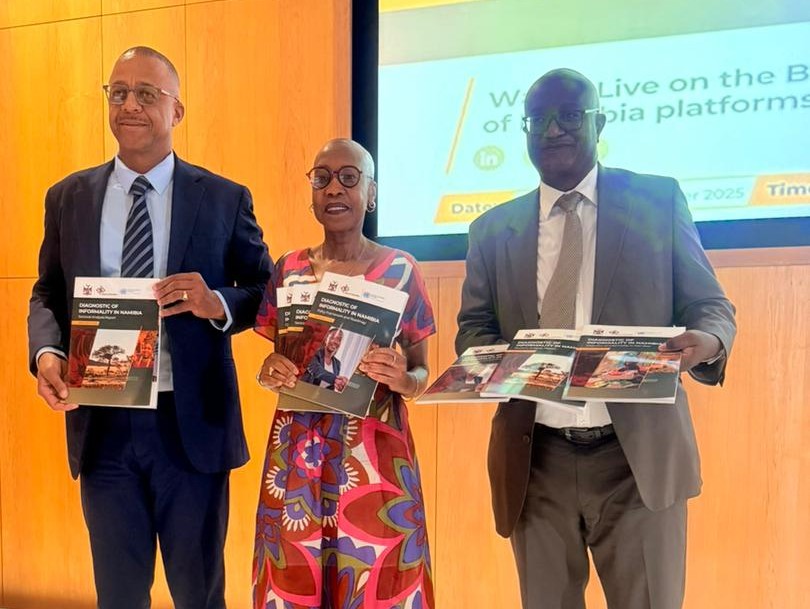
Namibia’s informal economy now contributes 26.5% to the country’s gross domestic product (GDP), representing approximately US$13 billion at GDP purchasing power parity (PPP) levels for 2025.
The data, released by the Ministry of Finance during the launch of the Diagnostic Report on Informality in Namibia, reflects steady growth from 24.7% in 2023, when the sector accounted for an estimated US$8 billion.
Ministry of Finance Executive Director and Chairperson of the National Working Group on Informality, Michael Nokokure Humavindu, said the 2024 approved National Informal Economy, Startups and Entrepreneurship Development Policy (NIESEP) highlighted the informal economy as a significant pillar of national production.
He noted that the new diagnostic report builds on that policy, offering the first comprehensive picture of the scale, contribution, and structure of the informal sector across Namibia’s regions.
“The data, however, tells a different, undeniable story. This sector is not a side economy; it is a pillar of our national life. It is the engine room where an estimated 58% of our workforce finds their livelihood. It contributes a significant portion of our GDP that demands our respect and full integration,” said Humavindu.
He said the report is not just a document but a reflection of the realities faced by Namibians working outside formal employment systems, as the sector continues to be driven by women, who make up more than half of informal enterprises, and youth who are creating their first businesses despite limited access to capital and regulatory barriers.
“This report, the National Diagnostic on Informality in Namibia, is therefore a mirror we hold up to ourselves. It reaffirms a truth we can no longer ignore: Namibia cannot transition to shared prosperity while half its workforce transitions daily between survival and exclusion,” said Humavindu.
The Executive Director noted that Namibia cannot effectively diversify its economy without scaling up and propelling, in the most sustainable manner, the bedrock of its indigenous entrepreneurial capital.
He said the report was produced through a participatory approach that involved speaking directly with informal workers, including street vendors, taxi drivers, mechanics, and food sellers.
The process revealed key constraints such as lack of security, financial exclusion, and a burdensome regulatory environment that hinders growth and integration into the formal economy.
“The power of this work lies not only in the diagnosis but in the roadmap it provides — a blueprint that speaks to legal reforms, inclusive finance, fit-for-purpose business registration, spatial justice, and digital inclusion. It is a roadmap that recognises that transitioning to formality is not a punishment, but an invitation into dignity, productivity, and protection,” said Humavindu.
He also acknowledged the institutions and partners that made the report possible, including the Government of Namibia, the Bank of Namibia, and the United Nations.
He said the findings will serve as a foundation for legal and financial reforms aimed at ensuring that informal workers are fully integrated into the country’s development agenda.
“The informal economy does not need our sympathy. It needs policy. It needs supportive legislation. It needs reform. It needs investment. Above all, it needs respect,” said Humavindu.
Deputy Governor of the Bank of Namibia, Ebson Uanguta, said the report provides empirical evidence to guide targeted infrastructure, financial, and social development strategies that reflect the realities of the majority of Namibians.
“This report gives voice to the aspirations and challenges of individuals in our open markets, agricultural corridors, home-based businesses, and informal settlements. It reminds us that for a majority of Namibians, the informal sector is the economy,” said Uanguta.
He said the responsibility now rests with policymakers and institutions to transform the report’s findings into tangible reforms.
Uanguta urged collaboration between government, regulators, civil society, and the private sector to move beyond dialogue and implement structural solutions that promote dignity and opportunity for informal workers.