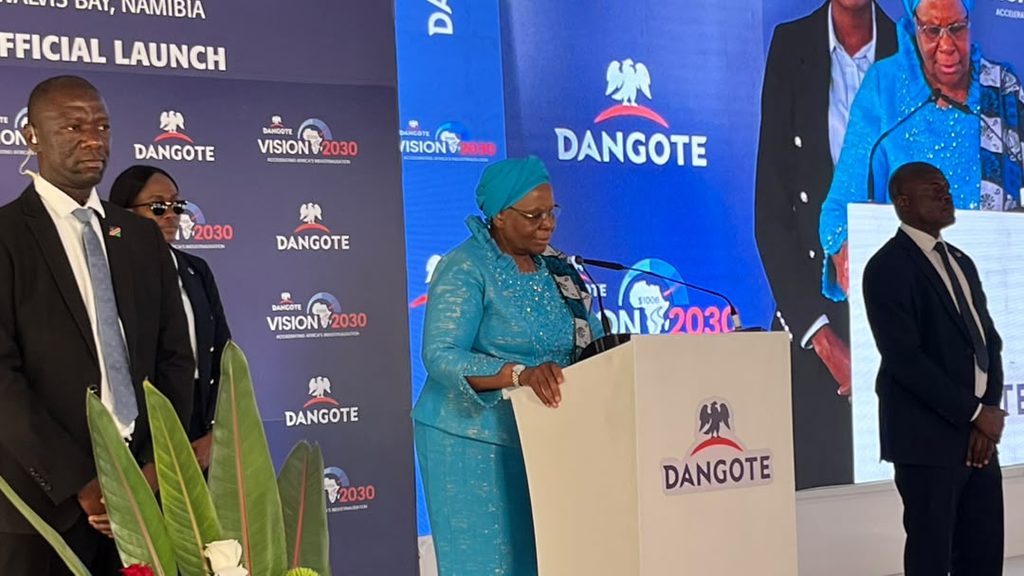
President Netumbo Nandi-Ndaitwah says the Dangote Namibia Tank Farm and Regional Pipeline Project will strengthen Namibia’s position as a regional energy and logistics hub, while warning that bureaucratic delays continue to threaten major investments in the country.
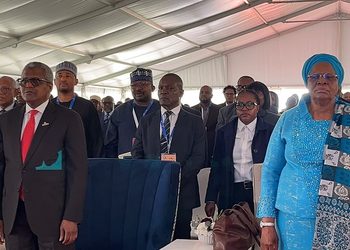
Speaking at the project’s official launch at Farm 58 in Walvis Bay on Wednesday, Nandi-Ndaitwah said the government must accelerate administrative processes to attract and retain investments capable of driving economic growth, creating jobs and reducing poverty.
The project, spearheaded by Dangote Industries Limited, involves the development of a 600-million-litre petroleum storage facility and a planned 1,700-kilometre regional pipeline connecting Walvis Bay to markets across southern Africa.
The storage facility will have capacity for 360 million litres of diesel and 240 million litres of petrol, while the proposed pipeline network will extend towards Otjiwarongo and Rundu in Namibia, and Ghanzi and Francistown in Botswana.
The wider distribution network is expected to serve Botswana, Zambia, Zimbabwe, Malawi and the southern Democratic Republic of Congo, positioning Walvis Bay as an alternative fuel import and distribution gateway for landlocked countries.
Nandi-Ndaitwah said she had personally intervened to ensure the project proceeded after previous experiences in which major investors abandoned planned developments because of administrative delays.
“I have witnessed as a Minister of International Relations and Cooperation very serious investors who wanted to invest in Namibia, but they got frustrated by our bureaucratic systems and we lost very important projects,” she said.
The President said she subsequently instructed National Planning Commission Director-General Ambassador Kaire Mbuende to coordinate the Dangote investment and provide regular updates on its progress.
“I had to call Mr Dangote and plead with him that please hold on. I will make it work,” she said.
Nandi-Ndaitwah said Namibia could not afford to continue losing investment opportunities because of inefficient government processes, particularly when the country needed infrastructure development and private-sector investment to address unemployment and poverty.
She said the project was aligned with Namibia’s broader infrastructure development priorities and its ambition to become a strategic gateway for regional trade, logistics and energy distribution.
The President also called for greater African ownership of economic development, arguing that countries on the continent must take responsibility for addressing their development challenges rather than continuing to depend on former colonial powers.
“Africa, over 60 years of our independence. Yes, the colonial administration has made the damage. But for how long will we continue to wait for them to correct the damage they have caused on us? We must now take charge of our responsibility,” she said.
She cited the African Union’s Agenda 2063 and the African Continental Free Trade Area as important frameworks for advancing regional integration, infrastructure development and intra-African trade.
Nandi-Ndaitwah said public-private partnerships would remain central to Namibia’s development strategy, stressing the need for stronger cooperation between government and investors.
Meanwhile, Erongo Governor Natalia Goagoses said the investment would strengthen the region’s role as a logistics and industrial centre, supported by the Port of Walvis Bay and transport corridors linking Namibia to neighbouring countries.
Goagoses said the project aligned with the Sixth National Development Plan, particularly its focus on infrastructure development, industrialisation and economic growth.
She said Erongo’s established mining, fishing, logistics and tourism sectors provided a foundation for attracting further investment and expanding regional supply chains.
“Investments of this nature will strengthen our economic base, enhance regional supply chains and create meaningful opportunities for our communities,” Goagoses said.
The governor said the project was expected to create employment opportunities, encourage local business participation and strengthen commercial activity in Walvis Bay and surrounding communities.
She added that the proposed fuel storage and pipeline infrastructure could expand Namibia’s participation in regional petroleum supply chains by linking the Port of Walvis Bay directly to inland distribution markets.