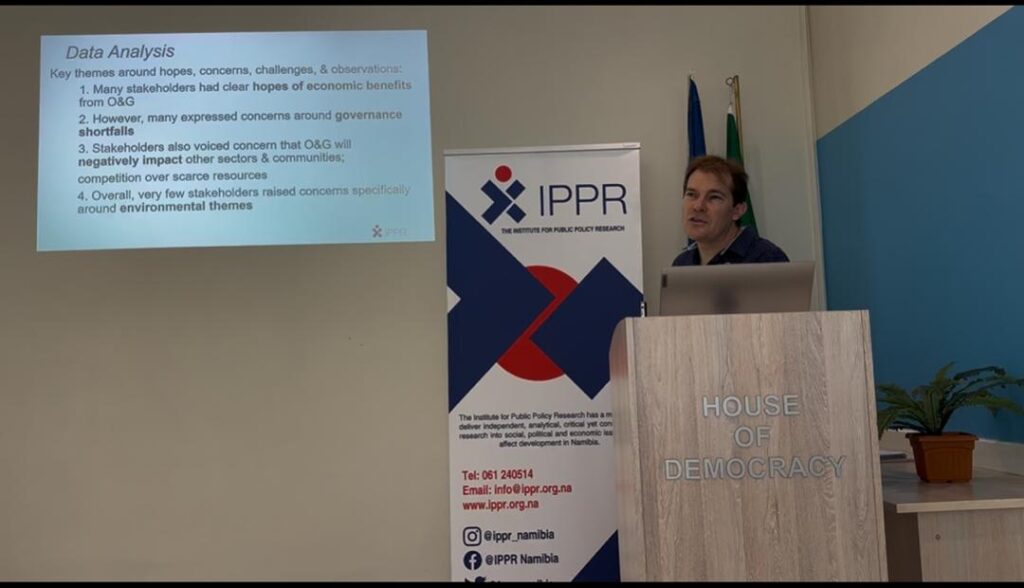
Namibian communities are placing high hopes on the country’s emerging oil and gas industry to deliver jobs, investment, and improved living standards, but many remain cautious about governance challenges, corruption, and environmental risks.
This is according to preliminary findings shared by Dietrich Remmert, a research associate at the Institute for Public Policy Research (IPPR), who presented early insights from an ongoing study examining stakeholder perceptions of the oil and gas sector.
“One of the most consistent themes to emerge from our analysis is that many stakeholders have strong economic expectations from oil and gas. They view it as a significant opportunity for investment, employment, and economic growth,” Remmert said.
However, the study also identified widespread concern about governance and mismanagement. Several respondents questioned whether the economic benefits would reach ordinary Namibians, citing previous instances where development promises had gone unfulfilled. Others warned that, without transparency and accountability, oil revenues risk being lost to corruption or elite capture.
Local authorities and community groups further cautioned that a surge in jobseekers could strain public infrastructure and essential services such as housing, water supply, and healthcare. Some also expressed concern that the growing demand for skilled labour in the oil sector might draw workers away from industries like tourism and small business operations.
“These were seen as critical risks that could undermine the sector’s positive impact if not properly managed,” Remmert said.
He added that more than half of the stakeholders interviewed raised concerns over the quality of public consultations, particularly those linked to Environmental Impact Assessment (EIA) meetings. Many participants found the sessions overly technical and difficult to follow, which limited meaningful community participation.
Environmental concerns, though less common, were mostly raised by academics and civil society groups. They warned of the potential for marine degradation, overexploitation of natural resources, and cumulative environmental pressures from multiple industries, including oil, hydrogen, and aquaculture.
“Only a few participants, mainly from civil society organisations, academia, and independent research circles, highlighted environmental risks. This pattern suggests that awareness of potential environmental impacts remains limited outside expert communities,” he noted.
Remmert explained that while data collection is still ongoing, the main trends are unlikely to change.
He said the research team had exercised caution when interpreting responses to avoid misrepresenting participants.
Most respondents, he added, did not take an extreme position for or against oil development but instead expressed measured optimism tempered by concern over governance and accountability.