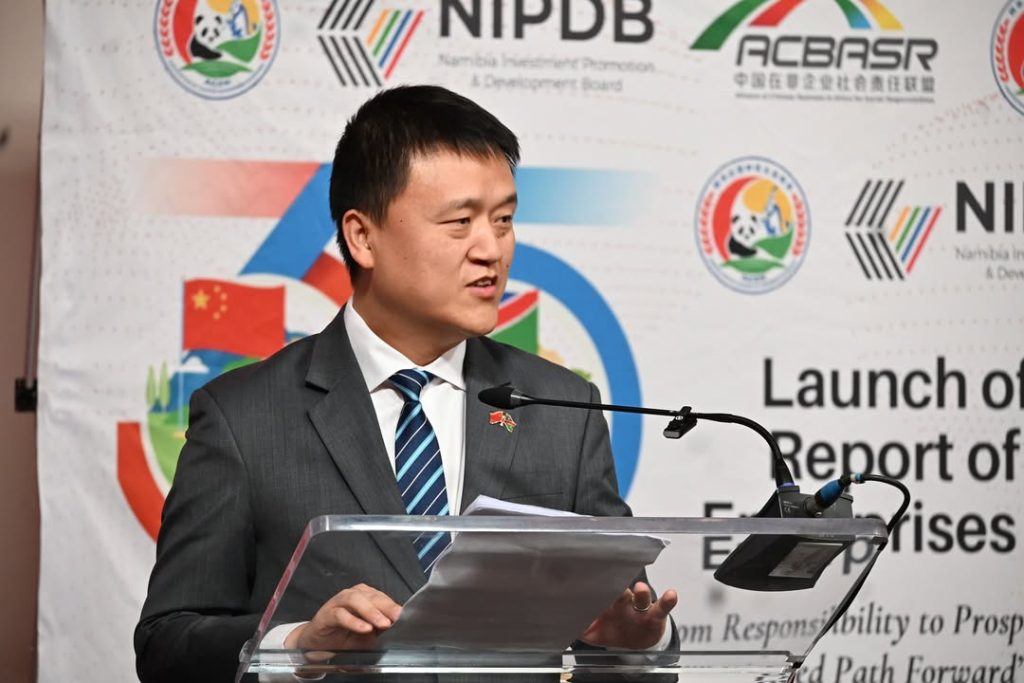
Chinese enterprises have generated more than 10,000 jobs in Namibia since 2013, according to a corporate social responsibility (CSR) report released in Windhoek.
The jobs span mining, energy, agriculture, infrastructure development, manufacturing and services.
The report showed a steady rise in employment, with 7,663 jobs in 2020, 9,432 in 2021, 10,150 in 2022, and a peak of 10,930 in 2023 before easing slightly to 10,515 in 2024.
Deputy Minister of Industries, Mines and Energy, Gaudencia Krohne, said Chinese enterprises had contributed significantly to local employment.
“Since 2015, Chinese enterprises in Namibia have created more than 10,000 direct and indirect jobs across sectors including mining, energy, agriculture, infrastructure development, manufacturing, and services,” she said.
Krohne stressed the importance of skills transfer alongside job creation.
“Many of these opportunities are accompanied by on-the-job training and skills transfer, ensuring Namibians gain expertise that will benefit the nation well into the future,” she said.
She also cautioned that development projects must not neglect local communities.
“Development that does not involve or empower local communities cannot be sustained. Consulting communities and addressing their needs is essential for long-term success,” she said.
The Association of Chinese Enterprises in Namibia (ACEN) linked these contributions to Namibia’s broader industrialisation agenda. ACEN President, Luo Wei, said: “From mineral resource development to infrastructure upgrades, from technology transfer to talent cultivation, Chinese enterprises have implemented many benchmark projects across strategic sectors such as uranium mining, port construction, and renewable energy.”
The Ministry of Industries, Mines and Energy reaffirmed that sustainable employment remains a key policy priority. Krohne highlighted value addition in mining, renewable energy expansion and stronger international partnerships as central to creating lasting opportunities.
“As our President has emphasised, skills transfer, local content, and knowledge-sharing are essential pillars of Namibia’s development. These must remain central to every partnership,” she said.
Margareth Gustavo, Executive for Competitiveness and Branding at the Namibia Investment Promotion and Development Board (NIPDB), underscored the role of Chinese enterprises in Namibia’s growth.
“This report highlights a crucial dimension in the commitment of these companies to social responsibility, particularly in energy, mining and infrastructure,” she said.
Gustavo added that sustainable development relies on empowering both enterprises and communities in line with Namibia’s national priorities. She noted the creation of over 10,000 jobs as a key outcome of Chinese investment.
“Indeed, among the highlights is the more than 10,000 employment opportunities created by Chinese enterprises,” she said.
She also commended Chinese investors for their responsible business practices.
“We welcome continued collaboration built on shared values and mutual support,” Gustavo said.