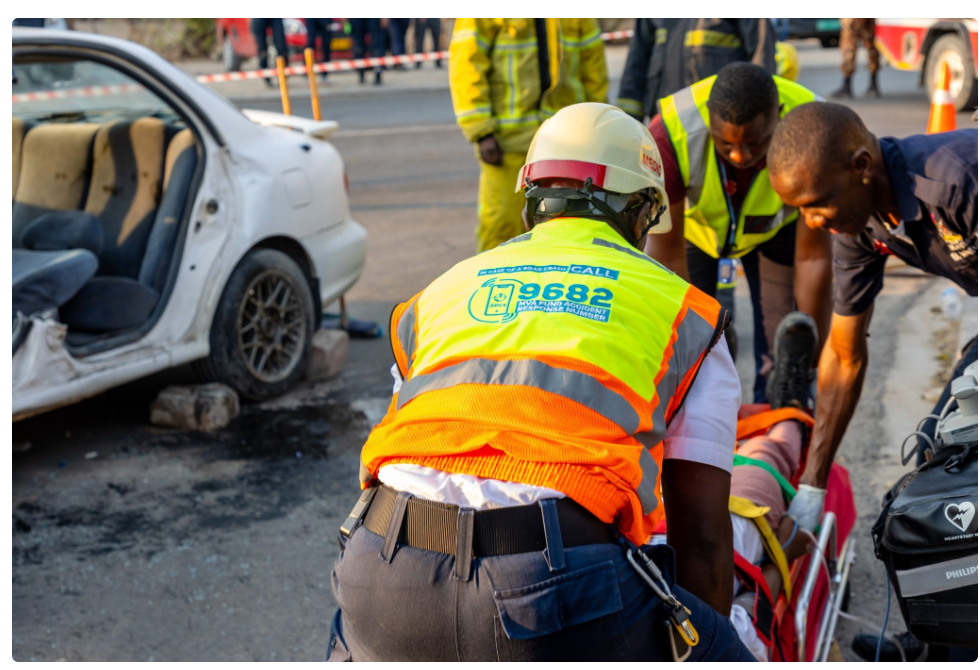
The Motor Vehicle Accident (MVA) Fund has called for the accelerated revival and expansion of Namibia’s rail network after 48 people were killed and 211 injured in 112 truck-involved crashes recorded between 1 January and 16 September 2026.
MVA Fund Manager for Accident and Injury Prevention Jones Lutombi said shifting more long-distance freight from roads to rail could reduce the exposure of heavy vehicles to crashes along Namibia’s major transport corridors.
He said Namibia’s ambition to become a regional logistics hub requires a multimodal transport system that supports freight movement while improving road safety.
“We need to have a shift into a multimodal transport system that caters for every road user. Whether you are a cyclist or a pedestrian. We need to separate and calm the roads. We need to embrace road user separation, and then we need to have fleet standards,” Lutombi said.
While road freight remains critical to trade and economic activity, Lutombi said greater use of rail and intermodal transport could reduce the number of trucks travelling long distances on major corridors.
“Road freight is indispensable, but rail and intermodal transfer can reduce avoidable crash exposure along these corridors,” he said.
Lutombi said Namibia should increasingly use rail to move cargo destined for regional markets, particularly along trade corridors linking Walvis Bay with neighbouring countries.
“We need to aspire to start doing that. The rail route does not pick cargo from Namibia to Katima. We need to start doing that,” he said.
He also argued that road safety should be viewed as a productivity issue for the logistics sector because crashes, congestion, breakdowns and driver fatigue can disrupt supply chains.
“Safety as productivity issue. Fatigue, congestion, breakdowns and severe crashes are supply chain risks, not only road risks,” Lutombi said.
MVA Fund Chief Corporate Affairs Officer John Haufiku said Namibia recorded 112 truck-involved crashes between 1 January and 16 September 2026, resulting in 211 injuries and 48 fatalities.
Erongo recorded the highest number of truck-related crashes at 30, resulting in 15 fatalities, while Khomas recorded 21 crashes and the highest number of injuries at 59.
Otjozondjupa recorded 14 crashes, 36 injuries and 14 fatalities. Together, Erongo and Otjozondjupa accounted for 29 of the 48 truck-related deaths recorded during the period.
“The data further show that collisions were the most common crash type, accounting for 57 crashes, 157 injuries and 37 fatalities. Pedestrian-related crashes accounted for 24 incidents, 17 injuries and 10 fatalities, highlighting the vulnerability of pedestrians in crashes involving heavy vehicles,” Haufiku said.
He said collisions accounted for approximately 77% of all injuries and fatalities recorded in truck-related crashes, highlighting the severity of heavy-vehicle collisions on Namibia’s roads.
Haufiku said the figures reinforce the need for greater attention to truck driver safety, responsible heavy-vehicle operations, pedestrian awareness and measures to reduce collision-related fatalities along the country’s major transport routes.