Concerns over transparency, consultation and community inclusion in Namibia’s emerging green hydrogen sector are intensifying as local communities and civil society groups question whether large-scale projects are benefiting ordinary Namibians.
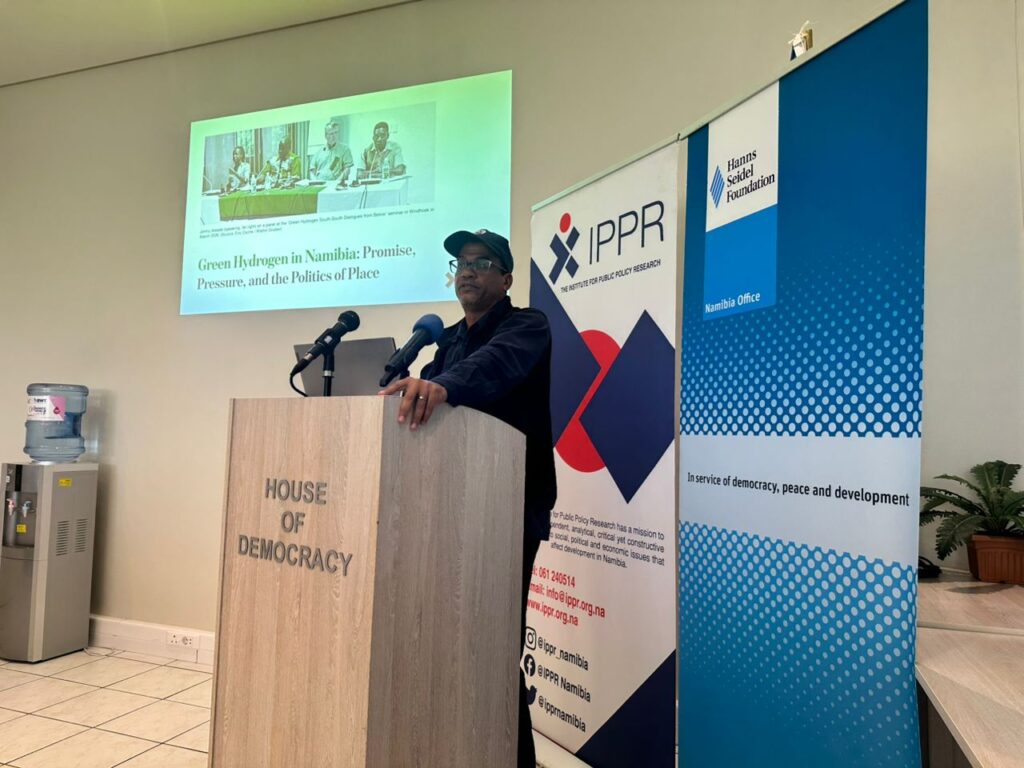
The warning was issued by the Institute for Public Policy Research (IPPR) during the launch of the latest Green Hydrogen Monitor, where researchers cautioned that growing tensions around project implementation could escalate if communities continue to feel excluded from decision-making processes.
IPPR Research Associate Frederico Links said communities in areas targeted for green hydrogen development are not rejecting investment or economic development, but are increasingly concerned about how projects are being rolled out.
“I think it needs to be made clear, as we have stated in previous editions of the Green Hydrogen Monitor, and as he also highlights quite clearly here, that communities in Daures and other parts of the country are not opposed to progress. The concerns are centred on how development is implemented and whether it reflects local realities. Communities are seeking approaches that are inclusive, transparent, and respectful of both environmental systems and cultural heritage. Ultimately, it comes down to transparency, inclusion, and respect for people’s environments and livelihoods,” Links said.
He warned that poor communication between project developers and local communities is creating unnecessary mistrust and tensions on the ground.
The concerns were amplified during an international seminar hosted earlier this year at the Namibia University of Science and Technology (NUST), where researchers, academics, indigenous leaders and civil society representatives from countries including Brazil, Colombia, Chile and South Africa shared experiences linked to large-scale energy and extractive projects.
Participants highlighted similarities between Namibia’s green hydrogen ambitions and experiences elsewhere, particularly concerns over the exclusion and marginalisation of local and indigenous communities.
Links said while Namibia has so far avoided the violent conflicts seen in some countries linked to mining and energy developments, warning signs are beginning to emerge.
“Namibia’s situation remains comparatively peaceful, and we do not see widespread violence or intimidation linked to these projects. However, there are concerns and whispers of growing tensions, and nobody wants the situation to escalate further,” he said.
At the same time, concerns are mounting over whether Namibia’s education system is capable of supplying the specialised skills needed to support the country’s planned green industrialisation drive.
Links cited findings from the Namibia Investment Promotion and Development Board (NIPDB) State of Skills Demand and Supply report, which found that Namibia’s education and training systems are not adequately prepared to meet the future labour demands of sectors such as green hydrogen, oil and gas, artificial intelligence and digital industries.
He warned that without major reforms to education and skills development, many specialised positions in emerging industries could ultimately be filled by foreign expertise rather than Namibians, limiting local participation in sectors expected to drive future economic growth.