Friday, July 31, 2026
SUBSCRIBE
The Brief | Namibia's Leading Business & Financial News
  • Home
  • Companies
    • Finance
    • Agriculture
    • Technology
    • Property
    • Trade
    • Tourism
  • Business & Economy
  • E-PAPERreader
  • Mining & Energy
  • Opinions
    • Analysis
    • Columnists
  • Africa
No Result
View All Result
The Brief | Namibia's Leading Business & Financial News
  • Home
  • Companies
    • Finance
    • Agriculture
    • Technology
    • Property
    • Trade
    • Tourism
  • Business & Economy
  • E-PAPERreader
  • Mining & Energy
  • Opinions
    • Analysis
    • Columnists
  • Africa
No Result
View All Result
The Brief | Namibia's Leading Business & Financial News
Subscribe
No Result
View All Result
DSTV WC26 Campaign
Home Latest

Green hydrogen projects face scrutiny over community inclusion and transparency

by reporter
May 21, 2026
in Latest
7
A A

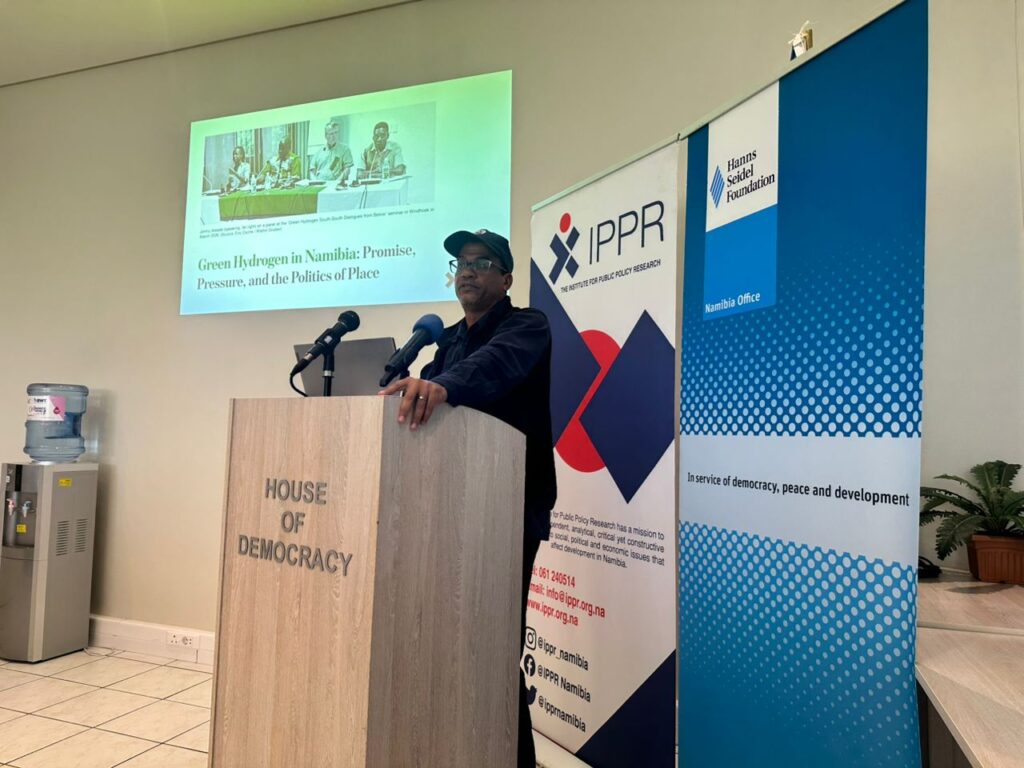
Concerns over transparency, consultation and community inclusion in Namibia’s emerging green hydrogen sector are intensifying as local communities and civil society groups question whether large-scale projects are benefiting ordinary Namibians.

The warning was issued by the Institute for Public Policy Research (IPPR) during the launch of the latest Green Hydrogen Monitor, where researchers cautioned that growing tensions around project implementation could escalate if communities continue to feel excluded from decision-making processes.

IPPR Research Associate Frederico Links said communities in areas targeted for green hydrogen development are not rejecting investment or economic development, but are increasingly concerned about how projects are being rolled out.

“I think it needs to be made clear, as we have stated in previous editions of the Green Hydrogen Monitor, and as he also highlights quite clearly here, that communities in Daures and other parts of the country are not opposed to progress. The concerns are centred on how development is implemented and whether it reflects local realities. Communities are seeking approaches that are inclusive, transparent, and respectful of both environmental systems and cultural heritage. Ultimately, it comes down to transparency, inclusion, and respect for people’s environments and livelihoods,” Links said.

He warned that poor communication between project developers and local communities is creating unnecessary mistrust and tensions on the ground.

The concerns were amplified during an international seminar hosted earlier this year at the Namibia University of Science and Technology (NUST), where researchers, academics, indigenous leaders and civil society representatives from countries including Brazil, Colombia, Chile and South Africa shared experiences linked to large-scale energy and extractive projects.

Participants highlighted similarities between Namibia’s green hydrogen ambitions and experiences elsewhere, particularly concerns over the exclusion and marginalisation of local and indigenous communities.

Links said while Namibia has so far avoided the violent conflicts seen in some countries linked to mining and energy developments, warning signs are beginning to emerge.

“Namibia’s situation remains comparatively peaceful, and we do not see widespread violence or intimidation linked to these projects. However, there are concerns and whispers of growing tensions, and nobody wants the situation to escalate further,” he said.

At the same time, concerns are mounting over whether Namibia’s education system is capable of supplying the specialised skills needed to support the country’s planned green industrialisation drive.

Links cited findings from the Namibia Investment Promotion and Development Board (NIPDB) State of Skills Demand and Supply report, which found that Namibia’s education and training systems are not adequately prepared to meet the future labour demands of sectors such as green hydrogen, oil and gas, artificial intelligence and digital industries.

He warned that without major reforms to education and skills development, many specialised positions in emerging industries could ultimately be filled by foreign expertise rather than Namibians, limiting local participation in sectors expected to drive future economic growth.


author avatar
reporter
See Full Bio
Previous Post

Conservation sector contributes N$109 million to Namibia’s economy in 2025

Next Post

Urbanisation and oil sector growth increase pressure on Namibia’s housing and infrastructure

Must Read

Person using an ATM, inserting a card while holding a wallet nearby in a bank lobby
Latest

High banking costs keep many Namibians out of formal financial system

July 31, 2026
Professional man in a white shirt with a teal logo stands with arms crossed in a bright, modern office setting (logo reads 'DAURES GREEN HYDROGEN VILLAGE').
Latest

Mondjila appointed to lead Daures Green Hydrogen Village Phase 2

July 31, 2026
Namibia fuel prices set to drop in June
Latest

Fuel prices to rise by N$2.00 a litre as government restores levies

July 31, 2026
Namibia’s beef exports plunge nearly 50% in Q2
Latest

Namibia targets higher beef exports and value addition in livestock sector

July 31, 2026
Erongo Regional Council sign on a beige brick wall with a blue canopy over a gated entrance along a sidewalk.
Latest

Erongo proposes reclamation plant to address water challenges

July 31, 2026
Professional headshot of a man in a dark suit and red tie against a white background.
Latest

NamPost appoints Willem Mouton as CEO

July 31, 2026
Load More

Related News

WFP provides emergency food aid to over 96,000 Namibians in July

WFP provides emergency food aid to over 96,000 Namibians in July

September 9, 2025
Are you being gaslighted?

Are you being gaslighted?

June 8, 2023
Namibia’s food costs rise despite strong cereal harvest

Namibia’s food costs rise despite strong cereal harvest

August 7, 2025

Browse by Category

  • Africa
  • Agriculture
  • Analysis
  • Business & Economy
  • Columnists
  • Companies
  • Finance
  • Finance
  • Fisheries
  • Green Hydrogen
  • Health
  • Investing
  • Latest
  • Market
  • Mining & Energy
  • Namibia
  • namibia
  • News
  • Opinions
  • Property
  • Retail
  • Technology
  • Tourism
  • Trade
The Brief | Namibia's Leading Business & Financial News

The Brief is Namibia's leading daily business, finance and economic news publication.

CATEGORIES

  • Business & Economy
  • Companies
    • Agriculture
    • Finance
    • Fisheries
    • Health
    • Property
    • Retail
    • Technology
    • Tourism
    • Trade
  • Finance
  • Green Hydrogen
  • Investing
  • Latest
  • Market
  • Mining & Energy
  • namibia
  • News
    • Africa
    • Namibia
  • Opinions
    • Analysis
    • Columnists

CONTACT US

Cell: +264814612969

Email: newsdesk@thebrief.com.na

© 2026 The Brief | All Rights Reserved. Namibian Business News, Current Affairs, Analysis and Commentary

Welcome Back!

Login to your account below

Forgotten Password?

Retrieve your password

Please enter your username or email address to reset your password.

Log In
No Result
View All Result
  • Home
  • Companies
  • Mining & Energy
  • Business & Economy
  • Opinions
    • Analysis
    • Columnists
  • Africa

© 2026 The Brief | All Rights Reserved. Namibian Business News, Current Affairs, Analysis and Commentary

This website uses cookies. By continuing to use this website you are giving consent to cookies being used. Visit our Privacy and Cookie Policy.