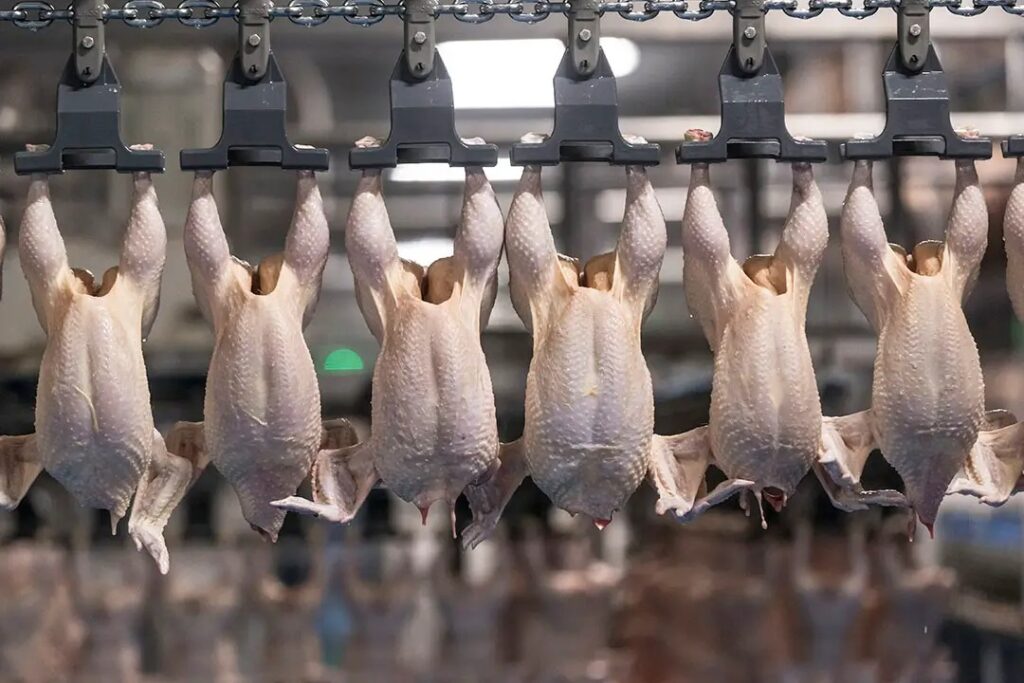
Namibia slaughtered 14.36 million chickens for domestic consumption by the end of September 2025, reflecting strong local production despite competition from imports, according to the Livestock and Livestock Products Board of Namibia (LLPBN).
The Board reported that processed chicken exports reached 893,782 kilograms, with Zambia taking 59.2%, Botswana 15.2%, South Africa 13.1%, and Zimbabwe 12.4%.
Imports remained high at 15.9 million kilograms year-to-date, but live-bird imports fell sharply by 79.4% from 62,150 in August to 12,800 in September, all of which were day-old chicks from South Africa.
The cumulative total for 2025 stood at 352,701, showing increasing self-sufficiency.
The sheep industry, LLPBN said, continued to decline, with 30,242 head marketed in September, down 31.3% year-on-year.
Total marketing fell 20.1% month-on-month to 423,174 head year-to-date, compared to 699,968 in 2024. Slaughtering improved slightly to 12,248 head, up 4.7% year-on-year, but live exports dropped 44.3% to 17,994 head, mainly to South Africa.
Producer prices remained high due to limited supply and herd rebuilding. The A2 lamb price averaged N$85.53/kg, down 9.2% month-on-month but 20.7% higher than a year ago. Dorper lambs averaged N$41.81/kg, bringing the year-to-date average to N$38.52/kg, up 18.6% from 2024.
Year-to-date sheep-meat exports dropped 56.7% to 273,546 kilograms from 632,045 kilograms last year.
In September, exports totalled 33,845 kilograms, up 20.4% year-on-year, with 79% shipped to South Africa and 21% to the Seychelles, the Board said.
The goat sector showed mixed performance. Marketing rose 25.1% month-on-month to 13,613 head but remained 16.8% lower than last year.
Live exports totalled 13,576 head, with South Africa importing 13,139, followed by Botswana, Zimbabwe, Tanzania, and Angola.
Year-to-date volumes reached 90,457 head, down 15.7% as farmers rebuilt herds. Auction prices strengthened, with goat lambs averaging N$50.16/kg, kapater N$45.43/kg, and rams N$37.92/kg, reflecting steady demand and improved animal conditions, LLPBN noted.
The pork industry remained the most stable performer, with 4,879 pigs marketed in September, up 14.2% month-on-month and 21% year-on-year.
Imports surged 54.3% to 718,243 kilograms, 74.5% higher than last year. Year-to-date imports reached 5.1 million kilograms, slightly below 2024’s 5.2 million kilograms.
Spain remained Namibia’s top supplier, accounting for 70.6% of pork imports, followed by South Africa (20.2%), France (2.5%), Belgium (2.3%), and Ireland (1.0%), according to the LLPBN.