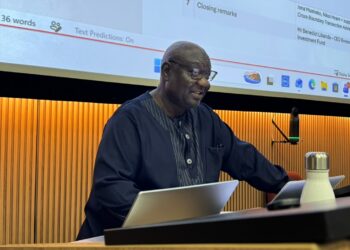
By Dr Matuikuani Dax
In Namibia today, we are faced with a stark dichotomy. On the one hand, policymakers cite an “oversupply” of medical doctors and nurses.
Each year, universities graduate cohorts of young health professionals ready to serve, yet these highly trained doctors, nurses and allied healthworkers stand idle.
On the other hand, the public is constantly told of a health sector “under crisis”: staff shortages at clinics, gaps in primary care, and patients left unattended.
How can both realities be true?
This contradiction is not the result of bad planning. It is the product of politics — and more precisely, of how health financing decisions are made.
The Political Economy of Health
For too long, healthcare has been framed as a moral good dependent on donor generosity or fiscal availability—rather than as a structural outcome of political economy. The politics of health unfold in the fiscal ledgers that decide whose lives are worth investing in.
A political economy analysis forces us to ask uncomfortable questions: Who benefits from the current allocation of resources? Who loses? And why does a country with upper-middle-income credentials still fail to fund its most basic health needs?
Health financing is not an accounting exercise. It is the most visible expression of political will. When budgets are drawn, choices are made: debt repayment versus hospital expansion, defense procurement versus primary health care. Namibia does not face a “health financing crisis” so much as a political prioritization crisis.
Structures That Constrain Us
Since independence, Namibia’s health sector has relied on domestic resources and external assistance. Donor support is shrinking, and domestic financing has not filled the gap. Health spending remains at 11.5% of government expenditure, short of the 15% Abuja target.
Recruitment freezes become the default adjustment tool. Posts are frozen. Graduates remain idle. Strategic HRH plans sit on shelves, unfunded. Primary health care—the bedrock of universal health coverage—suffers from a lack of personnel. The human impact is measured in mothers turned away from antenatal care, TB patients lost to follow-up, and the silent, preventable tragedies that never make headlines. Notwithstanding the increase in unemployment among qualified health professionals.
Underpinning this is a simple structure: limited fiscal space, competing priorities, and a system that treats health as a cost rather than an investment.
The Mirage of Fiscal Space
Government officials often lament limited fiscal space. The state insists it has no money to hire more health workers. Yet recent health procurement reforms tell a different story. By tightening loopholes in pharmaceutical purchasing, the Ministry of Health has demonstrated that resources can be recovered. Millions that once vanished into inefficiencies are now being redirected toward services.
These reforms represent a candle in the dark. They show that with political commitment, Namibia can recoup funds and reinvest them in health. This is not a trivial win. It proves that fiscal space is not a static figure. It is created — or destroyed — by governance choices. If we can save money through smarter procurement, why not apply the same rigor to staffing and infrastructure development?
The “Oversupply” Narrative
Labelling unemployed doctors and nurses an “oversupply” is politically convenient. It shifts accountability from government inaction onto the graduates themselves. But let us be clear: no country with rising population needs, persistent HIV and TB burdens, and widening non-communicable disease threats can claim to have too many health workers.
Namibia’s predicament is not one of oversupply — it is one of absorption. The inability to employ available health professionals reflects the mismatch between budget ceilings and health needs. To describe this as an oversupply is to misdiagnose the problem. The pathology is political, not demographic.
Unless Namibia strengthens its domestic financing base, the country risks a hollowed-out health system — programs without funding, professionals without jobs, and communities without care.
A Provocation, Not a Plea
In conclusion, health systems are reflections of the societies they serve. Namibia’s health workforce dilemma invites a broader reckoning with how domestic policy choices shape public welfare. Namibia must decide whether it is content to produce unemployed doctors and nurses while simultaneously exporting its talent and importing health crises. The ultimate cost of this neglect will be tallied not just in fiscal reports, but in shortened lives, broken families, and a nation that failed to care for its own people when it had the means to do so
The “oversupply” of health professionals is not an inevitability. It is the symptom of an absent architecture — a lack of a coherent framework linking workforce production, financing, and service delivery. It is a choice — a choice to underfund health, to underinvest in primary care, and to misalign national priorities.
*Dr. Matuikuani Dax is a Global Health Specialist and Independent consultant. You can contact her on matuikuani@gmail.com