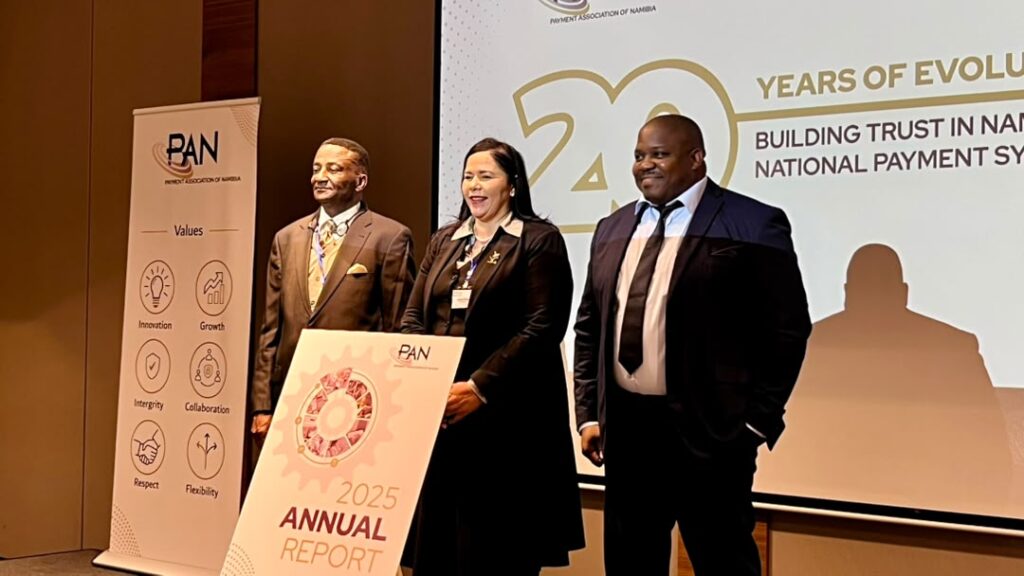
The Payments Association of Namibia (PAN) increased its revenue to N$10.62 million during the 2025 financial year, driven by higher membership contributions, while ending the year with more than N$5.5 million in accumulated reserves despite recording a small accounting deficit.
According to PAN’s 2025 Annual Report, membership contributions rose to N$10.48 million, remaining the association’s main source of income and funding governance reforms, organisational development and preparations for its expanded role under the Payments System Management Act.
PAN Acting Chief Executive Officer Mbapeua Kauuova said the association has continued to evolve alongside Namibia’s payments sector over the past 20 years while strengthening confidence in the national payment system.
“For twenty years, Payments Association of Namibia has grown alongside Namibia’s payments landscape while remaining committed to one enduring principle: building trust in the national payment system. This report chronicles our journey during the 2025 financial year and reflects on twenty years of progress while looking ahead to the next chapter of Namibia’s payments evolution,” Kauuova said.
The report said PAN invested in governance reforms, organisational restructuring and technical capacity during the year to prepare for a more complex and modern payments environment.
The association implemented a revised organisational structure, strengthened executive and technical capacity and advanced governance reforms required under the Payments System Management Act.
Despite posting an accounting deficit of N$15,891, PAN ended the financial year with approximately N$6.0 million in cash and cash equivalents and received an unmodified audit opinion.
“While these investments resulted in a modest accounting deficit of N$15,891, the Association concluded the year with more than N$5.5 million in accumulated reserves and approximately N$6.0 million in cash and cash equivalents, demonstrating that institutional strengthening was achieved without compromising financial sustainability,” Kauuova said.
He said maintaining a strong financial position would enable PAN to continue supporting the implementation of the National Payment System Strategy 2026–2030 and the country’s increasingly interconnected payments ecosystem.
Speaking at PAN’s annual general meeting and the launch of the 2025 annual report during the association’s 20th anniversary celebrations, Bank of Namibia Deputy Governor Loenie Dunn said Namibia had continued expanding its digital payments infrastructure, with the country’s instant payments solution becoming operational in June 2026.
“The future of payments will not be shaped by regulation or technology alone. It will ultimately be shaped by how effectively we collectively collaborate. Payments are becoming increasingly interoperable and digital, and cooperation between regulators, payment service providers and the broader payments ecosystem will be essential,” Dunn said.