China has begun implementing agreements signed during President Netumbo Nandi-Ndaitwah’s recent state visit to Beijing, with follow-up engagements already underway to advance cooperation in trade, agriculture, education, healthcare and investment.
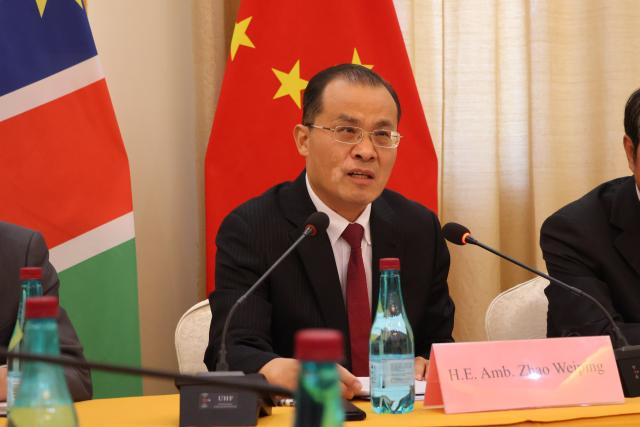
Chinese Ambassador to Namibia Zhao Weiping said the visit marked a new phase in bilateral relations after both countries agreed to elevate ties to a China-Namibia community with a shared future for the new era.
Speaking on the outcomes of the visit, Zhao said the two countries signed eight bilateral cooperation agreements aimed at expanding practical collaboration and strengthening political and economic relations.
“This visit was a complete success, which will have far-reaching significance on the development of China-Namibia relations. President Xi Jinping and President Ndaitwah jointly decided to elevate the bilateral relations to a China-Namibia community with a shared future for the new era,” Zhao said.
He said China had committed additional government grant funding for development projects in Namibia and expanded support for education and skills development.
According to Zhao, China’s Ministry of Commerce awarded scholarships for master’s and doctoral studies to 87 Namibian students this year, while the two countries also signed an agreement on technical and vocational education and training.
Agriculture also featured prominently during the visit, with Namibia securing a phytosanitary protocol that will allow fresh table grapes to be exported to China.
Zhao said China had also opened its market to wild aquatic products from Africa, creating new export opportunities for Namibia.
He added that China’s decision to extend zero-tariff treatment to all tariff lines for the 53 African countries that maintain diplomatic relations with Beijing would further boost Namibia’s agricultural exports.
“Starting from May 1, China extended zero-tariff treatment for 100 percent tariff lines to all 53 African countries having diplomatic relations with China. We will adopt more measures to facilitate the export of African agricultural products to China,” Zhao said.
The ambassador said the two countries also agreed to expand cooperation in healthcare through medical personnel training, disease control, emergency health response and pharmaceutical production, while China would continue deploying medical teams to Namibia.
He said the signing of the Framework Agreement on Economic Partnership for Shared Development would provide a long-term institutional framework for expanding bilateral trade and investment.
Zhao added that China would encourage more Chinese companies to invest in Namibia and participate in the country’s industrialisation.
“China encourages more competent Chinese enterprises to invest and operate in Namibia and strengthen cooperation in the process of Namibia’s industrialisation,” he said.
The ambassador noted that President Nandi-Ndaitwah was accompanied by about 200 Namibian business representatives, describing it as the largest Namibian business delegation to visit China since diplomatic relations were established.
He said business promotion events in Beijing, Shanghai and Guangzhou, together with engagements in other provinces, strengthened commercial ties between companies from the two countries. During the visit, the President also met representatives from more than 30 Chinese companies.
Zhao said implementation of the agreements had already begun through engagements with Namibian ministers, while government and business delegations from China’s Guangdong and Sichuan provinces are expected to visit Namibia in the coming months to advance cooperation.
“Nothing will only stay on the papers. There will certainly be concrete actions. We will work together with the Namibian side to implement everything we have agreed through this visit,” Zhao said.