Friday, July 31, 2026
SUBSCRIBE
The Brief | Namibia's Leading Business & Financial News
  • Home
  • Companies
    • Finance
    • Agriculture
    • Technology
    • Property
    • Trade
    • Tourism
  • Business & Economy
  • E-PAPERreader
  • Mining & Energy
  • Opinions
    • Analysis
    • Columnists
  • Africa
No Result
View All Result
The Brief | Namibia's Leading Business & Financial News
  • Home
  • Companies
    • Finance
    • Agriculture
    • Technology
    • Property
    • Trade
    • Tourism
  • Business & Economy
  • E-PAPERreader
  • Mining & Energy
  • Opinions
    • Analysis
    • Columnists
  • Africa
No Result
View All Result
The Brief | Namibia's Leading Business & Financial News
Subscribe
No Result
View All Result
DSTV WC26 Campaign
Home Latest

Bank of Namibia  hikes repo rate to 6.75%

by reporter
June 17, 2026
in Latest
9
A A
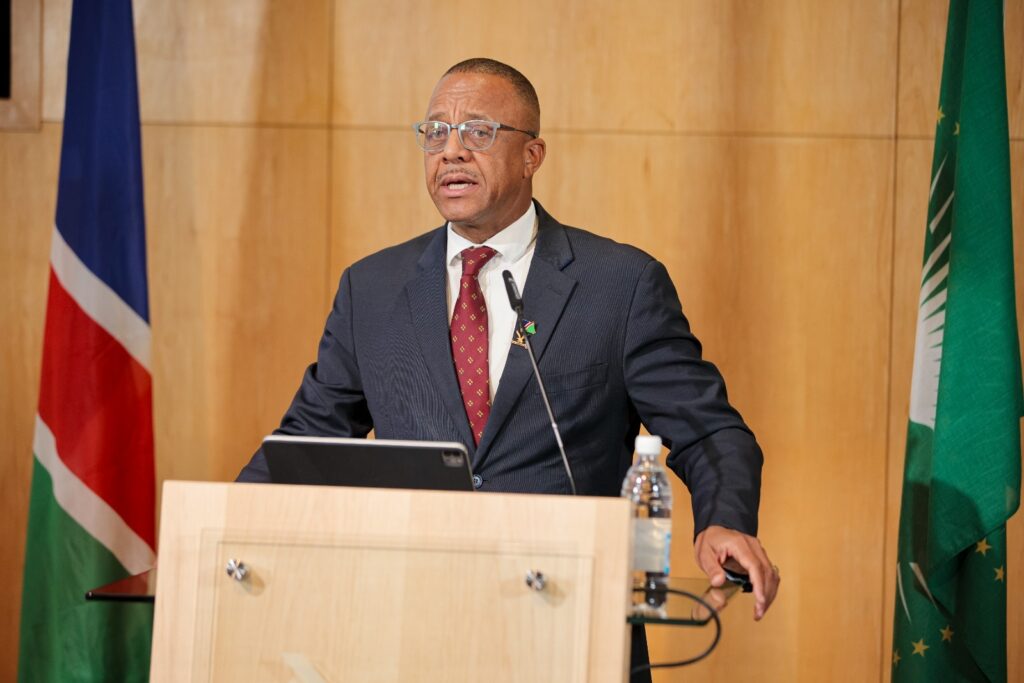
Man in a dark suit and red tie delivers a speech at a wooden podium with flags in the background

The Bank of Namibia (BoN) has increased the repo rate by 25 basis points to 6.75%, citing rising inflationary pressures linked to higher oil prices, food costs and the need to protect the one-to-one peg between the Namibia dollar and the South African rand.

The decision, taken by the Monetary Policy Committee (MPC) during its meeting on 15 and 16 June, was in line with the expectations of economists surveyed by The Brief, who had largely forecast a 25-basis-point increase.

The move raises the prime lending rate to 10.25%.

Bank of Namibia Governor Ebson Uanguta said the MPC opted for a moderate tightening of monetary policy to contain inflation risks while safeguarding macroeconomic stability.

“This policy stance is deemed appropriate to mitigate inflationary risks, support the stock of international reserves and safeguard the one-to-one link between the Namibia Dollar and the South African Rand,” Uanguta said.

The central bank said inflation has accelerated both globally and domestically as energy price shocks and supply chain disruptions continue to filter through economies.

Uanguta noted that South African inflation rose from 3.1% in March to 4.0% in April, while several major central banks, including the South African Reserve Bank, the European Central Bank and the Bank of Japan, have shifted towards tighter monetary policy.

In Namibia, headline inflation increased from 2.1% in March to 4.1% in May, driven mainly by higher transport costs resulting from rising fuel prices.

As a result, the BoN revised its inflation outlook upwards and now expects average inflation of 4.0% in 2026 before easing to 3.6% in 2027.

“The upward revision is grounded mainly on the assumption of higher oil prices,” Uanguta said.

He warned that inflation risks remain tilted to the upside due to possible increases in administered prices, exchange rate movements and any renewed escalation of conflict in the Middle East.

Despite the rate increase, the central bank acknowledged that domestic economic activity remains subdued.

Economic performance weakened during the first four months of 2026, particularly in the mining, manufacturing, tourism, electricity generation, construction and communications sectors. Agriculture, however, recorded strong growth supported by improved crop production.

The BoN expects economic growth to improve from 1.7% in 2025 to 2.6% in 2026, supported by stronger activity in uranium mining, wholesale and retail trade, financial services and public administration.

However, Uanguta cautioned that geopolitical tensions, weaker global demand, the potential emergence of El Niño and water supply constraints affecting uranium mining continue to pose risks to the outlook.

Private sector credit extension remained relatively weak despite some improvement. Credit growth increased to 4.8% year-on-year in April, driven mainly by household borrowing, while lending to businesses moderated.

Meanwhile, Namibia’s international reserves increased from N$51.8 billion at the end of March to N$55.4 billion at the end of May, providing 3.5 months of import cover.

“The Committee was mindful of the subdued domestic economic activity and sluggish credit extension to the private sector. In balancing these against the imperative to maintain the currency peg and mitigate second-round effects of the energy shock, a moderate tightening of monetary policy was deemed appropriate,” Uanguta said.

He added that the central bank would continue to monitor inflation expectations, capital flows and broader economic developments and would take further action if necessary.

“The Bank of Namibia will continue to closely monitor developments and stands ready to take appropriate measures to contain second-round inflationary effects and safeguard the currency peg,” Uanguta said.


author avatar
reporter
See Full Bio
Previous Post

Govt moves to establish Tax Court within High Court system

Next Post

Hardap expands farmer support as region pushes to become agricultural hub

Must Read

Namibia’s beef exports plunge nearly 50% in Q2
Latest

Namibia targets higher beef exports and value addition in livestock sector

July 31, 2026
Erongo Regional Council sign on a beige brick wall with a blue canopy over a gated entrance along a sidewalk.
Latest

Erongo proposes reclamation plant to address water challenges

July 31, 2026
Professional headshot of a man in a dark suit and red tie against a white background.
Latest

NamPost appoints Willem Mouton as CEO

July 31, 2026
Outdoor street market with colorful umbrellas and fruit stalls along a sunny sidewalk.
Latest

Windhoek approves 20 new informal trading sites to tackle 3,000-space shortage

July 31, 2026
Why Humility Is the New Competitive Advantage in Leadership
Latest

Know the difference between enjoying your age and destroying your future

July 31, 2026
Close-up portrait of a woman wearing a gray blazer over a black-and-white striped top, facing the camera against a gray background.
Latest

Leadership is not a position. It’s a responsibility

July 31, 2026
Load More

Related News

NaCC determines 52 mergers and acquisitions, seeks summoning powers

NaCC determines 52 mergers and acquisitions, seeks summoning powers

December 8, 2023
Govt calls for extensive lead exposure studies in Rosh Pinah

Govt calls for extensive lead exposure studies in Rosh Pinah

October 8, 2023
Let’s start at the grassroots to empower Namibian MSMEs for retail success

Let’s start at the grassroots to empower Namibian MSMEs for retail success

February 5, 2025

Browse by Category

  • Africa
  • Agriculture
  • Analysis
  • Business & Economy
  • Columnists
  • Companies
  • Finance
  • Finance
  • Fisheries
  • Green Hydrogen
  • Health
  • Investing
  • Latest
  • Market
  • Mining & Energy
  • namibia
  • Namibia
  • News
  • Opinions
  • Property
  • Retail
  • Technology
  • Tourism
  • Trade
The Brief | Namibia's Leading Business & Financial News

The Brief is Namibia's leading daily business, finance and economic news publication.

CATEGORIES

  • Business & Economy
  • Companies
    • Agriculture
    • Finance
    • Fisheries
    • Health
    • Property
    • Retail
    • Technology
    • Tourism
    • Trade
  • Finance
  • Green Hydrogen
  • Investing
  • Latest
  • Market
  • Mining & Energy
  • namibia
  • News
    • Africa
    • Namibia
  • Opinions
    • Analysis
    • Columnists

CONTACT US

Cell: +264814612969

Email: newsdesk@thebrief.com.na

© 2026 The Brief | All Rights Reserved. Namibian Business News, Current Affairs, Analysis and Commentary

Welcome Back!

Login to your account below

Forgotten Password?

Retrieve your password

Please enter your username or email address to reset your password.

Log In
No Result
View All Result
  • Home
  • Companies
  • Mining & Energy
  • Business & Economy
  • Opinions
    • Analysis
    • Columnists
  • Africa

© 2026 The Brief | All Rights Reserved. Namibian Business News, Current Affairs, Analysis and Commentary

This website uses cookies. By continuing to use this website you are giving consent to cookies being used. Visit our Privacy and Cookie Policy.