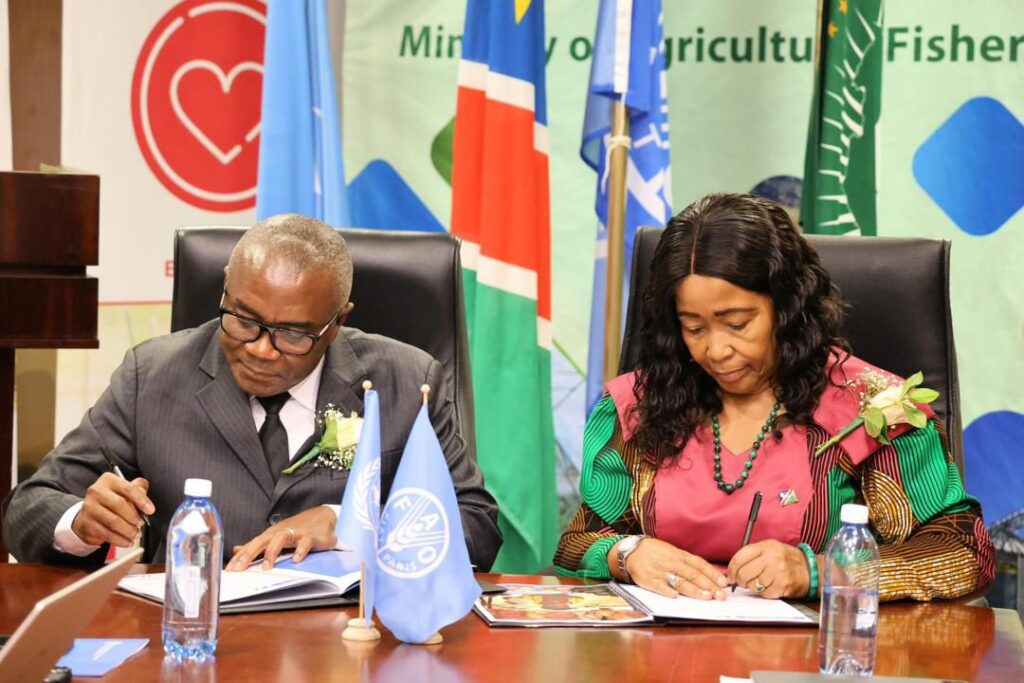
A funding gap of US$8.9 million (about N$163 million) threatens the implementation of a new food security programme in Namibia under the Food and Agriculture Organization of the United Nations (FAO) Country Programming Framework for 2025–2029.
The programme, developed in partnership with the Ministry of Agriculture, Fisheries, Water and Land Reform, requires total funding of US$15.7 million (approximately N$287 million), of which only US$6.8 million (about N$124 million) has been secured to date.
FAO Representative ad interim Patrice Talla Takoukam said additional resources will need to be mobilised to ensure full implementation.
“The total resource requirement for this Country Programming Framework is US$15.7 million, of which US$6.8 million is currently available, leaving a gap of US$8.9 million,” Takoukam said.
He noted that the funding challenge comes at a time when global development assistance is declining and competition for resources is intensifying.
“We should strategically close that gap with impact-driven evidence when global Official Development Assistance is contracting and competition for funds is intensifying,” he said.
The programme aims to support Namibia’s efforts to strengthen food security, transform agri-food systems and build climate resilience in the agricultural sector.
According to FAO, food insecurity remains a major concern in Namibia, with 57.2% of the population experiencing moderate or severe food insecurity.
“Nearly one in five Namibians is undernourished and more than one in five children under the age of five is stunted,” Takoukam said.
He also highlighted a sustained decline in public investment in agriculture over the past two decades, reflected in Namibia’s Agriculture Orientation Index.
“Namibia’s Agriculture Orientation Index stands at just 0.26, a figure that tells us that public investment in the sector most critical to rural livelihoods and national food security has been declining for decades, from 0.54 in 2001 to where we stand today,” he said.
The framework aligns with national development priorities, including the Sixth National Development Plan, Harambee Prosperity Plan II and Vision 2030.
Takoukam said FAO will pursue the remaining funding through bilateral and multilateral partnerships, climate finance mechanisms and joint United Nations programmes.
“Good intentions and comprehensive frameworks are not enough; we must make the case for investment with rigour and demonstrated results,” he said.
Minister of Agriculture, Fisheries, Water and Land Reform Inge Zaamwani said the programme will support Namibia in strengthening institutional capacity and coordination for the national agri-food transformation strategy.
“This is a cornerstone for our long-term vision, ensuring that our policies, institutions and stakeholders are aligned to drive inclusive and sustainable growth in the agricultural sector,” she said.
Zaamwani noted that implementation will be coordinated by government through the ministry, with involvement from multiple institutions, including the Ministry of Environment, Forestry and Tourism, the Ministry of Health and Social Services and the National Planning Commission.
She also acknowledged the participation of key sector institutions, including the Namibia Agronomic Board, the Livestock and Livestock Products Board of Namibia and the Agricultural Mechanisation and Seed Improvement Project (AMTA).
Meanwhile, the Government of Namibia has welcomed a contribution of 4,896 metric tonnes of rice worth US$1.7 million (about N$31 million) from the Republic of Korea through the United Nations World Food Programme’s OnDemand Service.
The rice will support approximately 300,000 people between April and December 2026, as vulnerable households continue to recover from the 2024–2025 drought, one of the most severe in the country’s history, which affected an estimated 1.4 million people across all 14 regions.