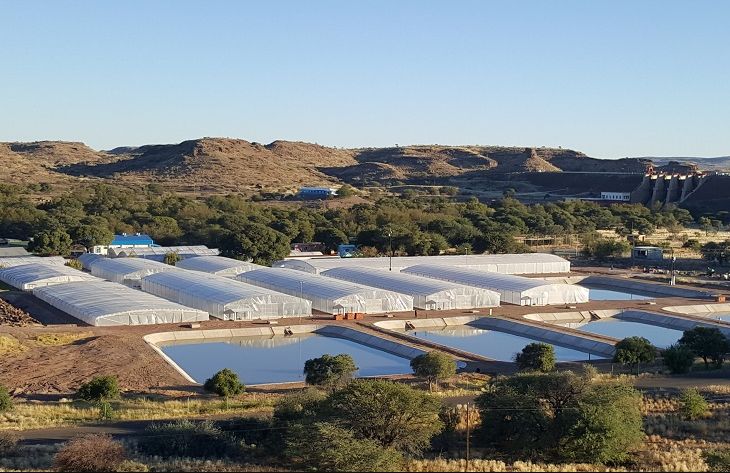
The Ministry of Agriculture, Fisheries and Land Reform is exploring a public–private partnership (PPP) model to revive the Hardap Inland Aquaculture Centre as government moves to restore operations at one of Namibia’s largest inland fish production facilities.
Executive Director Teofilus Nghitila said the centre, located in the Hardap Game Park about 24 kilometres north of Mariental, represents a significant national investment in aquaculture but has fallen into a deteriorated state and requires urgent intervention to return to production.
The facility was established to support inland fisheries development by breeding freshwater fish and supplying tilapia fingerlings to small-scale farmers across several regions of the country.
“We made a brief stopover here at the aquaculture facility which in my view has been a major investment in aquaculture ever in Namibia and I think the ministry has a duty really to reinstate this facility,” Nghitila said during a recent visit to the centre.
He expressed concern over the current condition of the infrastructure, describing the facility as severely underutilised and in need of rehabilitation.
“I feel sad that I’m seeing a facility like this in this dilapidated state. It really needs all of us as management of the ministry to ensure that we make proposals either to join hands with private–public partnerships to really ensure that we attract investment to ensure that we bring this facility back to production,” he said.
Under the proposed revival plan, the ministry is considering mobilising private sector investment through a PPP arrangement to rehabilitate the centre and restore production capacity.
The Hardap Inland Aquaculture Centre plays a central role in Namibia’s inland fish farming programme, producing tilapia fingerlings which are supplied at subsidised prices to small-scale farmers in the Hardap, //Kharas, Khomas, Omaheke, Otjozondjupa and Erongo regions.
The centre also supplies fingerlings to other government aquaculture facilities, including the Leonardville Fish Farm in the Omaheke Region, where fish are grown to market size.
Nghitila said management within the ministry would assess the operational challenges affecting the centre and develop proposals aimed at restoring its production capability.
“It’s a wasted investment in my view and I think when we get back as management we need to interrogate this issue and make sure we will do everything we can to bring this facility back to production,” he said.
He added that reviving aquaculture facilities across Namibia could strengthen national food security and improve access to affordable fish products for households.
“When I look at the map where we have these aquaculture facilities countrywide, the footprints across the country are almost everywhere and if we bring them under production they will contribute immensely to national food security,” Nghitila said.
“The fish will be affordable and we will be able to distribute this fish to communities in remote areas of our country.”
According to the ministry, expanding aquaculture production could also help complement Namibia’s marine fisheries sector, where fish products are often expensive for many households.
“If we have aquaculture across the country, we will really ensure that it complements our marine fisheries which is expensive. Our efforts on aquaculture will also be an important component in our effort to make Namibia food secure,” Nghitila said.
Senior Fisheries Research Technician Ernita Morwe said production levels at the Hardap facility are currently very low due to deteriorating infrastructure and operational challenges.
She noted that if properly rehabilitated and fully capacitated, the centre could create employment opportunities, contribute to food security and support broader economic development.
Morwe urged the ministry’s leadership to prioritise the rehabilitation and capacitation of the aquaculture centre in order to restore its role in Namibia’s inland fisheries sector.
Nghitila has since directed senior management within the ministry to urgently address the operational challenges affecting the facility and set a target for the centre to return to full production by December this year.
The ministry said consultations with stakeholders will be undertaken to identify sustainable investment models and long-term solutions for the Hardap centre and other aquaculture initiatives facing similar operational constraints across the country.