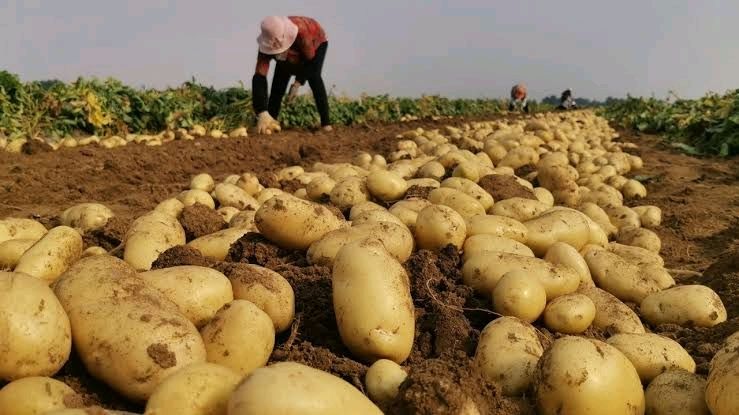
Local potato supply is expected to increase by an estimated 2,000 tonnes as the Namibian Agronomic Board advances the implementation of its Potato Value Chain Development Subsidy Scheme for the 2025/26 financial year, following the rollout of the programme’s first phase in September 2025.
The scheme forms part of the Board’s five-year crop value chain development strategy and aims to stimulate sustainable commercial potato production through subsidised inputs, farmer capacity building, mentorship and market facilitation.
Applications for the programme were issued in October 2025 and later extended to 30 November 2025 to broaden participation. This resulted in 101 applications from producers across all seven production zones, covering a total of 129 hectares.
Following a comprehensive assessment process, 40 farmers were approved to participate in the scheme, with 41 hectares confirmed for planting in February 2026, the Board said.
Small-scale farmers accounted for about 90% of the applications, reflecting strong uptake among emerging producers in the horticulture sector.
“All beneficiaries will be supported with subsidised inputs, free training, mentorship and market linkages,” the Board said.
The approved hectares are expected to yield around 2,000 tonnes of potatoes, with harvesting projected for July and August. This is expected to contribute to increased local supply, reduced imports, improved food security and job creation.
The Board said it will continue to work closely with approved farmers throughout the implementation period to provide ongoing support.
Namibia’s potato industry continues to struggle to meet domestic demand, with annual consumption exceeding 40,000 tonnes.
Local production for the formal market is estimated at about 8,534 tonnes, forcing the country to rely heavily on imports to meet consumer demand.
The Board said informal markets account for roughly 41% of locally produced potatoes, highlighting the significant role of unregulated trade in the national supply chain.
During the 2024/25 financial year, potato imports reached 22,751 tonnes, underscoring Namibia’s dependence on foreign suppliers.
“Namibia produces only a fraction of the potatoes it consumes, creating a strong reliance on imported supplies to meet local demand,” the Board said.
The sector continues to face structural constraints, including the absence of local seed potato production, which forces farmers to import all seed potatoes, increasing costs and delaying planting schedules.
In addition, limited post-harvest washing and packaging capacity restricts access to formal retail markets, while domestic processing of value-added potato products, such as frozen chips and crisps, remains absent.
The Board said these challenges continue to keep Namibia dependent on imports to supply both retail and fast-food markets.