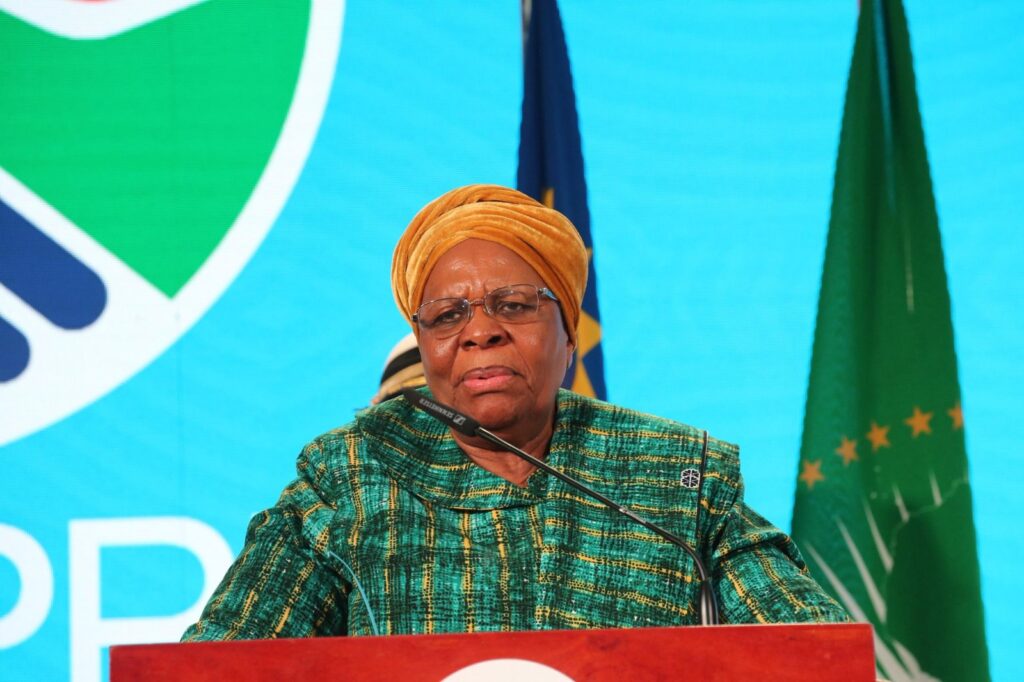
President Netumbo Nandi-Ndaitwah has announced sweeping visa and economic reforms, including the introduction of five-year visas for serious investors, as part of efforts to attract long-term investment, improve Namibia’s ease of doing business, and strengthen the country’s economic competitiveness.
Delivering her closing remarks at the Namibia Public–Private Forum held in Windhoek, Nandi-Ndaitwah said the Ministry of Home Affairs must urgently review and simplify the visa application process to make it easier for investors and visitors to enter the country.
“The visa regime must be reviewed and application forms simplified to make it easier for investors and visitors to access the special visa programme,” she said, adding that “serious investors should be granted five-year permits.”
She further directed that infrastructure at Hosea Kutako International Airport be improved by adding more counters to reduce congestion in the arrivals hall, and that the long-delayed Migration Bill be enacted before the end of the financial year.
Nandi-Ndaitwah said government is preparing a series of tax reforms to strengthen competitiveness and fairness within the economy. These measures, she noted, are in line with global efforts to increase tax-to-GDP ratios and promote equality through progressive taxation.
In trade and investment, she directed that the Special Incentives Policy for Manufacturing be finalised and made operational within two months to accelerate value addition and industrial growth.
She acknowledged that the lengthy process of starting a business in Namibia remains a constraint and called on the Business and Intellectual Property Authority (BIPA) to take the lead in reforming registration procedures.
“My vision is clear: to make doing business in Namibia simple, seamless, swift, accessible, and integrated,” she said. “I want it to be an enabling, one-stop experience that becomes an incentive in itself to invest and innovate in our country.”
Nandi-Ndaitwah confirmed that Cabinet has approved BIPA’s acquisition of a new fit-for-purpose building, which will open in November 2025 as Namibia’s One-Stop Business Hub, bringing all key business services under one roof.
In the agriculture sector, she said the Ministry must strengthen its plant health capacity before the end of the financial year and expedite the implementation of the Transformation of the Agri-food Sector (STAS) plan by December 2025. She also highlighted the importance of aligning education with labour market needs, stressing that Namibia must “equip young people with practical and digital skills” to enhance innovation and competitiveness.
Turning to the mining sector, the President said Namibia’s rich endowment of strategic minerals could be “a true game changer” if well managed and supported by local capacity-building initiatives.
“Namibians must be equipped to take up the high-value jobs of the future rather than depending on outside expertise,” she said.
She added that while government will continue to act as an enabler and regulator, genuine transformation depends on greater private-sector participation.
To accelerate progress, Nandi-Ndaitwah announced the establishment of three task forces on Economic Recovery, Health, and Housing, drawn from the Forum’s working groups.
These teams will include additional government members and are expected to report back to her by January 2026.
The President underscored that inclusive development begins with dignity, citing access to quality healthcare, affordable housing, serviced land, and proper sanitation as basic rights rather than privileges.
She also praised Namibia’s creative, tourism, and cultural sectors for their potential to create jobs and build national pride, calling for stronger collaboration between public and private actors.
Nandi-Ndaitwah commended the spirit of openness and cooperation that characterised the Forum, saying Namibia’s future depends on unity, consistency, and delivery.
“Namibia has the brains, the will, and the heart; now we must match it with discipline and delivery,” she said. “The future of this country depends on the decisions we make today.”