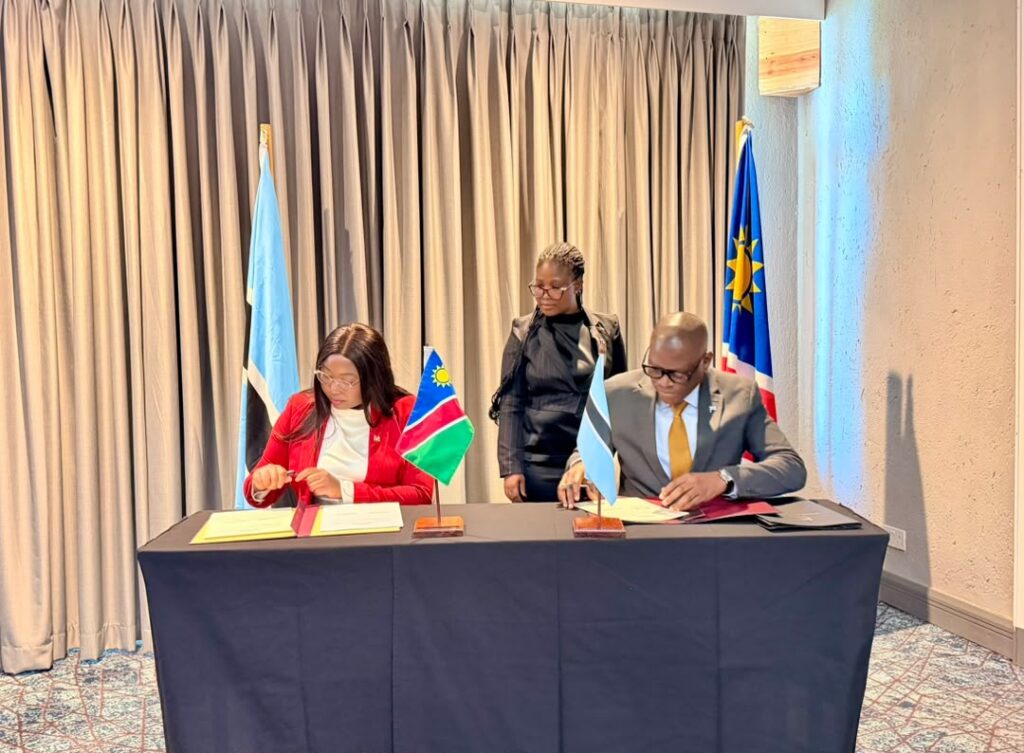
Namibia and Botswana have signed a Memorandum of Understanding (MoU) to strengthen cooperation in digital infrastructure, cybersecurity, cross-border connectivity and emerging technologies as the two countries seek to accelerate regional digital transformation.
The agreement, signed in Kasane, Botswana, establishes a framework for collaboration in broadband infrastructure, digital government, ICT regulation, innovation, research, emerging technologies and capacity building.
Botswana’s Minister of Communications and Innovation, David Tshere, said the partnership is intended to move beyond policy discussions towards implementing practical digital projects.
“Digital transformation and ICT present one of the most important opportunities to achieve this diversification, create employment, promote innovation and improve the lives of our citizens,” Tshere said.
The agreement follows commitments made under the Namibia-Botswana Bi-National Commission, where both governments identified telecommunications connectivity, infrastructure sharing, cybersecurity and digital transformation as priority areas for bilateral cooperation.
Namibia’s Minister of Information and Communication Technology, Emma Theofelus, said the MoU will promote knowledge sharing and joint initiatives aimed at strengthening regional digital integration.
Implementation of the agreement will be overseen by joint technical working groups focusing on connectivity, cybersecurity, digital skills, innovation, digital public services and infrastructure development.
“Continued investment, infrastructure expansion, innovation, and sustainable business models remain critical to achieving inclusive digital transformation,” Theofelus said.
The two countries are already collaborating on regional connectivity through a partnership between Mobile Telecommunications Limited (MTC) and Botswana Fibre Networks (BoFiNet), which established the first direct fibre-optic connection between Namibia and Botswana.
Botswana is also expanding broadband access through its Universal Access and Service Fund and the SmartBots Programme, with more than 228 villages already upgraded from 3G to 4G connectivity.
“Through the Universal Access and Service Fund, more than 228 villages have already benefited from the upgrading of communication networks from 3G to 4G,” Tshere said.
Cybersecurity was identified as another key area of cooperation, with both countries committing to strengthen information sharing, institutional collaboration and skills development to improve resilience against cyber threats.
“Cyber threats do not respect national borders, and our response must therefore include information sharing, skills development, institutional cooperation and strengthened collective resilience,” Tshere said.
Botswana recently enacted the Cybersecurity Act, 2025 and the Digital Services Act, 2025 to strengthen the regulatory framework for secure digital services, fintech and digital trade, while Namibia’s National Cybersecurity Incident Response Team (NAM-CSIRT) continues collaborating with Botswana’s BW-CIRT on cybersecurity capacity building.
The agreement also covers cooperation in digital public services. Botswana is developing a digital ecosystem integrating services such as electronic identification, electronic payments, permit applications and revenue collection.
Tshere said Botswana’s Digital Economy Roadmap aims to increase the ICT sector’s contribution to 20% of gross domestic product, positioning digital technology as a major driver of economic growth.
“We therefore see ICT not merely as an enabler of other sectors, but as a sector of economic production in its own right,” he said.