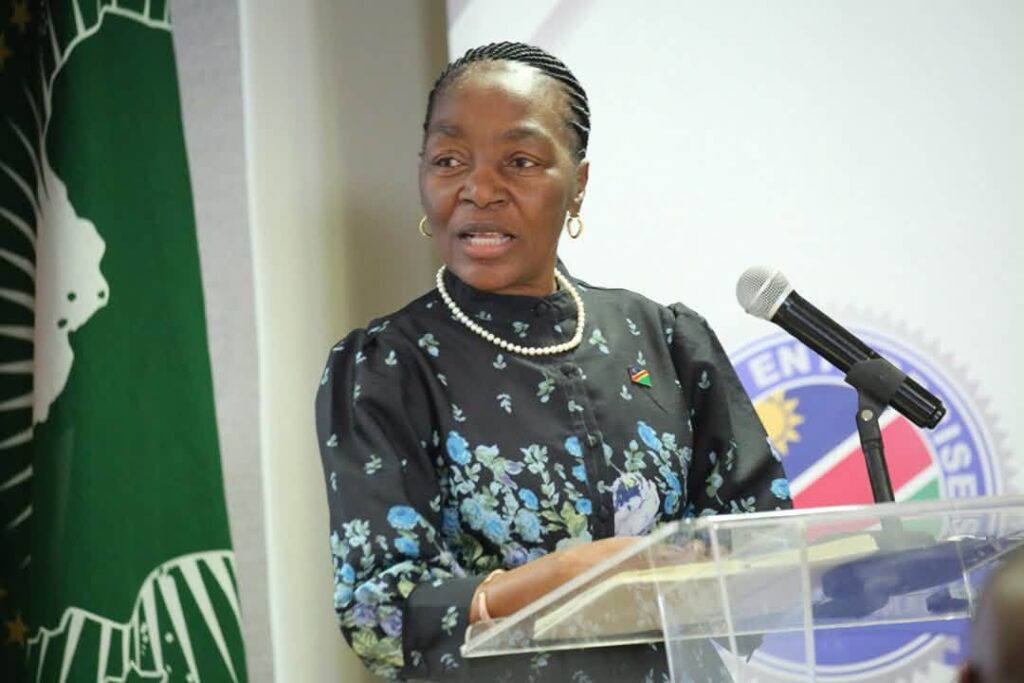
…Kristofine Naunyango was appointed Manager of the Public Asset Management Agency in December
The Namibian government is moving to centralise the management of selected state assets through a new Public Asset Management Agency as part of sweeping reforms aimed at improving the performance of state-owned enterprises (SOEs) and strengthening oversight of public assets.
Finance Minister Ericah Shafudah announced the planned reform during the inaugural CEOs Strategic Dialogue with the President, saying the Executive had concluded that the current decentralised approach to managing public assets was no longer delivering the desired outcomes.
She said the agency would oversee selected categories of state assets rather than take responsibility for all government property.
“The second issue is collective. We also looked at how we manage state assets and realised that managing them individually through ministries and SOEs requires improvement. Therefore, as the Executive, we have agreed that it would be beneficial to establish an agency responsible for public asset management. Not all public assets will fall under this agency. We will clarify which assets will be included so that there is no unnecessary concern that everything will be transferred to this agency. I wanted to inform you that this reform is also coming, and we will engage and consult with you as we progress,” Shafudah said.
The agency forms part of a broader overhaul of Namibia’s public enterprise governance framework, with government seeking to improve coordination, eliminate duplication and strengthen accountability across SOEs.
Shafudah said government had reviewed several governance models over the years, including direct ministerial oversight, the former Ministry of Public Enterprises and the current arrangement under the Ministry of Finance.
She said those experiences had led government to adopt a hybrid model under which SOEs remain under their respective line ministries while operating within standardised governance policies, guidelines and oversight frameworks.
“We learn as we go and reflect on our experiences. Through this process, we have also realised that a hybrid model can work. Under this approach, SOEs would remain under their relevant ministries, but there would also be an additional element where guidelines, policies and frameworks are standardised under one umbrella,” she said.
The minister confirmed that amendments to the Public Enterprises Governance Act are before Parliament and are expected to be among the priority Bills when the National Assembly resumes on 1 September.
She also expressed concern that only 75% of public enterprises are aligned with the objectives of the Sixth National Development Plan (NDP6).
“When I saw the figure of 75%, I wondered whether those who were not aligned were under my responsibility. I am going to take stock and assess the situation. If it turns out that some entities are not aligned, I know that the information is confidential, but I will find a way to address it,” she said.
Shafudah urged SOEs to stop citing limited financial resources as the primary reason for poor performance.
“Limited resources cannot continue to be the explanation. What exists is what we have, and we must use it in an effective and efficient manner,” she said.
She added that the success of NDP6 would ultimately be measured by tangible outcomes such as job creation, poverty reduction and reduced inequality rather than policy commitments alone.
The reform follows President Netumbo Nandi-Ndaitwah’s appointment of Kristofine Naunyango as Adviser to the Minister of Works and Transport and Manager of the Public Asset Management Agency for a five-year term effective 1 January 2026, signalling government’s intention to operationalise the new institution.