President Netumbo Nandi-Ndaitwah has challenged Namibia’s state-owned enterprises (SOEs) to stop relying on meetings and rhetoric and instead deliver concrete reforms, investment projects and measurable economic outcomes.
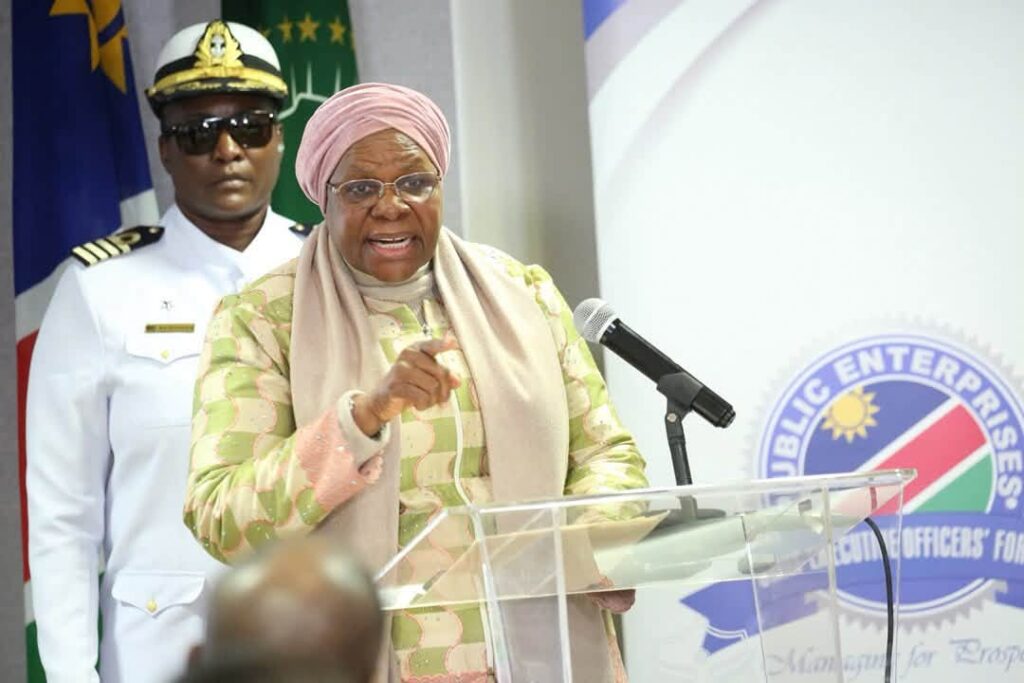
Addressing chief executive officers and board chairpersons of public enterprises during a strategic dialogue, the President said the time for discussing problems had passed, directing every SOE to submit practical solutions capable of strengthening the country’s economy.
She instructed each public enterprise to identify one reform that would unlock its full potential, list investment projects ready for implementation within the next 24 months and specify obstacles requiring Cabinet or presidential intervention.
“Therefore, I am giving you your final assignment from this dialogue. I am encouraged by your contributions and the challenges you have identified. I want each of you to provide answers to the following: What single reform would unlock the potential of your public enterprise and enable it to contribute more meaningfully to Namibia’s economy? Which strategic investment projects are ready for implementation within the next 24 months? What constraints require Cabinet or presidential intervention to enable you to deliver services to Namibians?” she said.
Beyond investment plans, the President directed SOEs to identify outdated legislation requiring reform, demonstrate how proposed changes would create jobs, explain how procurement supports Namibian businesses and SMEs, and show how their operations can reduce imports, expand exports and promote balanced regional development.
Nandi-Ndaitwah warned that strategic dialogues would no longer be judged by the number of participants or presentations, but by whether they produce results.
She questioned whether government had become too focused on consultation at the expense of decisive planning.
“But when everyone becomes part of the strategic process, what does that mean? When I came here, I was expecting a strategic dialogue. However, when I was introduced and told that it was open to the whole country, I questioned how one strategises with the entire country. To me, that raised concerns about whether we are serious about developing strategies or whether we are simply repeating the same sentences and using big words that we have repeated before,” she said.
The President said Namibia’s development challenges were not solely the result of limited financial resources but also stemmed from weak execution and poor project management.
She criticised the practice of awarding projects to institutions or contractors that lack the capacity to deliver, despite funding already being available, saying such decisions delay development and undermine public confidence.
Nandi-Ndaitwah also called for greater integrity within public institutions, arguing that capable individuals should be allowed to implement the ideas they develop rather than being sidelined once projects move into execution.
“The person who brings the idea should be involved in its implementation because they understand what needs to be done. Removing them from the process can cause the idea to fail. We must respect merit and ensure that capable people are given opportunities to execute their ideas,” she said.
She said stronger execution by public enterprises would be critical to achieving the objectives of the Sixth National Development Plan (NDP6) and laying the foundation for Namibia’s post-2030 development agenda, with value addition, agriculture, food security, research and innovation remaining central to the country’s long-term economic transformation.