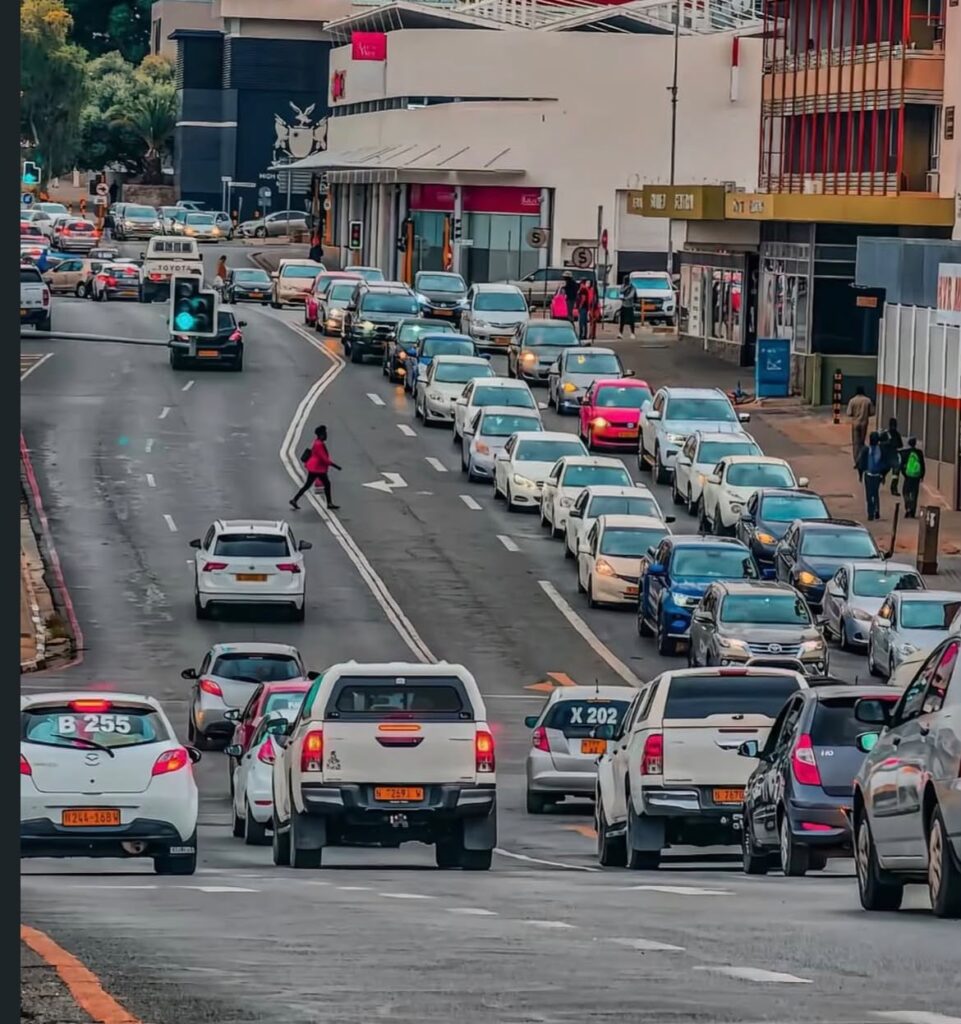
The City of Windhoek has warned that traffic congestion will continue to worsen unless Namibia invests in a modern, integrated public transport system, saying expanding roads alone will not solve the capital’s growing mobility challenges.
The municipality said congestion is a symptom of a broader transport challenge driven by increasing reliance on private vehicles and the absence of a mass public transport network.
According to the City, international experience shows that no major city has successfully eliminated congestion simply by building more roads or upgrading intersections.
Instead, it said sustainable urban mobility depends on integrating road infrastructure with reliable and affordable public transport, supported by safe walking and cycling facilities.
“Globally, successful cities rely on integrated transport systems where strategic road infrastructure is complemented by efficient, reliable and affordable public transport, together with safe walking and cycling facilities.”
The City said Windhoek remains relatively small by international standards but has become increasingly dependent on private motor vehicles. Although vehicle ownership remains comparatively low, particularly in the north-western suburbs, four-door sedan taxis remain the dominant form of public transport and contribute significantly to peak-hour traffic volumes.
The municipality identified funding as the biggest obstacle to developing a modern public transport system, noting that urban transport requires significant capital investment and ongoing operational subsidies.
“The primary reason why this has not yet been realised in Windhoek is not a lack of planning or vision, but simply funding. Unlike road infrastructure, urban public transport across the world requires ongoing operational subsidies in addition to substantial capital investment. To date, Namibia has not established a sustainable funding mechanism to support such a system.”
The City said it has been engaging the Ministry of Works and Transport and the Ministry of Urban and Rural Development over the past year to develop a sustainable funding model for urban public transport.
At the same time, the municipality is updating its Integrated Transport Master Plan (ITMP), which includes traffic counts, travel demand forecasting and transport modelling to assess mobility needs over the next 20 years.
Preliminary findings indicate that traffic congestion will deteriorate significantly under a business-as-usual scenario unless public transport is substantially improved.
“The preliminary findings of the ITMP confirm that, under a ‘business-as-usual’ scenario, and without a significant improvement in public transport, traffic congestion will continue to worsen drastically as the city grows.”
While road upgrades remain part of the City’s transport strategy, officials stressed they must be complemented by investment in public transport infrastructure.
Current projects include upgrades to Winnie Madikizela-Mandela Drive, Auas Road, Peter Nanyemba Road and the lower section of Independence Avenue. Future upgrades are planned for Sam Nujoma Drive (west), Hosea Kutako Drive through the Northern Industrial Area and David Herero Meroro Road serving Rocky Crest, with these corridors designed to accommodate future public transport and non-motorised transport infrastructure.
The City said investing in public transport is ultimately more sustainable and cost-effective than continually expanding road capacity, which is constrained by both cost and available space.
The warning comes amid growing criticism from residents over worsening traffic congestion across Windhoek, particularly during peak commuting hours.