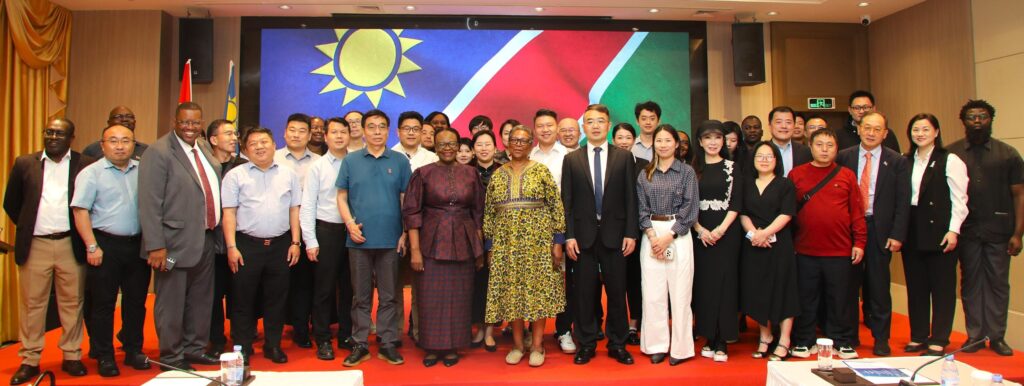
Namibia has called for increased value addition to its natural resources as a key strategy to address its trade imbalance with China, one of its largest trading partners.
Speaking at the Namibia–Shenzhen Business Roundtable and Networking Cocktail Reception in China, Minister of International Relations and Trade Selma Ashipala-Musavyi said Namibia continues to export mainly raw materials while importing higher-value manufactured goods.
She said value addition is central to government’s development agenda under its national priorities, which include agriculture, sport, creative industries, youth empowerment, quality healthcare, education and training, as well as land, housing and sanitation.
“While our exports to the world have generally increased over the years, we still experience a negative trade deficit with China and many other countries. This deficit can only be closed if Namibia and her cooperation and trading partners add value to its resources. Therefore, the 8th Administration identified seven national priorities to create sustained economic growth and sustainable development, namely agriculture, sport, creative industries, youth empowerment, quality health, quality education and training, land, housing and sanitation,” she said.
China ranks among Namibia’s top trading partners, with trade volumes increasing from US$1.2 billion in 2019 to US$1.44 billion in 2024.
The minister also used the platform to position Namibia as an attractive investment destination, citing political stability, sound macroeconomic policies and its strategic location. She encouraged Chinese investors to explore opportunities in agriculture, mining, renewable energy, manufacturing and tourism.
Particular emphasis was placed on mineral processing, green hydrogen, and emerging oil and gas developments, as well as value-added activities in fisheries and agriculture.
Namibia is also positioning itself as a logistics hub for Southern Africa, leveraging its ports at Walvis Bay and Lüderitz to provide access to regional and international markets.
“Namibia is strategically positioned as a logistics trade hub. Our main ports, Walvis Bay and Lüderitz, are key assets. The Port of Walvis Bay, expanded with Chinese technical assistance, can now handle large cargo volumes and vessels. This positioning makes Namibia a preferred gateway to Southern Africa, particularly for landlocked neighbours such as Botswana, Zambia and Zimbabwe,” she said.
She added that government is finalising amendments to its foreign investment legislation and introducing Special Economic Zones to promote manufacturing and processing.
Ashipala-Musavyi urged Chinese businesses to leverage Namibia’s access to regional markets through agreements such as the African Continental Free Trade Area, noting that establishing operations in Namibia offers broader entry into the African market.