The United States has reauthorised the African Growth and Opportunity Act (AGOA) until 31 December 2026, removing the threat of tariffs on key Namibian exports and providing renewed certainty for sectors reliant on access to the US market.
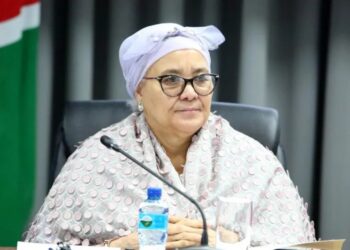
Minister of International Relations and Trade Selma Ashipala-Musavyi confirmed the development during a media briefing, saying the extension includes retroactive benefits dating back to September 2025.
“The African Growth and Opportunity Act has been officially reauthorised through 31 December 2026. This extension, which includes retroactive benefits from September 2025, removes the 15% tariff threat that loomed over our exports and provides immediate relief and medium-term certainty for our beef, fisheries and speciality agriculture sectors,” she said.
The continuation of duty-free access is expected to stabilise Namibia’s export flows to the United States, particularly for high-value agricultural and fisheries products that rely on preferential trade arrangements to remain competitive.
Ashipala-Musavyi said the extension also sends an important signal to investors and exporters by reducing uncertainty around market access.
“For the Namibian private sector, this certainty translates into investment confidence. Our relationship with the United States remains a key part of our export strategy,” she said.
The minister noted that global trade dynamics are increasingly shaped by geopolitical considerations, with tariffs, supply chains and market access emerging as strategic tools used by countries to influence economic relationships.
“Trade is no longer just about economics. It has become an extension of geopolitical strategy, where tariffs, supply chains and market access are used as instruments of global influence,” Ashipala-Musavyi said.
Following the restructuring of government functions in 2025, the Ministry of International Relations and Trade (MIRT) was given a mandate to align Namibia’s foreign policy more closely with trade promotion and market access efforts.
“Our responsibility at MIRT is to secure market access for Namibia’s products internationally. We see ourselves as the chief marketing agency for Namibia abroad,” she said.
The ministry’s strategy forms part of Namibia’s broader effort to move beyond exporting raw materials and support a transition towards higher-value production, although the industrialisation and manufacturing agenda remains under the mandate of the Ministry of Industrialisation and Mines.
Alongside efforts to secure market access in the United States, the government is also focusing on expanding trade opportunities within Africa through the African Continental Free Trade Area (AfCFTA).
Ashipala-Musavyi said the ministry conducted engagements across Namibia’s fourteen regions in late 2025 to prepare businesses for participation in the continental trade framework and developed guidance material to help smaller firms understand export requirements.
“We have developed a step-by-step guide specifically tailored for our small businesses to simplify the process of understanding market opportunities and rules of origin under the African Continental Free Trade Area,” she said.
She added that strengthening access to both international and regional markets remains central to Namibia’s export diversification strategy as global trade competition intensifies.