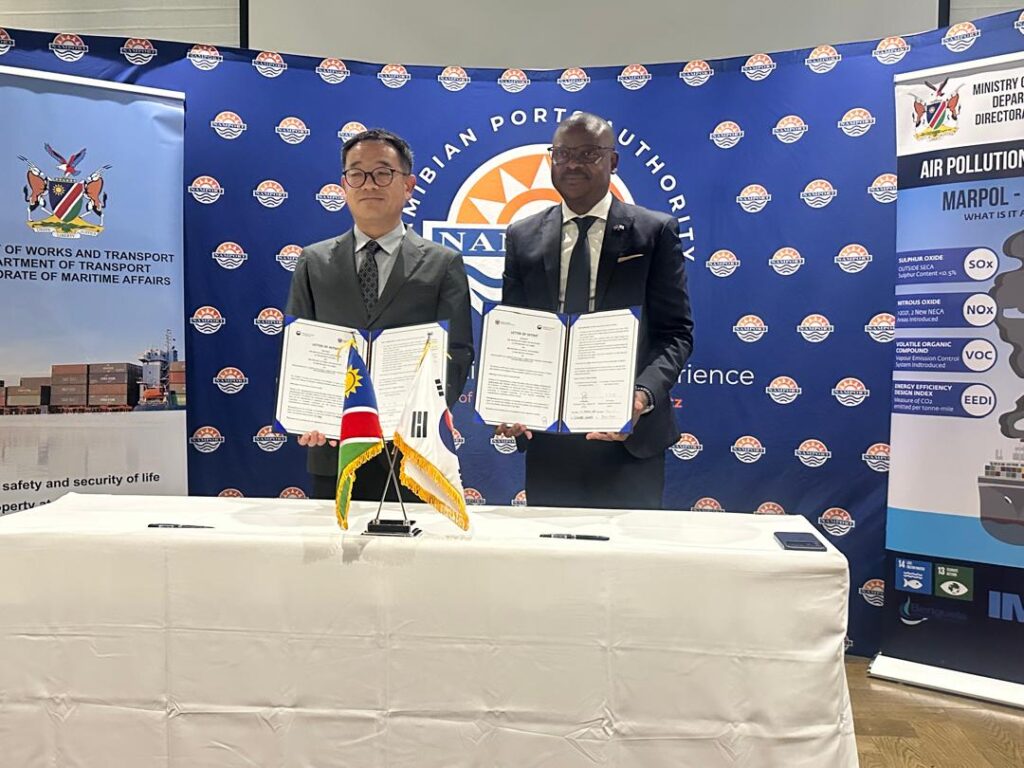
The Namibian Ports Authority (Namport) has secured technical and financial support from the African Development Bank (AfDB) and the Ministry of Oceans and Fisheries of the Republic of Korea to develop a comprehensive 10-year Green Port Strategy aimed at transforming Namibia’s port operations.
Speaking at the official signing ceremony for the Green Ports Strategy Cooperation Letter of Intent on Monday, Namport Chief Executive Officer Andrew Kanime said the partnership will provide high-level technical assistance to develop a comprehensive Green Port Policy, a detailed Green Port Investment Plan and a Green Port Implementation Roadmap.
He said these instruments will guide infrastructure expansion, prioritise sustainable investments and provide a clear, phased framework for executing Namibia’s green port transition in a structured and measurable manner.
“The generous funding and technical partnership with the AfDB and the Korean government will enable us to translate our policy commitments into a comprehensive and implementable Green Port Strategy. It will help us move from vision to action, from commitment to measurable impact,” Kanime said.
Kanime added that Namibia’s selection as a flagship beneficiary under the International Port Development Cooperation Programme reflects growing international confidence in the country’s policy clarity, implementation capacity and commitment to sustainable economic development.
He noted that while maritime transport remains central to global trade and economic growth, the evolving global maritime landscape increasingly demands sustainability, responsible resource management and climate resilience alongside operational efficiency.
“As the custodian and steward of Namibia’s ports in Walvis Bay and Lüderitz, Namport is committed to advancing port operations that drive national development, connect Southern Africa to global markets and promote environmentally sustainable practices across the maritime services value chain,” he said.
Namport has already begun its transition towards greener operations.
In March 2022, the Namport Board adopted a strategic decision to transform both ports into fully fledged, future-proof green ports, leading to the development of the Namport Corporate Sustainability Policy.
The policy is anchored on four pillars: Corporate Social Investment, Environmental Stewardship, Economic Prosperity and Governance.
Kanime said the Environmental Stewardship pillar prioritises reducing operational emissions through the adoption of low- and zero-carbon fuels, improving air and water quality, strengthening infrastructure resilience against climate risks such as rising sea levels and extreme weather events, and protecting sensitive coastal and marine ecosystems, including the Walvis Bay Lagoon.
The strategy also focuses on habitat protection and improved management of ship-related waste to support sustainable port operations over the long term.