By Hanks Saisai
A growing number of farmers and agripreneurs have ventured into the production of eggs and meat, and this trend continues to escalate.
However, for a farmer to specialize in producing fresh table eggs, it is important to understand that a certain type of chicken should be reared.
Layers, as commonly known, are the leading type of chicken hens utilized globally to produce fresh table eggs. In the Namibian context, Lohmann hens (usually, brown) are the dominant breed, laying between 295 and 320 eggs per hen annually.
Farmers aspiring to venture into fresh table egg production should first conduct market research to identify possible markets, such as households, wholesalers, or restaurants.
This will help determine quantities demanded and demand patterns, allowing a farmer to align production accordingly. Moreover, to farm with layers effectively, it is important to determine whether to invest in day-old chicks or point-of-lay hens.
Chicks will cost N$28.00 per chick, and the farmer must be cognisant of the feeding programme. To ensure optimal growth, a farmer should feed the chicks chick/pullet starter from day 1 to day 42 (week 6), then the feed must be changed to chick/pullet grower (day 43 to day 112).
On day 113, when the hens reach point-of-lay, it is essential to transition to layer mash. As a tip, farmers must always develop a feeding programme that ensures that the hens have access to feed and water as early as possible, with the first ration provided at 07h00 and the second at 15h30.
Egg production typically begins during week 16 to week 20, and it is essential for the farmer to record the date when approximately 15 to 30% of the hens start laying eggs.
This will be used as the starting date of the production cycle that will last for 365 days. During this period, farmers are advised to ensure that the hens have access to 16 – 17 hours of light each day (from 06h00 to 18h00, the sunlight provides 12 hours of light, from 18h00 to 23h00, 4 – 5 hours of light must be provided in the poultry house).
Furthermore, farmers are advised to ensure that each hen is fed 110 grams per day during the 243 days of summer. In winter, it is crucial to feed the hens 130 grams per hen per day over the 122 days of the season.
When temperatures drop significantly, farmers should use infrared heat bulbs (175 W) to keep hens warm in the poultry coops, which helps prevent a reduction in egg production.
Another essential aspect to understand about layers is that they can be reared in two systems, which are mainly the Deep Litter System and Battery Cage System. In the Deep Litter System, the hens are placed in a coop with bedding material that covers the floor to a depth of 7.5 cm. The hens are allowed freedom of movement and are stocked at a density of 6 hens per m2.
This system provides insulation, helping to regulate temperature within the coop, especially in colder climates.
Additionally, unlike some other systems, the deep litter material is not regularly removed, instead, it is managed and allowed to build up.
One drawback with this system is that a farmer will not know which of the hens lays an egg per day and which hen misses certain days, making it difficult for the farmer to measure productivity.
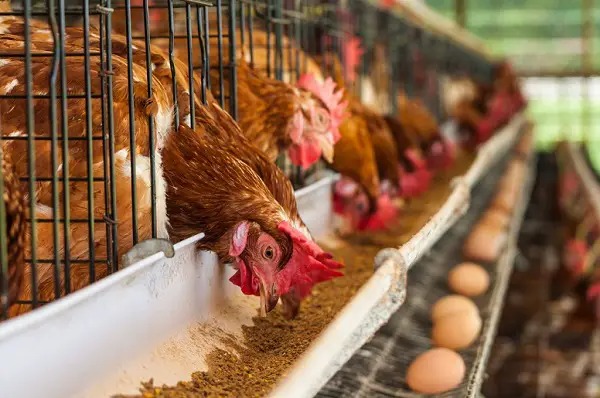
On the other hand, in the battery cage system, a farmer places the hens in a cage structure that has components that can house 3 to 4 hens in each compartment. The smallest cage can house about 96 hens in its 24 compartments.
This system can make it easy for farmers to measure the productivity of each hen and ensure that the right amount of feed is given.
This system has a slight disadvantage, which is the fact that hens can develop mounting stress after 4 to 5 months of being in the cage. And if the hens are not allocated according to their sizes and social affiliation, this can lead to bullying and pecking.
A few add-ons are to provide supplements to the hens with Opti-Boost or Stresspac to provide essential minerals such as calcium, iron, and zinc. Farmers must also vaccinate the hens with ND Clone 30, IB Ma5, Gumboro D78, and Nobilis Coryza to keep diseases at bay.
Moreover, it would be important to deworm the hens with Piperazine to eliminate the possibilities of internal parasites.
As for the farmers, it is advised that hens will develop a sense of recognizing colors, therefore, it is important to maintain the same color of outfits when handling the hens.
Understanding your layer hens is the first step to producing eggs profitably and sustainably. Farmers must aim to produce about 6 eggs per week per hen.
Moreover, it is important that the hens are allowed to produce eggs for 365 days, and at the end of this period, the hens should be replaced.
* Hanks Saisai is a Technical Advisor: Crops & Poultry at Agribank.