…477 housing opportunities identified in Windhoek’s Otjomuise
The National Housing Enterprise (NHE) is seeking N$572.49 million from institutional investors to finance 1,032 housing opportunities across four towns, as Namibia struggles to address a housing backlog exceeding 270,000 units.
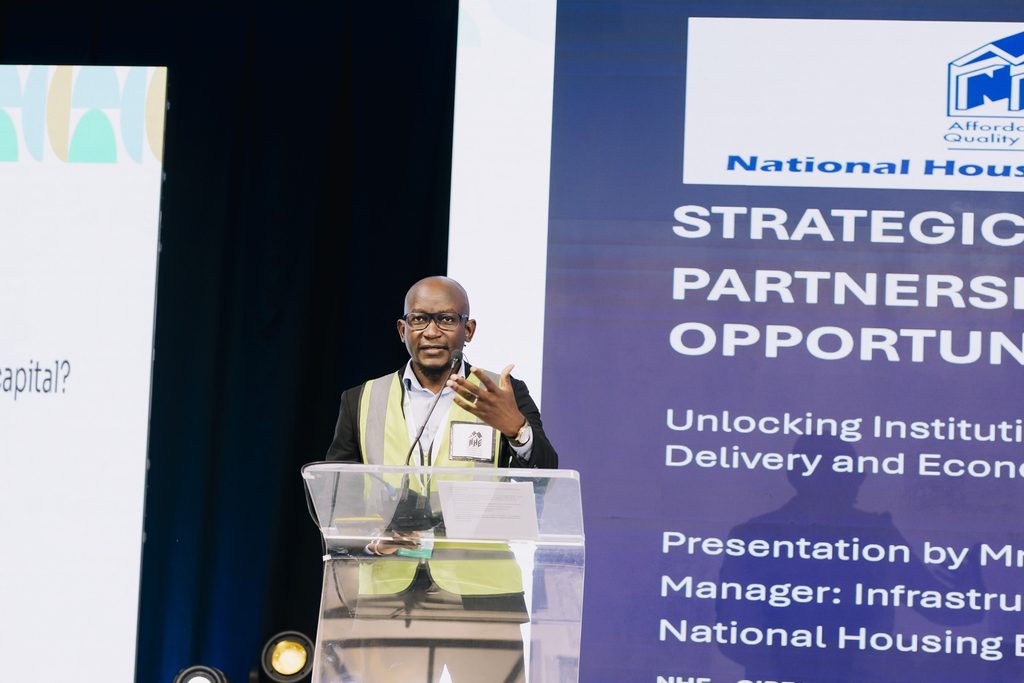
NHE Manager for Infrastructure Development Indileni Set-Sam Iipinge said the institution had identified investment-ready projects in Windhoek, Ongwediva, Oshakati and Opuwo, but access to development capital remained a major obstacle to implementation.
Speaking at the recent Government Institutions Pension Fund (GIPF) Pension and Investment Symposium, Iipinge said NHE had identified project sites, determined financing requirements and projected revenue streams, positioning the developments for potential institutional investment.
“The immediate investment pipeline comprises 477 opportunities in Windhoek’s Otjomuise, requiring N$299.42 million, 260 in Ongwediva at N$120.88 million, 228 in Oshakati at N$125.42 million and 67 in Opuwo requiring N$26.77 million,” he said.
Windhoek accounts for the largest share of the proposed investment, with the Otjomuise development requiring N$299.42 million, representing more than half of the total financing requirement.
Oshakati follows with N$125.42 million, while Ongwediva requires N$120.88 million and Opuwo N$26.77 million.
Iipinge said NHE’s ability to expand housing delivery was being constrained by a lack of appropriately structured institutional financing rather than insufficient demand or a shortage of projects.
“The main obstacle to scaling up housing delivery was not a shortage of projects, market demand or implementation capacity, but access to appropriately structured institutional development capital,” he said.
He identified inadequate infrastructure financing, delays in municipal land servicing, lengthy approval processes, rising construction costs and difficulties acquiring land as additional barriers to housing development.
According to NHE’s investment readiness assessment, nine of the 10 indicators had been met, with core infrastructure financing remaining the only partially met requirement.
The institution said the proposed developments were supported by identified sites, completed budget estimates, established demand and projected recoverable cash flows.
NHE estimates that the invested capital could be recovered within 24 to 36 months through housing sales, property transfers, land sales and other project revenues.
The proposed financing structure is based on recovering development capital through project proceeds rather than long-term mortgage repayments.
Construction and development activities are expected to take between 12 and 18 months, followed by a further 12 to 18 months for sales and property transfers.
The proposed investment is expected to support between 950 and 1,300 jobs, while generating additional economic activity through local procurement, opportunities for small and medium enterprises and growth in the construction sector.
The latest funding requirement follows the approval of a N$1.5 billion financing facility by the Development Bank of Namibia (DBN) and the Development Bank of Southern Africa (DBSA) in 2024.
The facility was intended to support the construction of approximately 2,300 housing units and the servicing of 1,350 plots across 27 sites.
Iipinge said NHE had the technical capacity and project management systems required to implement the proposed developments, citing its existing contractor network, ongoing construction projects and national presence.
“We take project management seriously, and I’m saying I’m coming from the site right now. Because we believe that, we need to see, what is happening on site?” he said.
He said NHE continued to monitor construction activities through site inspections and technical oversight to ensure projects met the required standards.