…17,000 plots targeted across 11 local authorities
The government has yet to deliver a single fully serviced residential plot under its current land servicing programme, despite targeting 17,000 plots across 11 local authorities at an estimated cost of more than N$2 billion.
Urban and Rural Development Minister James Sankwasa said the programme was being delayed by cash-flow constraints and insufficient capital funding, with the Ministry’s N$1.2 billion capital budget for the 2025/26 financial year falling short of the amount required to provide bulk infrastructure and basic services.
Responding to Question 330 raised by parliamentarian Dawid Christiaan Eigub, Sankwasa said the targeted plots were at various stages of infrastructure development, but none had been fully serviced with water, sewerage, electricity and roads.
The programme covers 5,000 plots in Windhoek and 1,200 each in Walvis Bay, Keetmanshoop, Rundu and Oshakati.
It has also been extended to Usakos, Bukalo, Katima Mulilo, Mariental, Otjiwarongo and Swakopmund, with each local authority targeting a further 1,200 plots.
The Ministry expects the infrastructure and servicing works to be completed by December 2026, although funding constraints continue to affect implementation.
“The Ministry continues to grapple with attaining the set targets on account of cash flow challenges. The bulk of the land servicing is in informal areas and state funding is the only source of funding available because our people in this area grapple with affordability challenges,” Sankwasa said.
He said most of the targeted land servicing was taking place in informal settlements, where residents could not afford the cost of infrastructure development, leaving the government as the primary source of financing.
Meanwhile, Sankwasa reported that 1,112 housing units were completed during the 2025/26 financial year, comprising 943 units through new developments and 169 through informal settlement upgrading initiatives.
Housing delivery increased during the first two quarters of the 2026/27 financial year, with 846 units recorded in the first quarter and a further 725 in the second quarter.
This brought cumulative housing delivery for the 2025/26 financial year and the first half of 2026/27 to 2,683 units.
Of the 846 units delivered in the first quarter of 2026/27, 475 were completed through new developments and 371 through informal settlement upgrading.
In the second quarter, 293 units were delivered through new developments, while 432 were completed under upgrading initiatives.
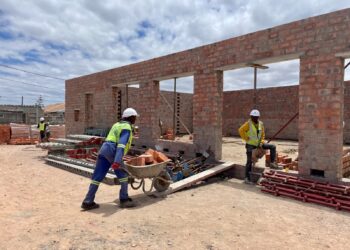
The Shack Dwellers Federation of Namibia (SDFN) accounted for a significant proportion of the reported housing delivery, particularly through informal settlement upgrading and new housing developments across several regions.
Sankwasa said another 304 housing units were under construction at Otjomuise Extension 10 in Windhoek, with completion expected by the end of December 2026.
A further 174 housing units were at the procurement stage, comprising 133 in Swakopmund, 36 in Walvis Bay and five in Mariental, with completion targeted before the end of the current financial year.
Addressing concerns over the government’s low-cost housing delivery targets, Sankwasa corrected Eigub’s reference to a target of 10,000 houses, saying the official target for the 2025/26 financial year was 3,000 units.
“The Ministry and its stakeholders are putting all efforts in place to meet the targets despite the sector being underfunded,” Sankwasa said.
He said the Ministry was working to secure additional funding, finalise procurement processes and strengthen its internal project management capacity to accelerate land servicing and housing delivery.
On institutional reforms, Sankwasa said there was no need to restructure the former Township Board because it had already been replaced by the Urban and Regional Planning Board under the Urban and Regional Planning Act, 2018.
The new board consolidated the functions of the former Namibia Planning Authority Board and Township Board.
Sankwasa said the Ministry would continue prioritising land servicing in informal settlements occupied by ultra-low- and low-income households, where inadequate infrastructure remained a major barrier to housing development.