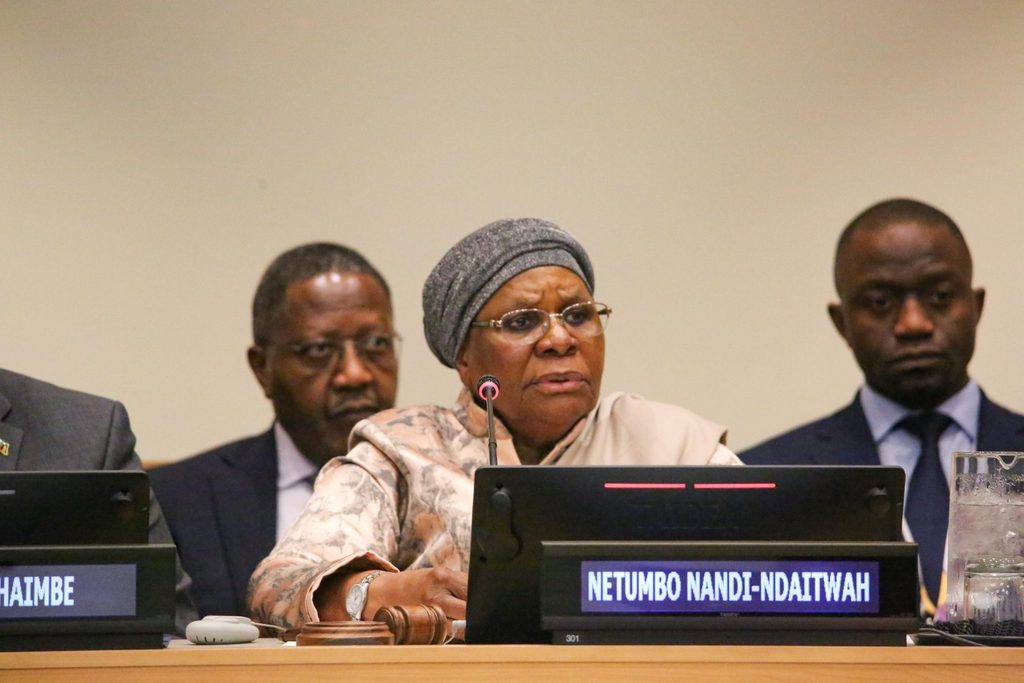
President Netumbo Nandi-Ndaitwah has called for stronger action to curb illicit financial flows from Africa and accelerate reforms to the international financial system, saying the loss of domestic resources is undermining the continent’s ability to finance development.
Speaking at a high-level side event on the implementation of the Pact for the Future during the 81st Session of the United Nations General Assembly in New York, Nandi-Ndaitwah said stronger domestic resource mobilisation is critical to financing Namibia’s development priorities.
She said Namibia has strengthened tax governance under the Sixth National Development Plan (NDP6), with domestic resources supporting programmes aimed at expanding access to education and promoting youth entrepreneurship.
“We are already seeing tangible fruit from this investment, and much of the resources come through strong domestic resource mobilisation initiatives, including through improved tax governance structures as outlined in our Sixth National Development Plan (NDP6),” Nandi-Ndaitwah said.
However, she said illicit financial flows continue to drain resources from Namibia and other African countries that could otherwise be directed towards development.
“Illicit financial flows still remain a challenge for Namibia and our continent at large, and our collective voice as Africa must be ever stronger in order to accelerate the reform of the international financial architecture, as agreed in the Pact for the Future and the subsequent Sevilla Commitment,” she said.
The Sevilla Commitment includes measures aimed at strengthening domestic resource mobilisation and tackling illicit financial flows, while the Pact for the Future contains commitments to reform the international financial architecture and increase the voice of developing countries.
Nandi-Ndaitwah also called for greater African participation in negotiations towards a United Nations Framework Convention on International Tax Cooperation, saying the continent should have a stronger voice in shaping global tax rules.
“Africa must be fully engaged in the negotiations towards a UN Framework Convention on International Tax Cooperation in order to create a just and effective international tax system for sustainable development,” she said.
The President said reform of the global financial system and stronger domestic revenue mobilisation are important to accelerating implementation of the Sustainable Development Goals (SDGs) and Africa’s Agenda 2063.
She said there is more than 90% convergence between the SDGs and Agenda 2063, providing African countries with an opportunity to pursue both development frameworks through coordinated implementation.
The Pact for the Future was adopted by UN member states in 2024 and includes commitments covering sustainable development and financing, peace and security, digital cooperation, youth and future generations, and reform of global governance. It was adopted alongside the Global Digital Compact and Declaration on Future Generations.
Nandi-Ndaitwah said Namibia is implementing elements of the pact through its National Digital Strategy 2025–2028, which focuses on digital innovation, cybersecurity and emerging technologies, including artificial intelligence, while promoting greater participation by women and young people in the digital economy.
She also highlighted government initiatives targeting young people, including free tertiary education and the National Youth Fund, saying Africa’s youthful population should be central to the continent’s development agenda.
“Our Youth remain the hope and strength of our Continent. African Youth make up over 60% of the Continent’s population, and by 2050, one out of every fourth person in the world is expected to be African,” Nandi-Ndaitwah said.
She called on African governments to take greater ownership of their development agendas and use international frameworks such as the Pact for the Future to advance economic and social development.
“As individual African countries, and as a collective, our responsibility is to take ownership of our development efforts. Our citizens are looking at us, the leaders, to make effective and bold decisions for their prosperity and advancement,” she said.