Namibia has warned that foreign expertise brought into its emerging oil and gas industry should not become a permanent substitute for local skills, as the country prepares for increasingly complex offshore development and production activities.
Labour, Industrial Relations and Employment Creation Minister Filemon Wise Immanuel said international specialists will be required in areas where Namibia currently lacks technical capacity, but petroleum companies should have clear mechanisms for transferring those skills to Namibians.
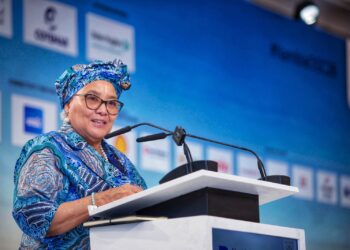
Speaking at the Namibia Oil and Gas Conference (NOGC) 2026 in Windhoek, Immanuel said the use of expatriate expertise should be transitional and subject to monitoring as local capabilities develop.
“The importation of these skills must not become a permanent substitute for local capacity. For local capacity, it must be an interim. It needs to be evaluated and monitored,” Immanuel said.
The issue is becoming increasingly important as Namibia moves beyond exploration towards potential development, which will require specialised expertise across drilling, engineering, subsea operations, project management and petroleum services.
Immanuel said Namibia needs to consider not only which foreign skills are required, but whether international specialists are being used to train Namibians who can eventually assume those positions.
The approach forms part of a wider government push to ensure that petroleum development creates lasting domestic capacity rather than leaving Namibia dependent on imported expertise throughout the life of the industry.
The recently approved upstream petroleum local content policy seeks to increase Namibian participation through employment, procurement, enterprise development, skills and technology transfer, ownership and financing.
Immanuel said the policy will need to be supported by legislation and effective implementation to ensure its objectives translate into measurable participation by Namibians.
He said the country must also prepare its workforce and businesses for the demanding operational requirements of the international petroleum industry.
“The industry requires safety, the industry requires quality standards, the industry requires a case for miles, the industry requires insurance. The industry requires timely, consistent and professional. You must prepare yourself for that,” Immanuel said.
The minister said petroleum development must ultimately deliver more than production volumes, with employment, decent wages, worker safety and job security forming part of the economic dividend expected from the sector.
“Our developmental trajectory and path must have a human face. It must be about how do we ensure occupational health and safety of those that will be employed? Can they think that? It must be about, how do we ensure dignity of those that will be deployed in this industry? It must be about how do we ensure job security by this industry? And how do we ensure decent wages for those that will be employed in this industry?” he said.
Immanuel said Namibia remains open to foreign investment and international expertise, but the long-term impact of that participation should include the development of Namibian professionals and businesses capable of taking increasingly significant roles in the petroleum value chain.
As offshore projects move towards potential development, the skills-transfer question is expected to become more pressing as Namibia seeks to ensure that international investment leaves behind technical capabilities that remain in the country beyond individual petroleum projects.