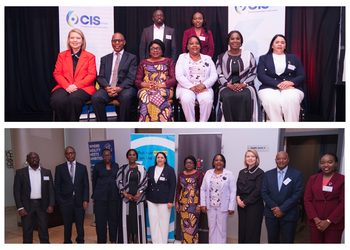
Namibia has begun reviewing its social security laws, policies and administrative systems against the International Labour Organisation’s (ILO) Social Security (Minimum Standards) Convention, 1952 (Convention No. 102), as government assesses the reforms required before ratifying the international treaty.
Opening a national technical workshop in Windhoek, Acting Executive Director in the Ministry of Justice and Labour Relations Aune Mudjanima said the gap analysis would determine whether Namibia’s legal and institutional framework complies with the convention’s minimum standards and identify areas requiring reform.
“A gap analysis is therefore essential. It enables us to identify areas of compliance, areas requiring minor adjustments, and those where more substantial reforms are needed. This ensures that ratification is not symbolic, but meaningful, responsible and sustainable,” Mudjanima said.
She said the review would provide a roadmap for legislative reforms, institutional strengthening, administrative improvements and sustainable financing while reducing the risk of committing to international obligations before national systems are fully prepared.
The exercise forms part of efforts to align Namibia’s Social Protection Policy 2021-2031 with Convention No. 102, which sets minimum standards across nine branches of social security for workers in both the formal and informal economy.
Mudjanima said government allocated N$7.27 billion to social grants during the current financial year to support vulnerable Namibians, demonstrating the country’s commitment to expanding social protection.
“In the current financial year, government channelled N$7.27 billion directly into social grants, supporting vulnerable Namibians. These figures demonstrate that our national budget is structurally geared toward social equity and the fulfilment of Article 95 of our Constitution,” she said.
She cited the ILO’s World Social Protection Report 2024-2026, which found that 52.4% of the global population receives at least one social protection benefit, while 3.8 billion people remain without any form of social protection.
The report also found that high-income countries spend an average of 16.2% of gross domestic product on social protection compared with 0.8% in low-income countries.
Mudjanima said the ILO identifies Mauritius as Africa’s benchmark for universal lifecycle social protection and South Africa for its extensive cash transfer programmes, while Namibia, Eswatini and Lesotho are among the leading Sub-Saharan African countries financing social protection primarily through domestic tax revenue.
She added that Namibia’s participation in the United Nations Global Accelerator on Jobs and Social Protection for Just Transitions has provided technical assessments and comparative analysis to support the country’s social protection reforms.
However, Mudjanima said the completion of the gap analysis had been delayed after some institutions failed to provide the required information.
“Social protection reform is a whole-of-government responsibility. When data is requested for national processes of this magnitude, all institutions must respond promptly and comprehensively. Our ability to design accurate, sustainable and inclusive systems depends on the quality of information we provide,” she said.