…as FATF delisting strengthens investor confidence
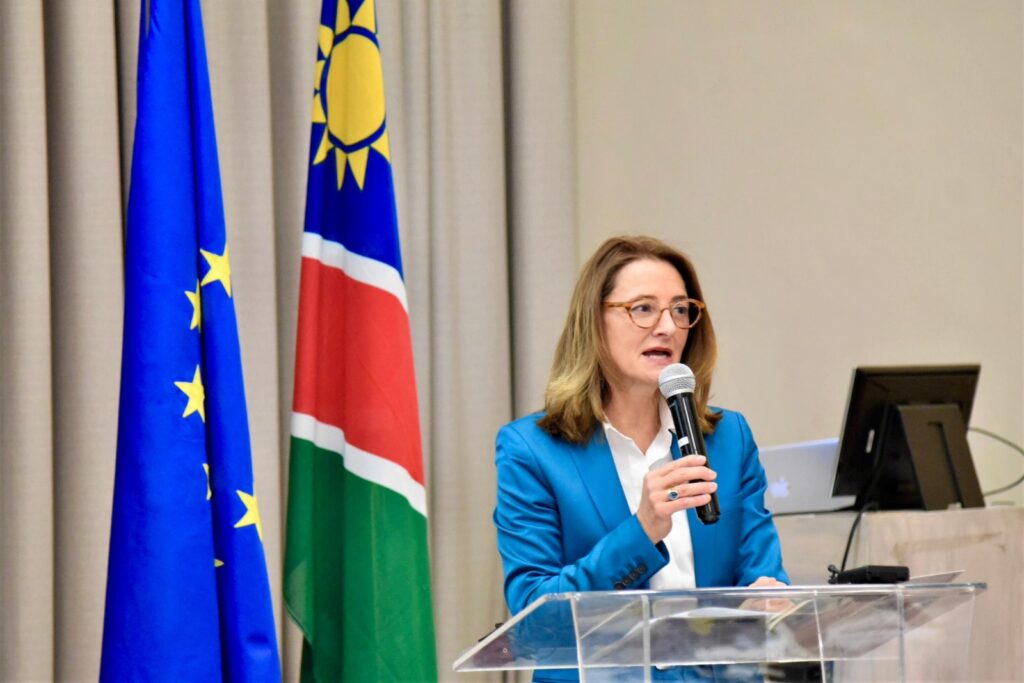
European Union Ambassador to Namibia Ana Beatriz Martins says Namibia’s removal from the Financial Action Task Force (FATF) grey list has strengthened investor confidence and reinforced the country’s position as a trusted destination for trade and investment, with EU-Namibia trade already supporting more than 46,000 jobs.
Martins said the European Union remains one of Namibia’s largest and most diversified economic partners, with bilateral trade reaching N$34.1 billion in 2025, comprising N$17.6 billion in Namibian exports and N$16.5 billion in imports.
“The European Union values its longstanding partnership with Namibia and will continue working closely with the Government, regulators and the private sector to strengthen a transparent, resilient and internationally trusted financial system that supports investment, sustainable growth and shared prosperity,” Martins said.
She said Namibia’s successful implementation of the FATF Action Plan demonstrates the country’s commitment to financial integrity and creates favourable conditions for investment, business expansion and job creation.
The Ambassador congratulated Namibia on its removal from the FATF grey list in June, describing it as a significant milestone achieved in record time.
“The European Union warmly congratulates Namibia on this important achievement of implementing FATF’s recommendations in record time. As a next step, we are committed to supporting Namibia through the EU’s own legislative delisting process,” Martins said.
She explained that Namibia’s removal from the FATF grey list automatically triggered the European Union’s legislative process, which is expected to result in the country being removed from the EU’s Anti-Money Laundering and Counter-Terrorism Financing (AML/CTF) list by the end of the year, subject to approval by the European Parliament.
Martins also clarified that Namibia’s inclusion on the current EU list reflects the bloc’s 2025 legislative update, which was based on the FATF’s 2024 grey-listing decision, and therefore does not take into account the country’s recent removal from the FATF grey list.
She stressed that the EU’s AML/CTF list does not impose sanctions or restrict trade, investment or development cooperation.
“It is important to highlight that the EU’s financial crime monitoring regime does not constitute sanctions or restrictions on trade, investment or development cooperation with listed countries,” Martins said.
Instead, she said, the legislation requires EU financial institutions to apply enhanced customer due diligence to transactions involving listed jurisdictions, in line with international anti-money laundering standards.
Martins said the European Union worked closely with Namibia throughout the implementation of the FATF Action Plan following the country’s grey-listing in 2024.
She said the EU supported capacity building for more than 150 officials from law enforcement and justice institutions through more than 10 specialised training programmes, with a further six training sessions planned for this year.