
By Royale Wealth Management in collaboration with Northstar Asset Management
Gold traded above $5,000 an ounce for the first time this year reigniting a debate that never really goes away: does gold belong in a serious investment portfolio, or is it just a bet dressed up in history? We don’t think the answer is obvious either way, and we’re sceptical of anyone who tells you it is.
What follows isn’t a case for buying or selling gold. It’s an attempt to think clearly about an asset that resists clear thinking.
You Can’t Value Gold. That’s the Starting Point.
Gold doesn’t generate earnings. It pays no interest and produces no rental income. There’s no discounted cash flow model, no yield spread, no price-to-earnings ratio that tells you what it’s worth. This isn’t a temporary problem waiting to be solved. It’s the nature of the asset.
That hasn’t stopped people from trying. Some analysts compare gold to inflation-protected bond yields. Others look at commodity ratios, or the direction of the US dollar. These relationships exist, but they’re loose and inconsistent. Central banks buying around 1,000 tonnes of gold per year is a real demand driver, yet speculative investors through exchange-traded funds matched that figure in 2025 alone. Gold’s role as a store of value now also faces competition from bitcoin and other digital assets, though gold’s physical properties, its centuries-long track record, and its regulatory acceptance give it a different character entirely. Whether that character is worth paying for is a separate question.
Part of what makes gold so volatile is its ownership structure. Of the roughly 220,000 tonnes above ground, central banks hold about 16%, jewellery accounts for 52%, and financial investors hold close to 30%, much of it for speculative purposes. New supply runs at only around 5,000 tonnes a year. When sentiment shifts in a market that thinly supplied where price sensitive jewellery buyers make up 50% of yearly demand, prices can move hard in either direction. The six years of weakness between 2013 and 2019 are a useful reminder of that.
A Frame, Not a Forecast
Since gold can’t be valued conventionally, investors need a different kind of anchor. One that we find genuinely useful draws on gold’s historical relationship with the US dollar, though we want to be upfront about its limitations.
Under the Bretton Woods agreement of 1944, major currencies were pegged to the dollar, which was itself fixed to gold at $35 per ounce. The US committed to converting dollars into gold on demand. That system broke apart in 1971 when Nixon cancelled the convertibility promise to gold. The question Bretton Woods leaves behind is this: if the US were still expected to back its currency with gold reserves, what price would be required? With roughly 8,100 tonnes in US reserves and approximately $2.5 trillion in circulation today, the implied figure is around $9,500 per ounce.
We’re not suggesting gold should trade there. The assumption underlying this framework, that investors in uncertain times treat gold as a dollar substitute, is exactly that: an assumption. But the framework does something useful. It helps identify when gold is sitting at historical extremes, either deeply out of favour relative to monetary conditions, or well ahead of them.
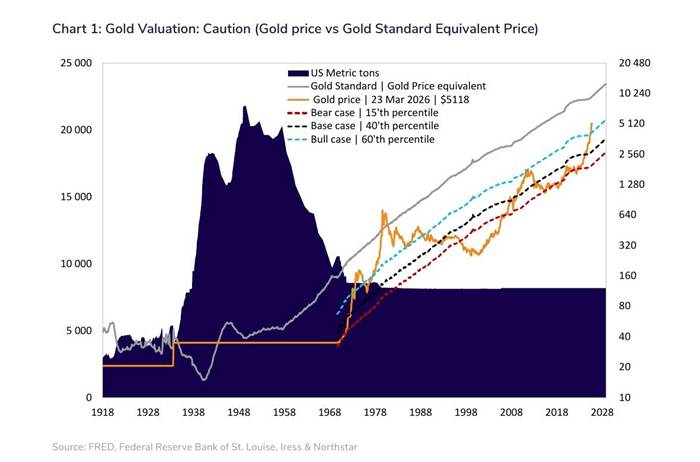
Gold reached the implied full-backing level only once in modern history, briefly in 1980. For most of the time since, it has traded at a significant discount to that level. At prices above $5,000, it has moved past what this framework treats as a conservative entry point. That doesn’t mean it can’t go higher. But it does mean the picture has changed. When gold was out of favour and cheaply priced, the potential upside was large relative to the likely downside. At current prices, that balance has shifted. Investors should weigh that honestly.
Forecasting Versus Thinking in Probabilities
One major study found that expert forecasters get their predictions right less than 47% of the time. Worse than a coin flip. Philip Tetlock’s research on superforecasters arrives at a similar conclusion: the most skilled analysts don’t make confident point predictions. They think in probabilities and ranges.
There’s a real distinction here. A forecast says gold will be at a specific price in twelve months. Probabilistic thinking asks what range of outcomes is plausible given current conditions, and whether the risk-reward balance justifies the exposure. The first approach pretends to know things nobody knows. The second is honest about uncertainty but still rigorous about process. Good frameworks don’t tell you what will happen. They help you figure out whether the odds are in your favour.
The Stronger Argument: What Gold Does in a Portfolio
The most compelling reason to own gold has to do with how gold behaves alongside other assets.
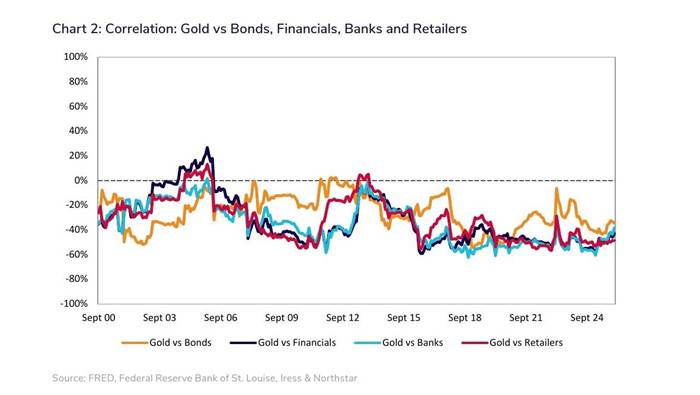
Over more than two decades, gold has shown a persistently negative correlation with bonds, financial stocks, banks, and retailers. When traditional portfolios are under pressure, gold has often moved the other way. That’s a genuinely useful property.
There’s a caveat worth taking seriously, though. In the immediate shock of a serious crisis, gold doesn’t always hold up. It sold off alongside equities in the early days of the 2008 financial crisis and again in March 2020 during the COVID panic, before recovering strongly in both cases. The diversification benefit is real, but it plays out over full market cycles rather than necessarily in the first days of a panic. Investors who know this in advance are better positioned to stay the course when it matters.
The cost of holding gold is real too. It produces no income, so every year you hold it, you’re giving up whatever you could have earned elsewhere. Whether that trade-off makes sense depends on the size of the allocation, the investor’s risk profile, and whether the current price offers enough upside to justify it.
Sentiment Is a Signal, Not a Strategy
Gold is cheapest when nobody wants it and most expensive when everyone does. That’s not a revelation; it’s true of most assets. But gold’s sentiment cycles are particularly pronounced, and they tend to persist long enough to trap investors on both sides.
The logic isn’t that negative sentiment predicts a price rise. It’s that when sentiment is deeply negative, the downside is usually more contained. The asymmetry is better. That’s different from trying to call the bottom. It’s a recognition that where the crowd is sitting tells you something about the shape of the risk you’re taking on.
Right now, enthusiasm for gold is high. The price has exceeded most rational reference frameworks. The same asymmetry that made it attractive at lower prices isn’t there anymore, at least not to the same degree. That’s not a prediction. It’s an observation about where things stand.
So Where Does That Leave Us?
At Royale, we take gold seriously as an asset class. We don’t dismiss it, and we don’t chase it. The diversification case is real, the behavioural dynamics are real, and the reference frameworks, imperfect as they are, tell you something useful about value extremes.
The honest answer to whether gold belongs in a portfolio depends on whether the diversification benefits are warranted by what you’re paying for it and each client’s circumstances should be treated uniquely. At the “right price”, when the odds seem to be in your favor, it earns its place. At the “wrong price”, any diversification need should at the very least limit its position size. Knowing the difference is exactly what disciplined wealth management is supposed to do.
*Royale Wealth Management is an authorised financial services provider. This article is for informational purposes only and does not constitute financial advice. Investors should consult a qualified financial adviser before making investment decisions.