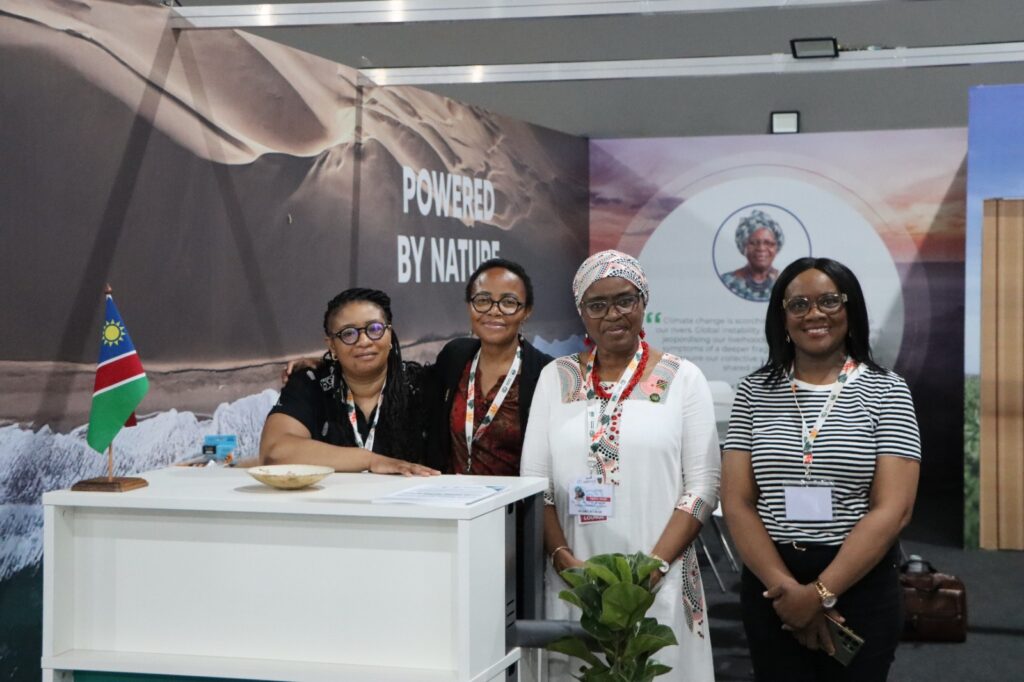
Namibia has called on the international community to increase fair, predictable, and accessible climate finance to help developing countries achieve a just transition and strengthen resilience against worsening climate impacts.
Speaking at the opening of Namibia’s pavilion at COP30, the Minister of Environment, Forestry and Tourism, Indileni Daniel, said the time for gradual progress had ended, urging developed nations to make concrete and measurable commitments to fund climate adaptation and low-carbon growth.
“The time for incremental action has passed. We need scaled-up, predictable, and fair climate financing that empowers developing nations to transition to climate-resilient and low-carbon economies,” Daniel said.
She said Namibia continues to experience the climate crisis as a daily and escalating reality, being one of the driest countries in sub-Saharan Africa, where prolonged droughts, floods, and water scarcity increasingly threaten livelihoods and ecosystems.
Daniel highlighted that the government has integrated climate action into national development plans, with key investments in renewable energy, green hydrogen, biodiversity conservation, and sustainable land management forming part of its transition strategy.
Speaking at the African Union High-Level Ministerial Dialogue, Daniel showcased Namibia’s inclusive conservation model, which is anchored in 86 community conservancies covering more than 20% of the country’s land area. She called for global support to protect rural livelihoods increasingly affected by the climate crisis.
“Climate change is threatening the sustainability of our conservancies, where communal communities bear the harshest impacts despite contributing the least to the climate crisis,” she said, urging that at least half of conservancy revenues be directed to local communities and that women and youth play a central role in conservation governance.
Environmental Investment Fund (EIF) Chief Executive Officer Benedict Libanda said COP30 provides a crucial platform to strengthen partnerships and mobilise investments aligned with Namibia’s climate priorities.
“COP30 presents a strategic opportunity for Namibia to deepen international partnerships and mobilise climate finance,” Libanda said.
He added that through its accreditation under global climate mechanisms, the EIF has already channelled adaptation and resilience funding to more than 200,000 Namibians.
Daniel also addressed the Climate Mobility Session at COP30, where she highlighted the urgent need to protect the rights and dignity of communities displaced by climate-induced events. Using drought-affected regions such as Kunene and Omusati as examples, she called for coordinated planning and flexible financing to ensure both “the right to remain” and “the right to relocate with dignity.”
She said climate change continues to displace people across Namibia through extreme droughts, floods, and persistent water scarcity, underscoring the human cost of the global climate emergency.
“In Namibia, people are being displaced by natural phenomena caused by climate change such as extreme droughts, floods, and water scarcity,” Daniel said.
The minister concluded that for Africa’s transition to be truly just, climate finance must move from pledges to delivery, ensuring that vulnerable nations like Namibia have the resources to protect communities, safeguard ecosystems, and build a sustainable future.