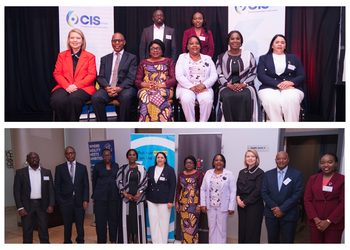
The Namibia Training Authority (NTA) plans to replicate the Nakayale, Eenhana and Valombola (NEV) TVET Hub model across the country to establish regional vocational training hubs aligned with Namibia’s economic priorities.
Speaking at the 3rd Joint Graduation Ceremony of the NEV TVET Hub, NTA Chief Executive Officer Erick Fundula Nenghwanya said the initiative forms part of the Authority’s broader strategy to transform the country’s technical and vocational education system.
“We are committed to scaling it across the country — establishing regional TVET hubs aligned with economic priorities in each region and expanding the Hub from the current three as we are at an advanced stage for the construction of Omuthiya VTC in the Oshikoto Region,” Nenghwanya said.
He explained that the plan envisions hubs specialising in key economic sectors that support Namibia’s industrialisation and job creation goals.
“Imagine hubs specialising in agriculture in east and west, logistics and mining in the central regions, hospitality and fisheries along the coast, and renewable energy and oil and gas in the south. Together, these hubs will form a network of excellence that supports Namibia’s industrialisation and skills agenda while creating employment and alleviating poverty in our country,” he said.
Nenghwanya noted that this approach aligns with Vision 2030, the National Development Plans (NDPs), and the Human Capital Development Strategy, by ensuring that vocational training is directly linked to employment, entrepreneurship, innovation and economic growth.
“This approach directly advances our Vision 2030, the National Development Plans, and the Human Capital Development Strategy — by aligning training to employment, entrepreneurship, innovation, and national growth,” he said.
He highlighted that the NEV TVET Hub was established in 2016 through the Promotion of Vocational Education and Training in Namibia (ProVET) project — a collaboration between the NTA and its long-standing partner, GIZ. The Hub, he said, was created in response to challenges that previously affected Namibia’s TVET system, including limited resources, duplication of programmes, and fragmented operations across vocational training centres.
“At the time, our TVET system faced pressing challenges of limited resources, duplicated training programmes, and isolated operations across vocational centres. Each VTC was doing its best, but largely on its own. The question before us was clear: How can we ensure quality, efficiency, and relevance with the resources we already have? The answer was collaboration through shared resources and specialisation,” Nenghwanya said.
He said the decision by the Nakayale, Eenhana, and Valombola Vocational Training Centres to collaborate rather than compete had a transformative impact on the sector.
“These three centres joined hands to share resources, facilities, trainers, and expertise. They chose to specialise, not to duplicate. They chose to collaborate, not to compete. And that decision changed everything,” he said.
Nenghwanya described the NEV TVET Hub as “a living example” of the power of partnership and unity.
“The NEV TVET Hub became a living example of what can happen when institutions unite behind a common purpose. It became a model of efficiency, quality, and shared excellence — a model that demonstrates the true meaning of ‘one system, one vision,’” he said.
He outlined the areas of specialisation within the three centres: Nakayale VTC in the Omusati Region focuses on ICT, Electronics, and Electrical Engineering; Eenhana VTC in the Ohangwena Region specialises in Civil Engineering; and Valombola VTC in the Oshana Region leads in Automotive Mechatronics.
Nenghwanya said the Hub was structured around seven key focus areas — governance, specialisation, training of trainers and management, stakeholder engagement, upgrading of equipment and facilities, rebranding, and the introduction of e-learning.
“These seven fields of activity form the backbone of the NEV TVET Hub model — a model that brings together governance, human capacity, infrastructure, and technology under one coordinated vision,” he said.
He added that these pillars established the foundation for the NTA’s ongoing transformation strategy to convert state-owned vocational centres into specialised technical colleges and reform TVET curricula as outlined in NDP6.
“Over the years, this collaboration has yielded impressive results. We have seen improved governance and planning across the three centres. We have seen cost savings and efficiency through shared resources. We have seen stronger industry partnerships that link our training to employment. And above all, we have seen improved training quality — producing graduates who are not just qualified, but work-ready, innovative, and resilient,” Nenghwanya said.
He noted that the NEV TVET Hub has proven the importance of collective effort.
“The NEV TVET Hub has proven something fundamental: when we work together, we achieve more. When we specialise, we enhance quality. And when we share what we have, we create value beyond measure,” he said.
While acknowledging that the journey had not been without challenges, he said these had become opportunities for learning and growth.
“These challenges have shown us that collaboration requires patience, adaptability, and a shared commitment to progress,” he said.
Nenghwanya commended the management, trainers, and teams of the three centres for their dedication and leadership.
“Your leadership and cooperation have set the standard for the rest of the country. You have shown what is possible when institutions think beyond boundaries and focus on shared purpose,” he said.
He expressed appreciation to development partners for their support, particularly GIZ, which he said had played a vital role in driving innovation and investing in Namibia’s skills development.
“To our development partners, especially GIZ, thank you for walking this journey with us — for your investment in innovation, and your belief in Namibia’s potential,” he said.
Addressing the graduates, Nenghwanya congratulated them for their achievement, describing them as a testament to the success of the NEV TVET Hub model.
“You are the living testimony of this collaboration’s success. You are entering the world of work equipped with the skills, knowledge, and values that will help build a stronger Namibia,” he said.
“Remember — your qualification is not just a certificate. It is a responsibility. It is a call to serve, to innovate, and to uplift your communities through the power of skill,” he added.
Nenghwanya concluded by highlighting the spirit of unity that defines the NEV TVET Hub. “Indeed, that is what the NEV TVET Hub represents: individual commitment which turns into collective success,” he said.