About 700 unemployed graduates will receive training under the EU-backed Ignite GH2 project to prepare them for jobs in Namibia’s green hydrogen industry.
The initiative will also train 40 instructors to Level 6 certification to strengthen technical and vocational education.
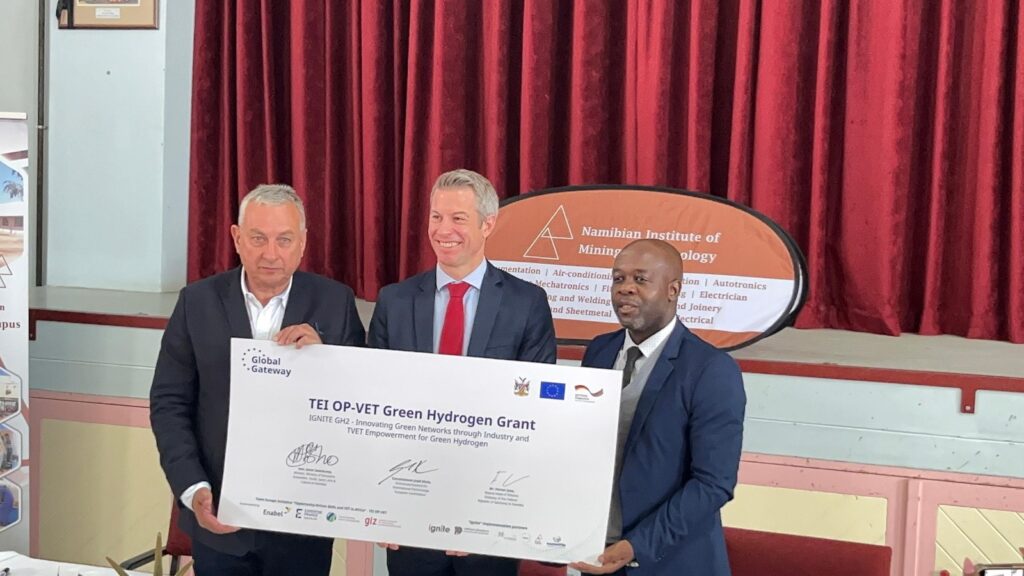
The agreement for Ignite GH2 was signed at the Namibian Institute of Mining and Technology (NIMT) during a European Union delegation visit led by Commissioner for International Partnerships Jozef Síkela.
He was joined by Barry Andrews, Chair of the European Parliament’s Committee on Development, eight senior committee members and the Delegation to the Africa-EU Parliamentary Assembly.
Síkela said Namibia’s hydrogen industry could generate tens of thousands of jobs.
“Through Global Gateway, we are turning this promise into tangible progress and real opportunities for people across the country. The Ignite GH2 project illustrates our 360 approach: investing not only in infrastructure, but equally in people. We are connecting young Namibians directly to concrete projects in the hydrogen economy, equipping them with the technical and vocational skills they need to seize opportunities in these emerging industries,” he said.
The programme, which begins in October 2025, will be implemented by the Namibian University of Science and Technology (NUST) and NIMT in cooperation with hydrogen operators Zhero and Hyphen.
Trainees will be added to the Hyphen, Zhero and Daures Green Hydrogen Village job seeker databases and granted priority recruitment status.
The project is financed by the European Commission and Germany under the Team Europe Initiative on opportunity-driven skills and vocational training in Africa, with implementation by Enabel, Expertise France, Edufi and GIZ.
In remarks delivered by Vice-Chair Hildegard Bentele, Andrews said education and training were vital for inclusive growth.
“Access to education and practical skills training is a cornerstone of human development and a precondition for inclusive and sustainable growth. More importantly, the timing of this programme to develop Technical and Vocational Skills (TVET) on green technologies,” he said.
Youth employment and skills development are key national priorities and part of the EU’s Global Gateway strategy, which promotes cooperation in technology, education and training.
NUST Vice-Chancellor Erold Naomab said the university was advancing this vision through strategic initiatives in research, innovation and workforce development.
“The Lüderitz Southern Campus, designed as a Science and Technology Park, will drive innovation in green hydrogen and oil & gas. Complementing this, the Namibia Energy Institute (NEI) serves as the national hub for research and training in renewable energy, energy efficiency, and low-carbon technologies, positioning NUST at the forefront of Namibia’s energy transition,” he said.
Naomab added that Namibia’s transition required more than scientists and engineers.
“We also need artisans and technicians to install, operate, and maintain renewable energy systems — and entrepreneurs to create local businesses and jobs across the hydrogen value chain. This is where the Ignite GH2 project plays a pivotal role,” he said.