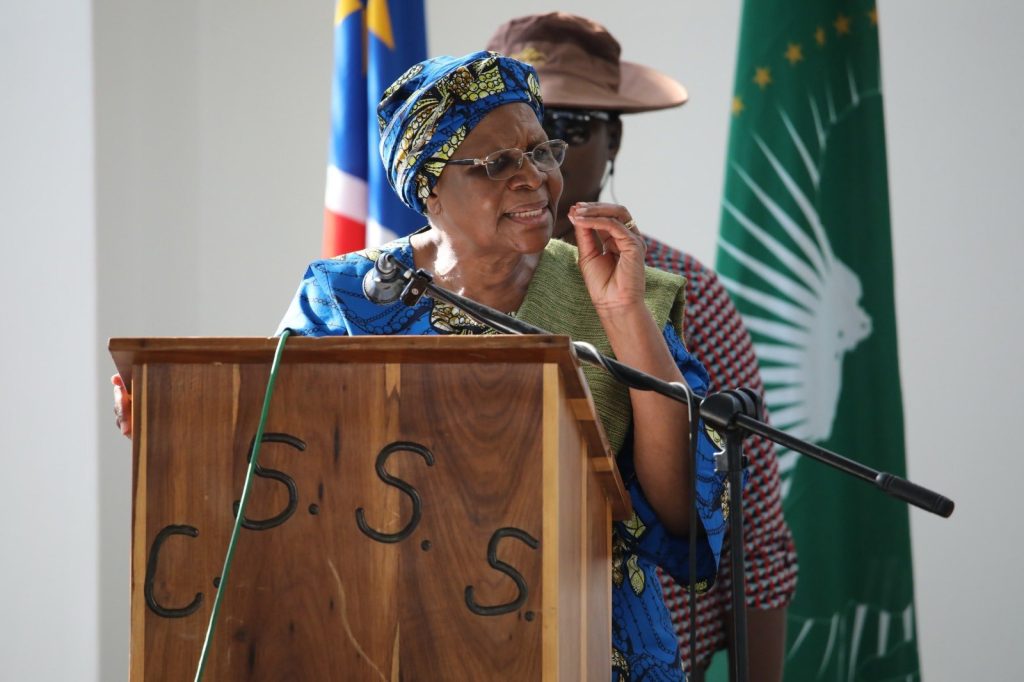
President Netumbo Nandi-Ndaitwah says significant progress has been made at Namibia’s Green Schemes following government interventions on fertiliser deliveries, tractors and irrigation systems.
“At Shadikongoro, only four pivots were working during my last visit. Now there are 14, with new ones added and old ones fixed. At Ndonga Linena, 20 pivots are functioning. This has resulted in higher production. Last year, parts of Ndonga Linena were still covered in bush. Today, those fields are being harvested,” she said.
The President noted that her inspection of Shadikongoro and Ndonga Linena in March last year had been disappointing, but that improvements were now evident.
She cautioned, however, that challenges remain.
“Farmers face high electricity costs, particularly demand charges, which must be addressed. At Shadikongoro, there is no harvester of their own. Delayed harvesting reduces crop value, so this must be resolved,” she said.
Nandi-Ndaitwah reiterated government’s commitment to food self-sufficiency through the full use of state-controlled farms. “I made a commitment on behalf of government that Namibia must feed itself, starting with the Green Schemes under state control. The Ndonga Linena manager told me the 1,000-hectare farm should be fully utilised by next year, including orchards in areas unsuitable for crops,” she explained.
She also visited the Kalimbeza Rice Project, where she called for stronger partnerships to unlock its potential.
“I visited the rice farm yesterday with the Indonesian ambassador. The University of Namibia began this project in partnership with an Indonesian university, which is still committed to supporting it. The Vice Chancellor and the Minister must now work together to ensure full production,” Nandi-Ndaitwah said.
Concluding her tour, she reaffirmed her administration’s goal of maximising agriculture’s role in national development. “I leave encouraged by the progress, though challenges remain. Our task is clear: feed Namibia and make full use of our agricultural potential,” she declared.
The Kalimbeza Rice Farm in the Zambezi Region spans 229 hectares, of which 150 hectares are allocated to rice production. In the 2024/25 season, 38 hectares were cultivated, yielding 108 tonnes of rice.
The President emphasised that the Zambezi Region, together with Kavango West and East, will remain priorities under her leadership to ensure Namibia strengthens its contribution to Africa’s food basket.