Wednesday, September 30, 2026
Subscribe
The Brief | Namibia's Leading Business & Financial News
  • Home
  • Companies
    • Finance
    • Agriculture
    • Technology
    • Property
    • Trade
    • Tourism
  • Business & Economy
  • E-PAPERreader
  • Mining & Energy
  • Opinions
    • Analysis
    • Columnists
  • Africa
No Result
View All Result
The Brief | Namibia's Leading Business & Financial News
  • Home
  • Companies
    • Finance
    • Agriculture
    • Technology
    • Property
    • Trade
    • Tourism
  • Business & Economy
  • E-PAPERreader
  • Mining & Energy
  • Opinions
    • Analysis
    • Columnists
  • Africa
No Result
View All Result
The Brief | Namibia's Leading Business & Financial News
Subscribe
No Result
View All Result
Home Companies Agriculture

Namibia’s beef exports plummet by 51.4% to 1.43 million kg in Q1

by reporter
May 12, 2025
in Agriculture
11
A A

The Namibian Livestock and Livestock Products Board says beef exports declined by 51.4% to 1.43 million in 2025, this is compared to the 2.94 million exported during the same period in 2024.

The drop in beef exports was part of a broader contraction across most livestock sectors, driven by reduced animal availability following drought-induced destocking in 2024.

“Y-o-y, beef exports totaled 1 425 615 kg during the period under review, a significant decrease compared to the 2 936 183 kg exported during the same period in 2024,” said LLPB Statistician: Trade & Strategic Marketing, Fransina Angula.

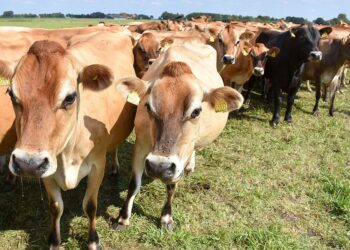
She further explained that cattle marketing plunged by 58% year-on-year to 37,577 animals in Q1 2025, down from 89,507. This steep decline is linked to the 2024 drought, which forced many farmers to market large numbers of cattle, leaving few market-ready animals for the current year.

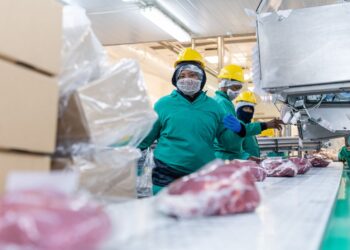
Furthermore, live cattle exports dropped significantly by 79.8%, and throughput at export-approved abattoirs fell by 24.2%. Slaughtering at domestic abattoirs also contracted by 22%. However, beef prices increased due to limited supply. B2-grade beef in the s-VCF averaged N$69.89/kg, up N$9.02 from the previous year while weaner prices climbed 17.7% to N$29.13/kg.

Angula also said that despite the downturn in volume, Namibia maintained key export markets, with the EU accounting for 84.2% of beef exports, followed by Norway (10.2%), the UK (3.4%), China (1.7%), and South Africa (0.8%).

“During the first quarter of 2025, 281 906 kg of hides and skins in the form of bovine wet blue and processed were exported to South Africa, Zimbabwe, the UK and China. Hides and Skins imports on the other hand totaled 165,976kg during the quarter under review,” she said

Similarly, the sheep sector recorded steep declines in Q1, mainly due to a shortage of market-ready animals. Slaughtering at export-approved abattoirs dropped 53.9%, while local abattoirs saw a 21.6% decline. Live sheep exports also fell by 44.2%.

According to Angula, despite the supply challenges, producer prices rose. The Namibian A2 lamb carcass price averaged N$88.74/kg up from N$76.52/kg in Q1 2024 while the s-VCF auction lamb price increased by 18.6% to N$36.38/kg.

“Mutton exports during the period under review dropped due significant reductions in throughput at export approved abattoirs and declined by 63.3 percent. As a result, only 82,707kg of lamb and mutton was exported to South Africa and Botswana and Norway, lower than the 2024 exports of 225,411kg,” she said

In the goat sector, total marketing fell by 15.1%, with only 20,758 goats marketed compared to 24,442 in Q1 2024. This contraction was again due to reduced availability of animals. The lamb auction price averaged N$39.57/kg during the quarter, she said.

On the other hand, the pork sector was the only segment to show growth. A total of 12,324 pigs were marketed at LLPBN-approved abattoirs in Q1 2025, a slight increase from 12,255 pigs a year earlier. Pork imports surged by 74.1% to 1,957,886kg. Spain led the supply with 30.4% of the imports, followed by China (17.8%) and South Africa (17.3%). The rest came from Botswana, the Netherlands, the UK, France, and Portugal.

“Although imports are dominant in the market, the Pork Market Share Promotion Scheme, administered by the LLPBN continues to assist local producers in maintaining significant market share,” she said.

She further explained that in the poultry sector, domestic slaughter reached 4,418,322 chickens in Q1 2025, and local egg production totalled 23,634,209 eggs. The country also imported 135,597 day-old chicks and 1,799 layer hens for breeding.

Namibia also exported 3,048,643kg of processed chicken products to South Africa, Botswana, Zimbabwe, Zambia, and the DRC. Meanwhile, imports of poultry products reached 6,659,199kg. Poland supplied 64.2% of these imports, followed by Brazil (18.8%), South Africa (12.4%), and a combined 4.7% from various countries including Argentina, Spain, Ireland, Thailand, and Ukraine.

author avatar
reporter
See Full Bio
Previous Post

When populism meets a spreadsheet

Next Post

Insulating the jerrican economy: Who to holds the handle?

Must Read

Adult rhinoceros standing at a muddy waterhole in a dry savanna, with distant antelope silhouettes in the background.
Agriculture

Namibia records 24 rhino poaching cases in 2026

September 29, 2026
Meatco misses 70,000 slaughter target
Agriculture

Meatco prepares to resume slaughter as FMD restrictions ease

September 28, 2026
Milk carton and a glass of milk, carton labeled MILK with a blue cap, 1L capacity, on a light gradient background.
Agriculture

FMD restrictions do not affect UHT, pasteurised milk supply

September 27, 2026
A herd of brown cows standing in a sunlit pasture with yellow ear tags visible on their ears
Agriculture

Namibia partially lifts FMD restrictions as disease remains confined to //Kharas

September 27, 2026
Herd of brown and black cows walking along a gravel rural road, ear tags visible under a clear blue sky with green trees nearby.
Agriculture

Govt establishes FMD Support Fund as outbreak response intensifies

September 26, 2026
Brown cattle with yellow ear tags walking along a dusty road in a rural landscape under a blue sky.
Agriculture

Namibia’s FMD positive cases rise to 17, remain confined to Karasburg

September 26, 2026
Load More

Related News

BoN among five African central banks expected to hike rates to subdue inflation

BoN among five African central banks expected to hike rates to subdue inflation

March 24, 2022
Recalibration for the survival of the fitting in an age of global uncertainty

Recalibration for the survival of the fitting in an age of global uncertainty

April 22, 2025
Vehicle sales surge by 27% in November as Toyota Hilux dominates

Vehicle sales surge by 27% in November as Toyota Hilux dominates

December 14, 2023

Browse by Category

  • Africa
  • Agriculture
  • Analysis
  • Business & Economy
  • Columnists
  • Companies
  • e-edition
  • Finance
  • Finance
  • Fisheries
  • Green Hydrogen
  • Health
  • Investing
  • Latest
  • Market
  • Mining & Energy
  • Namibia
  • namibia
  • News
  • Opinions
  • Property
  • Retail
  • Technology
  • Tourism
  • Trade
The Brief | Namibia's Leading Business & Financial News

The Brief is Namibia's leading daily business, finance and economic news publication.

CATEGORIES

  • Business & Economy
  • Companies
    • Agriculture
    • Finance
    • Fisheries
    • Health
    • Property
    • Retail
    • Technology
    • Tourism
    • Trade
  • e-edition
  • Finance
  • Green Hydrogen
  • Investing
  • Latest
  • Market
  • Mining & Energy
  • namibia
  • News
    • Africa
    • Namibia
  • Opinions
    • Analysis
    • Columnists

CONTACT US

Cell: +264814612969

Email: newsdesk@thebrief.com.na

© 2026 The Brief | All Rights Reserved. Namibian Business News, Current Affairs, Analysis and Commentary

Welcome Back!

Login to your account below

Forgotten Password?

Retrieve your password

Please enter your username or email address to reset your password.

Log In
No Result
View All Result
  • Home
  • Companies
  • Mining & Energy
  • Business & Economy
  • Opinions
    • Analysis
    • Columnists
  • Africa

© 2026 The Brief | All Rights Reserved. Namibian Business News, Current Affairs, Analysis and Commentary

This website uses cookies. By continuing to use this website you are giving consent to cookies being used. Visit our Privacy and Cookie Policy.