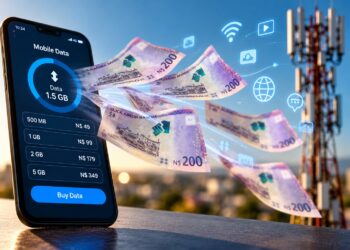
Namibia’s internet speed ranks 143rd out of 152 countries, with a median download rate of 13.72 Mbps, according to Ookla’s Speedtest Global Index.
The country also falls in the bottom 20% globally for digital infrastructure, e-security, and e-governance, as reported by Surfshark’s Digital Quality of Life Index.
Cirrus Capital, Head of Data Analytics and Economist, Tannan Groenewald, warns that a lack of competition is stalling progress, with MTC controlling an estimated 82% of the mobile market and delays in broadband expansion persisting.
“Namibia’s strongest component was internet affordability, although this metric considers the work time required based on the average wage to afford the cheapest mobile internet, thus, this is skewed by Namibia’s very high inequality. Meanwhile, Huawei’s ’24 Digitalisation Index, which assesses the level of ICT maturity and economic development, ranked Namibia 75th out of 77 countries assessed,” he added.
According to the 2023 Census, only 15.0% of Namibian households have access to home fixed internet connectivity, with the proportion among rural households just 5.1%.
“Due to Namibia’s low population density and the distance of rural areas from urban localities, providing high-speed broadband internet has proved challenging for current operators. Concerns remain around the lack of competition in the sector,” Groenewald explained.

Meanwhile, Cirrus Co-Founder Rowland Brown criticised Namibia’s delays in licencing Starlink, arguing that restrictive policies are hindering digital development in a country where rural connectivity remains as low as 5.1%.
This comes as the Communications Regulatory Authority of Namibia (CRAN) last year issued a cease-and-desist order to Starlink, accusing the satellite communications company of operating within Namibia without the required telecommunications license.
The regulator then revealed that it had already confiscated illegal Starlink terminal equipment from consumers and initiated criminal cases with the Namibian Police against those involved.
“This demonstrates the absurdity of keeping Starlink out of Namibia for so long. For a country with such low population density and such large areas, Starlink is the ideal technology. However, a mad, nationalistic and protectionist mentality stands in the way of development once again,” he said.
Brown contends that there are so many examples in history of where “protecting local industry” from foreign technology ends up leaving a country far behind its peers and the rest of the world.
“See Milton Friedman’s Free to Choose episode on hand looms in India (from the 1980s) as an example. You would think we would learn from this, but alas,” he said.
Currently, Starlink operates in 18 African countries, with Nigeria being the first to launch in January 2023.
Groenewald noted that where data is available (12 countries), the cheapest Starlink package is more affordable than the cheapest non-Starlink unlimited fixed internet package in five countries.
“Roughly half the price in Ghana and Kenya, 22% cheaper in Cape Verde, 14% cheaper in Mozambique, and more than 20 times cheaper in Zimbabwe,” he added.
Starlink packages are currently sold out in six African countries due to exceptionally high demand. In Zimbabwe, terminals sold out in October, less than two months after receiving permission to operate.
“Its strong demand in other African countries and subsequent impacts suggest that a more competitive ICT industry can drive costs down and improve availability in Namibia’s distant rural areas,” Groenewald said.
This comes as in the ‘24/’25 Mid-Year Budget, the Ministry of Finance forecasts the sector to grow at an average annual rate of just 2.3% over the next four years—the slowest among all broad sectors, he said.
Furthermore, MTC reported unforeseen delays in expansion projects in ’24, with a shift in focus towards hiring additional personnel.
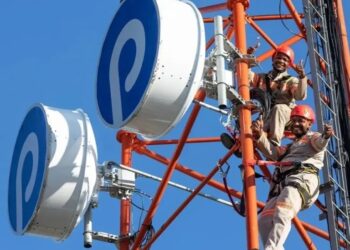
Namibia’s main internet service providers (ISPs) include Telecom Namibia, MTC Namibia, Paratus Telecom, Internet Technologies Namibia, IWAY, and Africa Online. These ISPs offer various services, including fibre, DSL, wireless, and mobile broadband.