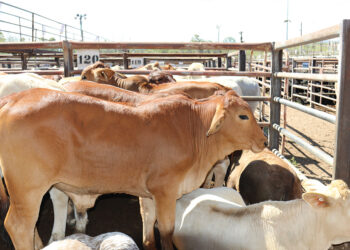
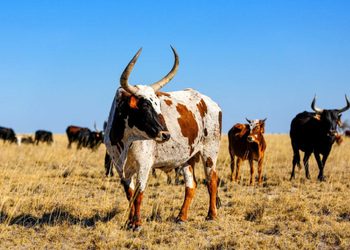
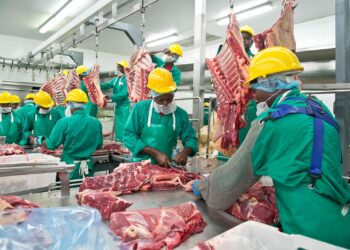
Livestock trading increased significantly in the first half of 2022 led by cattle marketing which increased by 20.3%.
During the same period, sheep marketing rose 39.8%, goat marketing was up 8.5% but pig marketing dropped 52.1% compared to the same period last year, according to a report by Simonis Storm.
This comes as beef exports increased by 97.5% during the first half of 2022 compared to the same period last year, with the Katima Mulilo export abattoir having resumed operations in 2Q2022 and facilitated beef exports to Angola, Ghana and Tanzania.
The report noted that exports led the growth in cattle marketing activity as local producers responded to a rise in prices offered by export approved abattoirs.
Prices paid by beef export approved abattoirs south of the veterinary cordon fence increased from an average of N$52.37/kg during the first half of 2021, to an average of N$61.06/kg during the second half of this year a 16.6% rise y/y, according to the Meat Board.
In addition, farmers also delivered better quality cattle as the slaughter mass at export approved facilities increased by 6.1%.
The latest monthly data from the Meath Board shows a 9.1% y/y increase in cattle marketing, sheep marketing rose 33.2% y/y, goats marketing dropped by 3.4% y/y and pig slaughtering was 8.7% up in June 2022.
“Local pork production only catered for 47% of local market demand, increasing the need for imports,” said Simonis.
Due to price differentials, local sheep producers directed about 73% of their sheep to South Africa, where local producers fetched higher prices, according to the Meat Board.
The board said Northern Cape abattoirs paid N$6.84/kg more than abattoirs in Namibia.
The agricultural sector, one of the pillars of the country’s economy, expanded by 5.9% y/y in 1Q2022, according to quarterly GDP figures.
Adding the fishing sector, the combined livestock, crop, forestry and fishing sector expanded by 7.2% according to the Namibia Statistics Agency’s 1Q2022 Agriculture Bulletin.
Leading growth in the sector is livestock which rose 3.6%, fishing up 2.7%, followed by crops with a slight increase of 0.5% and forestry up 0.4%.
Namibia remains a net food importer, exporting N$564.8 million worth of soft commodities in 1Q2022, compared to imports worth N$839.6 million. This led to a trade deficit of N$274.8 million.
Although fish landings declined by 16.1% y/y in 1Q2022, inflationary effects and a weak rand allowed export earnings to increase by 6.9% y/y in 1Q2022 for fillets, frozen fish, molluscs and crustacean sub-sectors.
Overall, growth in the sector appears positive after discussions with various industry players. Fish landings have been positive for hake, monk and horse mackerel companies YTD.
However, some companies had their worst snoek season in years, due to overpopulated seals in certain areas. Some industry players in the monk, sole, horse mackerel and crab sectors are looking at investing in new wet fish processing plants/factories in order to expand value addition activities.
Another opportunity currently being pursued by the local fishing sector is taking advantage of global supply chain disruptions.
European countries are looking at alternative options to have fish processed due to supply chain disruptions in China. The Ukrainian war has also intensified supply chains disruptions between Asia and Europe.
Namibia is in a strong position to benefit from this situation by marketing itself as an efficient and sophisticated fish processor, which current industry players are busy doing.
Cereal crop production decreased by 43.5% y/y in 1Q2022, with white maize production down by 47.7% y/y, wheat up 53.7% y/y and millet down 80.8% y/y in 1Q2022 according to the Namibian Statistics Agency’s (NSA’s) 1Q2022 Agriculture Bulletin report.
The Namibian Agronomic Board (NAB) regularly estimates local tonnage of crop harvests to meet local and export market demands. Based on their latest estimates, shortages in various horticulture/crop products are forecasted for the remainder of 2022. This implies that local supply will be largely insufficient, increasing the import requirement for basic food stuffs.