Namibia’s ambitions to beneficiate its mineral resources and develop downstream industries will depend on access to competitively priced electricity, predictable regulations and long-term investment capital, former Bank of Namibia Governor Johannes !Gawaxab has said.
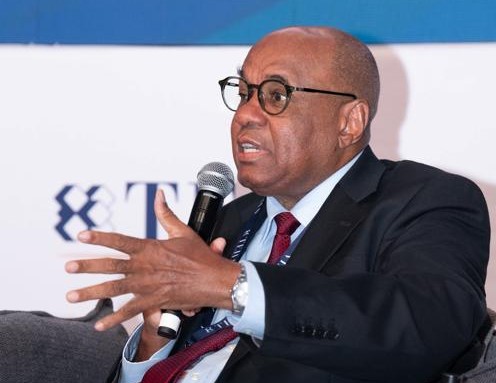
Speaking at the CEO Dialogue in Johannesburg, during a panel discussion on mining and energy sector constraints, !Gawaxab said resource-rich African countries, including Namibia, needed to address structural barriers preventing mineral wealth from translating into industrial development.
He identified electricity costs, regulatory uncertainty, infrastructure gaps and limited access to patient capital as the main constraints affecting the development of mineral processing facilities.
“Africa is endowed with resources and doesn’t have a minerals problem. It has an electrons problem, a rules problem, a competitiveness, and a patient-capital problem. Solve those four and value addition and development follow,” !Gawaxab said.
For Namibia, he said developing mineral value chains required more than restrictions on the export of unprocessed minerals, arguing that governments needed to create conditions that would make local processing commercially viable.
His remarks come after Namibia introduced restrictions on the export of unprocessed lithium, cobalt, manganese, graphite and rare earths in 2023 as part of efforts to encourage domestic value addition.
However, !Gawaxab cautioned that export restrictions alone would not attract investment in processing facilities, particularly where electricity costs, infrastructure gaps and financing constraints remained significant.
“These moves show we have leverage. But leverage on its own does not build a refinery. Bans tell capital where it may not go. They don’t tell it where it should go,” he said.
He said electricity affordability and reliability were particularly important for Namibia’s mineral processing ambitions because smelting and refining require substantial and consistent power supplies.
“If we want the refinery here and not in Asia or Europe, our electricity has to compete with theirs. Today, in too many places, it doesn’t,” !Gawaxab said.
He added that access to renewable electricity was becoming increasingly important for export competitiveness as international markets placed greater emphasis on the carbon intensity of industrial products.
!Gawaxab also identified regulatory predictability as a key factor influencing investment decisions, noting that mining and beneficiation projects typically require long-term commitments and substantial upfront capital.
“Investors can live with tough rules. What we cannot price is rules that change,” he said.
He argued that Namibia and other mineral-producing countries needed clearly defined and phased beneficiation requirements that would provide investors with sufficient certainty to plan infrastructure and processing investments.
On financing, !Gawaxab said African institutional investors, including pension funds and insurers, could play a greater role in financing mineral processing facilities and supporting infrastructure.
He noted that beneficiation facilities require significant upfront investment and can take several years to generate returns, making access to long-term capital essential.
“The capital to build Africa’s mineral value chains partly already sits in African balance sheets. We have not built the bridges to deploy it,” !Gawaxab said.
He proposed establishing co-investment platforms bringing together pension funds, insurers and development finance institutions, with development financiers providing guarantees or first-loss capital to reduce investment risks.
He also called for long-term offtake agreements between international buyers and African producers to help secure financing for local processing facilities.
!Gawaxab further argued that Namibia should pursue mineral beneficiation through regional value chains rather than attempting to develop every processing activity independently.
He proposed linking lithium production in Namibia and Zimbabwe with manganese and platinum group metals from South Africa, as well as copper and cobalt from Zambia and the Democratic Republic of Congo, supported by shared electricity infrastructure and efficient transport corridors.
“The battery doesn’t care which border the cathode crossed. Investors care whether the corridor works,” he said.
He said regional electricity cooperation could also support industrial competitiveness, with Namibia’s and Botswana’s solar and wind resources contributing to broader regional energy security through the Southern African Power Pool.
!Gawaxab said energy security, decarbonisation and industrial development needed to be pursued together, adding that reliable electricity remained essential for attracting manufacturing and mineral processing investments.
He also called for greater private-sector participation in electricity transmission infrastructure and the development of open electricity markets that would allow industrial users to access competitively priced power.
On the social impact of mining and energy developments, he proposed giving communities ownership stakes in mines, renewable energy projects and processing facilities rather than relying exclusively on corporate social responsibility programmes.
He said governments needed to provide stable regulations and open electricity markets, while international partners should move beyond purchasing raw minerals towards co-financing processing facilities.
He also urged African institutional investors to direct more long-term savings towards domestic and regional industrial development, arguing that progress should be measured by capital invested, infrastructure commissioned, competitive local businesses established and sustainable employment created.