… as Namibia launches new AfCFTA trading guide
Limited export readiness, inadequate access to trade finance, fragmented market information and complex regulatory requirements continue to prevent Namibian businesses from fully benefiting from the African Continental Free Trade Area (AfCFTA), government and United Nations officials said on Monday.
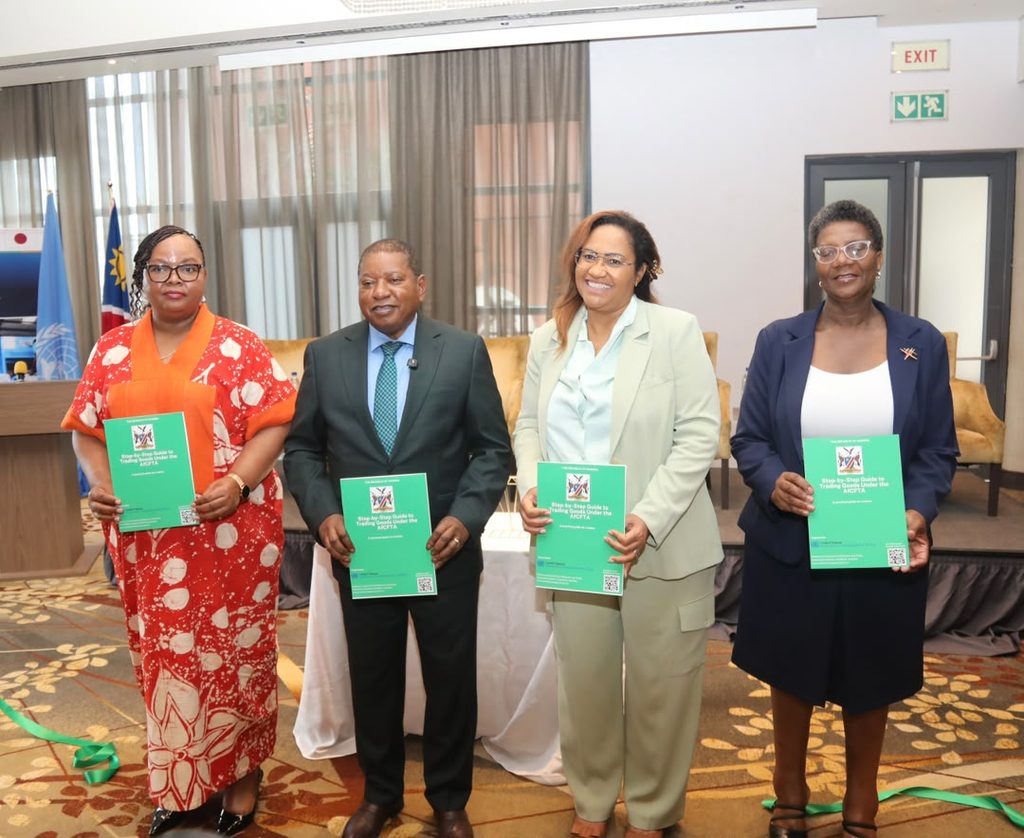
Speaking at the launch of Namibia’s Step-by-Step Guide to Trading Goods under the AfCFTA in Windhoek, officials said businesses continued to face difficulties navigating export procedures, meeting product standards, securing buyers and accessing logistics services, despite preferential access to continental markets.
Ministry of International Relations and Trade Executive Director Ambassador Jerobeam Shaanika said information on export and import procedures remained scattered across government institutions, creating uncertainty and additional costs for businesses, particularly micro, small and medium-sized enterprises (MSMEs).
He said businesses with competitive products and the capacity to fulfil export orders were often discouraged by complex documentation, permit requirements, customs procedures and uncertainty over which institutions were responsible for specific approvals.
“A business may have a competitive product, the ambition to enter a new market and the capacity to fulfil an order, yet find itself confronted by uncertainty about documentation, permits, customs procedures, standards and the institutions responsible for particular requirements. Such challenges can create unnecessary costs, discourage entrepreneurship and prevent otherwise capable businesses from pursuing opportunities beyond our borders,” Shaanika said.
He said the newly launched guide was intended to address these challenges by consolidating trade procedures and regulatory requirements into a single resource for exporters and importers.
“The Guide must not become a publication that is launched with enthusiasm and subsequently left on a shelf. It must become a working instrument that businesses consult, institutions promote and stakeholders continuously improve,” he said.
United Nations Economic Commission for Africa (ECA) Subregional Office for Southern Africa Director Eunice Kamwendo said preferential market access alone was insufficient to increase exports without improvements in productive capacity, export readiness and business support services.
She identified compliance costs associated with product standards, certification and customs procedures as additional barriers facing Namibian businesses.
Kamwendo said exporters also required market intelligence, trade finance, reliable logistics services and direct connections with potential buyers to convert market access into commercial transactions.
“Governments negotiate trade agreements, but businesses trade. Ultimately, it is businesses that must identify markets, meet product standards, understand rules of origin, obtain the necessary certificates and documentation, and successfully complete transactions,” she said.
Kamwendo said Namibia’s trade under the agreement remained concentrated in traditional Southern African Customs Union (SACU) and Southern African Development Community (SADC) markets, highlighting the need to diversify exports into other African markets.
She identified fish and fish products, livestock and meat products, horticulture, salt, charcoal, cosmetics, essential oils and mineral beneficiation as sectors with the potential to expand exports under the agreement.
Namibia signed the AfCFTA Agreement in July 2018 and ratified it in January 2019. The country subsequently launched its National AfCFTA Implementation Strategy in November 2022 and gazetted its provisional schedule of tariff concessions in December 2024.
Namibia recorded its first export consignment under the agreement in June 2025, when it shipped salt to Nigeria.
Kamwendo said the next phase of implementation should focus on helping businesses identify markets, comply with export requirements, establish commercial relationships and secure financing.
“The Guide can tell an enterprise how to trade. Market intelligence can help determine where to trade. Business-to-business engagements and trade missions can help firms identify whom to trade with. Export finance, logistics and business development services can then help businesses convert these opportunities into sustainable commercial transactions,” she said.
The newly launched guide outlines export and import documentation, regulatory procedures, product-specific requirements and the government institutions responsible for trade approvals.
It also provides guidance on tariff classification, rules of origin, exporter registration and procedures for obtaining the AfCFTA Certificate of Origin.
The guide further directs businesses to continental trade information platforms, including the AfCFTA e-Tariff Book, African Trade Observatory and Non-Tariff Barriers Reporting Mechanism.
The publication was developed with technical assistance from the ECA and financial support from the Government of Japan.
Its contents were reviewed during a stakeholder validation workshop held in Windhoek from 5 to 6 February 2026.